In the Cairngorms, “one does not look upward to spectacular peaks but downward from peaks to spectacular chasms”.
I could start every blog post I write with a quote from Nan Shepherd, but on this occasion it feels particularly apt. Today, I ran where she walked some 70 years ago.
It was these words I was reminded keenly of as I stood at the edge of a world; a world I wanted to throw myself into, to become part of – the rocks, the white water, the thrum of the place.
In the Cairngorms, one can be 10 feet from an edge and think these hills are naught but a rolling plateau. Come closer, and they plunge down, tingling the spine and snatching breath. It is a dramatic place, a powerful place, a dangerously beautiful place – but a fun one.
I like to think of it as a giant’s playground, we who are more inclined to the earth and simply allowed under the fence to peek inside – a jumble of granite for a wanderer to clamber into.
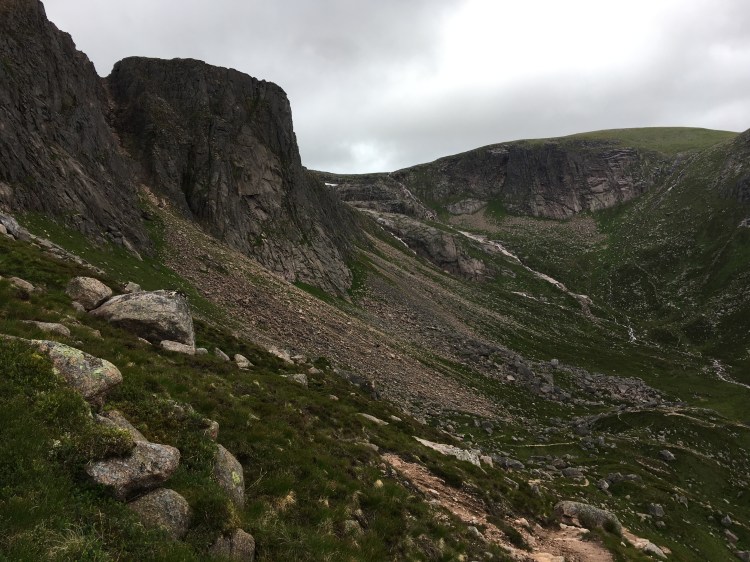
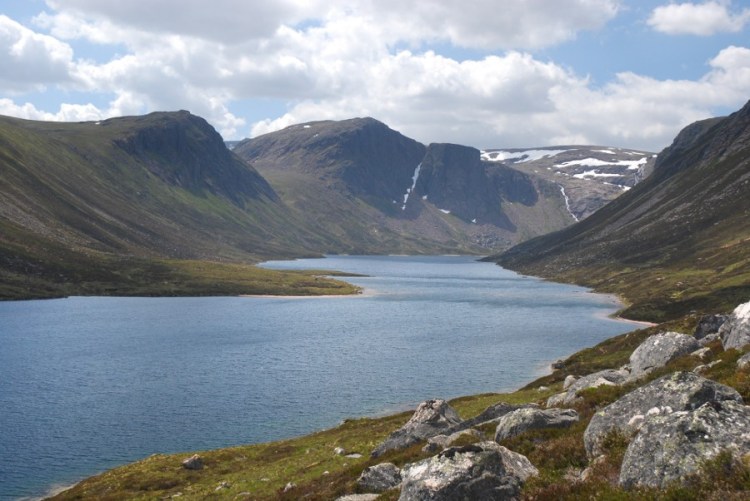
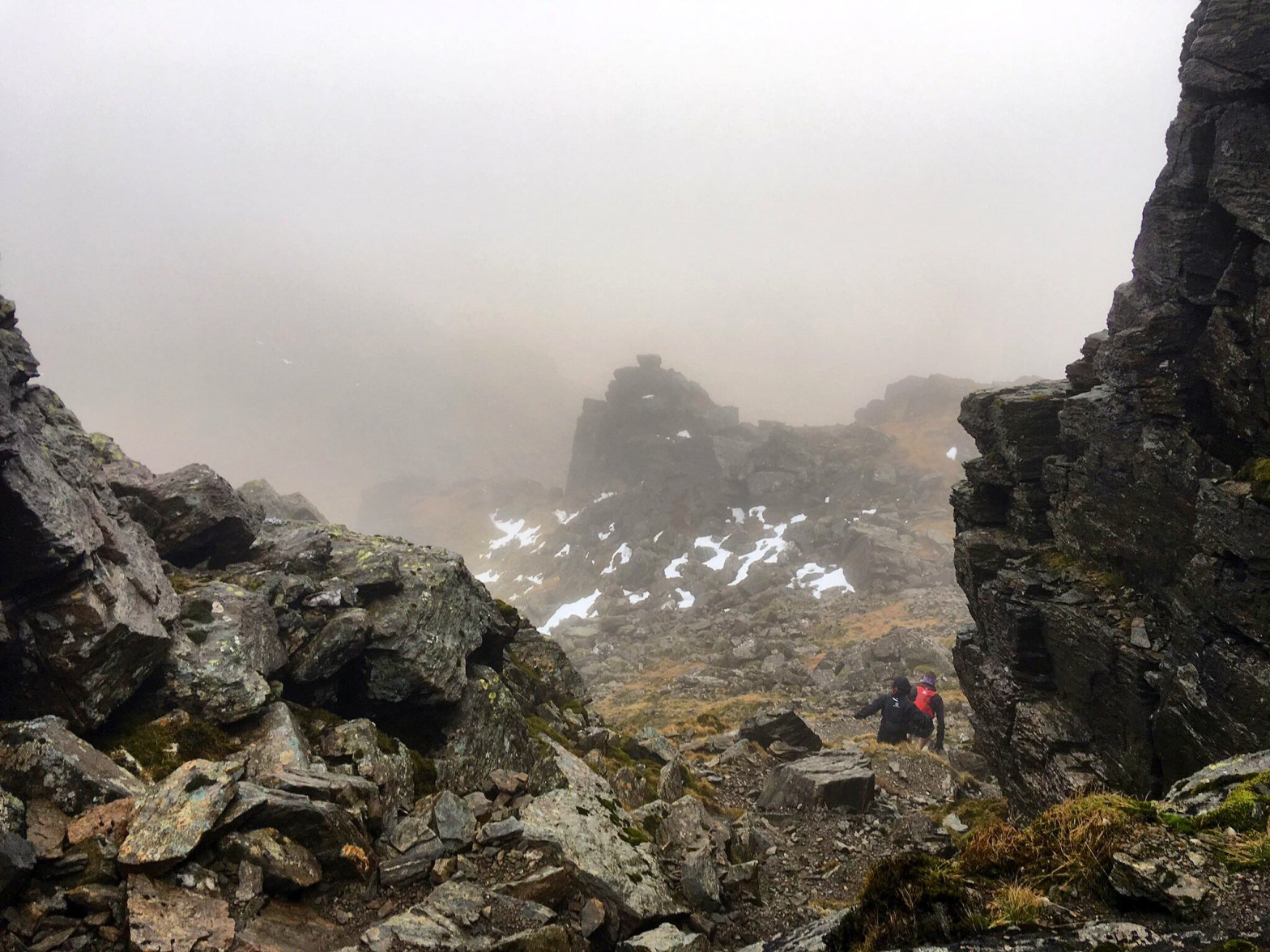
The world upon which I stood at the edge of was located halfway down the descent from a minor summit of A’Chaoinneach. It was like a city of stone appearing before me, the blue-emerald glinting of Loch A’an dancing upon the spires.
Loch A’an, Loch A’an, hoo deep ye lie! Tell nane yer depth and nane shall I.
Having just ascended Bynack More, I took the south-west route down to the cross-roads between Cairn Gorm, Fords of Avon and Strath Nethy. My fears of the A’an being full-bodied were washed aside having come across a distinctly dry flow on the way off Bynack More – an area that would usually be much wetter.
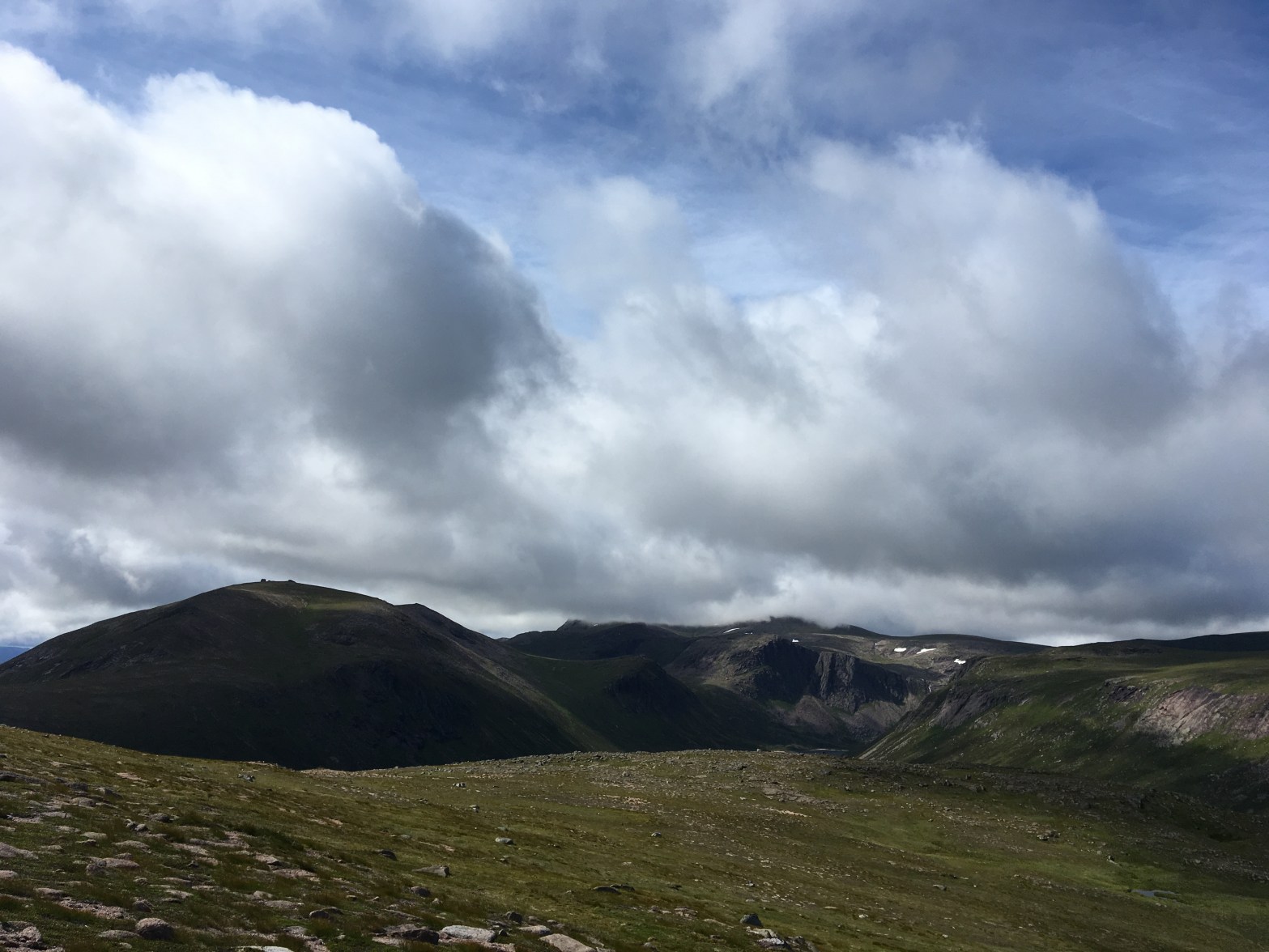
Beinn Mheadhoin from Bynack More.
I skipped over the river, beginning the hard rake up Beinn Mheadhoin. On Shetland, you might call it a skruid – steep, slippery, much of the granite acting like sand under my weight.
I crested its humped back, laverocks dive-bombing one another in the air as three ptarmigans rushed like hurried old women, only bothering to raise a wing slightly as if to show it might consider flying at some point.
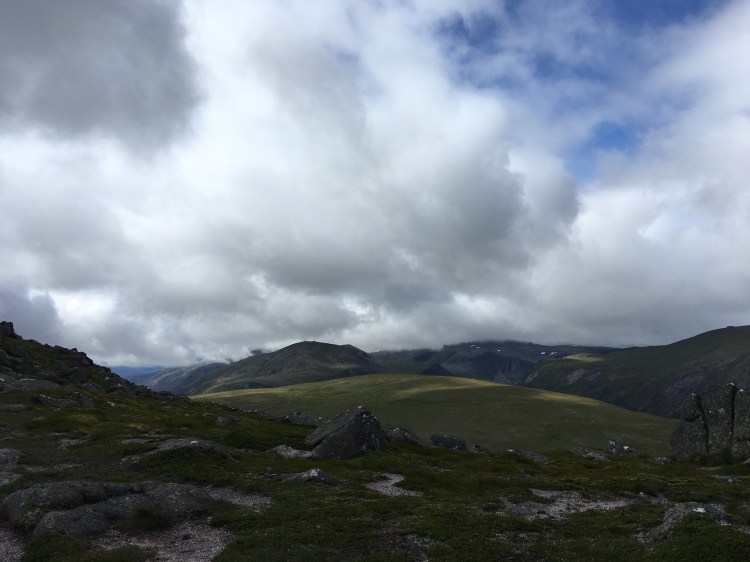
Beinn Mheadhoin is pimpled with lumpy tors, lying haphazardly across the hill like discarded giants’ furniture. It’s as if the goat being had vacated this seating spot at some point – leaving a sofa here, armchair there – leaving for a nicer spot, perhaps on neighbouring Ben A’an.
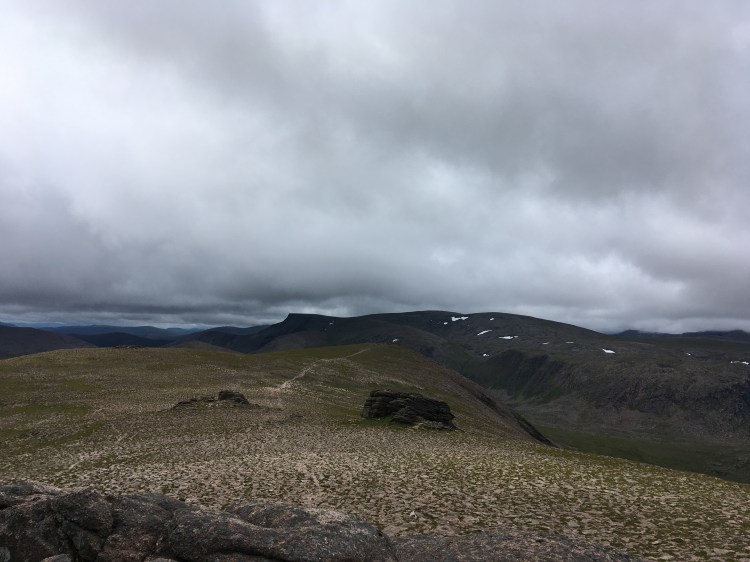
From here, the ballooning height of Ben MacDhui arose from the sweeping banks of Loch A’an, its peak shrouded in dark clouds. From this privileged vantage, one can really see what Shepherd meant when she wrote of Loch A’an: “Cairn Gorm and Ben MacDhui may be said to be its banks”, so blended are they. Around me, in the glens and nearby hills, veils of rain passed across aimlessly, drifting east before stopping to reconsider and heading north, eventually stopping altogether.
My eyes were “in my feet” as Shepherd would say, drifting over plump stones and munched granite sand, hardly putting a foot wrong. At Loch Etchachan, I headed north, clunking down into the outer boundary of the giant’s cricket pitch, so mighty were the tossed stones here.
The giant’s furniture.
The crags above soared up and over, their peaks seeming surprisingly close for their height. I found the Shelter Stone, which looks incredibly – well, sheltered! The ground around Loch A’an is testing, twisting and jarring, breaking rhythm wherever it can and presenting rocks just discreet enough for you to stub a toe off a dozen times.
Finally, the “Wall of Death” back to the plateau. Height is lost easily in the Cairngorms – pleasantly; it is gained, however, with much labour and heavy breathing. No matter, the blooming bell heather and the ice-white water that tastes so clear and sweet was enough to take away the effort.
As it plateaus, the final climb to the summit of Cairn Gorm appears easy, but is not. I took a shortcut, making a direct line for the summit. To my left, the Fiacaill Ridge grinned at me; I grimaced back.
I jogged over the crest of the hill and was met with two dozen people taking photographs of one another at the top.
“Gosh!” one woman in a yawning American accent cried. “Did you run all the way up this mountain?”
I confirmed I had, sparing the bits in-between my start and current position. Running down the initial descent from Cairn Gorm is like the Royal Mile nowadays: busy but, most of all, cobbled as hell.
Fiacaill Ridge grinning toothily.
After a stuttering initial descent, the Windy Ridge turns into a bit of a motorway, swooping its way down to the Cairngorm car park. I still had to go on, though. A quick check to see the ski centre bathrooms were indeed closed, I hunkered on, flowing gently down into Glenmore forest.
The Cairngorms may be scooped with spectacular chasms, but as I looked up from the comfort of my car I thought how spectacular are the peaks to look up to.
Driving into Keswick is like entering an enormous theatre. Centre stage, the peaks of Grisedale Pike and Causey Pike are foregrounded by Jacob’s Ladders – the lights of the stage.
To their right and left, the house seats of Skiddaw, Blencathra and Great Dodd are cast in shadow, awaiting the actors to step forward. I get a thrum of excitement as I drive down the aisle towards the scene, inviting me to enter into its play.
Until recently, I had not visited the Lake District. Since changing jobs, I have had the pleasure of visiting Keswick twice, both visits welcomed with a view like this and departed from with excellent memories.
It gets into you, this place. I was previously dismissive of the ‘Lakeland fells’, preferring my backyard’s delights of the Scottish Highlands. Amusingly, it was the Scotland-born biographer James Boswell who wrote: “The noblest prospect which a Scotchman ever sees, is the high road that leads him to England!”
It was against this backdrop – as the Lake District slowly wormed itself into my conscious – that another, similarly alien concept, worked itself into my brain. Namely: Round running.
Sitting at my desk in Pitlochry, I was reeling from a significant shot of Small World Syrup. I was on the phone to a colleague who, when I asked if he wanted to meet for a run while I was in his “neck of the woods” in Keswick, said: “Sadly not. I am actually supporting a Bob Graham.
“You might know him, actually. He works at Harvey Maps.”
Instantly, I had an inkling as to who he was talking about. Lewis Taylor, member of the Ochil Hill Runners, had been quietly flying through some of the best long distance events in the country.
Not the flashy ones, but the type of races that make a part-time trail runners’ toes curl and make the likes of Steve Birkinshaw nod in approval: The Great Lakeland 3 Day, Three Peaks Race, The Saunders Mountain Marathon, tough events to prepare you for one of fell running’s most revered challenges: The Bob Graham Round.
Recently, “round running” has become “cool”. Well, cool to a few people; the notion of running for nearly 24 hours, with an elevation gain bordering on Mount Everest and often through terrain preferred by goats – this isn’t your normal Parkrun.
It’s just you out there; you and your demons (and hopefully some friends).
I put this observation out on Twitter, following several weeks of (g)round breaking records set in some of the UK’s most dramatic landscapes: The Glen Etive Round, Mullardoch Munros, Ramsay’s Round.
People thought it impossible to break the four-minute-mile, but once broken a stream of others got over that mental hurdle.
This summer, hill and fell running’s long distance records have tumbled, and others have taken up the challenges. Well done to those who took them on.
I got a reply from Mr Round Runner himself, Jonny Muir, who said: “A boom that was triggered by a fortnight in the spring of 2016 when Jasmin broke the Bob Graham record and Nicky Spinks ran a double Bob Graham. Suddenly, round-running was cool.”
Hill running, you see, is a sport that is done for the doing of a thing, not in the having done. Round running epitomises that: One day, perhaps several days, in the mountains; running because it just feels right.
When the alarm went off at 23.30 on Friday 12 July, a million and one excuses presented themselves as to why I wasn’t going to Moot Hall.
I am actually going to a meeting at 10am now. I am not feeling so great. Sorry, I think I pulled my calf muscle again. I don’t know the terrain well (read: at all).
Once moving, though, those thoughts disappear. After all, I was running one leg of a Bob Graham; Lewis was running all five.
Leaving the B&B, I trotted down the street to Keswick’s town centre, the spire of Moot Hall ahead of me, the laughing and songs from the pubs either side barreling out onto the street.
I stopped at Moot Hall. Another group stood by the stairs, anxiously waiting for the start gun that would never sound and to begin on a journey they hadn’t paid to enter, but had spent months – perhaps years – training for.
Lewis appeared, followed by two others. Having only met briefly on a handful of occasions, I felt truly humbled to have been allowed to come along on this adventure, even if for a relatively brief time.
“Ross, this is Dan,” Lewis said, turning to the younger guy who gave a bright but bleary-eyed smile.
“This is Steve,” I shook Steve’s hand. Steve. I looked at Steve. There are times when instinct or some sixth sense catches you joining dots before you know you have done it.
There are only so many Steve’s with round glasses sat slightly askew on a face crafted by years in the mountains down this way.
Summit of Great Calva – Eight minutes up
We stood, watching Lewis and his dad staring down at his watch as the time slowly drifted to midnight. And we were off, running briskly down the street and into a tiny alleyway.
“Fancy a beer?” a guy asked. Later, hopefully.
When I mentioned I was running leg one during a meeting earlier in the day, I was met with a, “Oooh! That’s a tough one! The climb up Skiddaw is pretty draining, but in the dark it might be quite nice.”
She was right. From my B&B, the scar up Skiddaw shone like a lightning bolt, endlessly meandering upwards to its summit. Nowhere to hide. In the dark, though, the climb could have gone on for miles and I doubt it would have made a difference.
At just after 01.10, we touched Skiddaw’s summit.
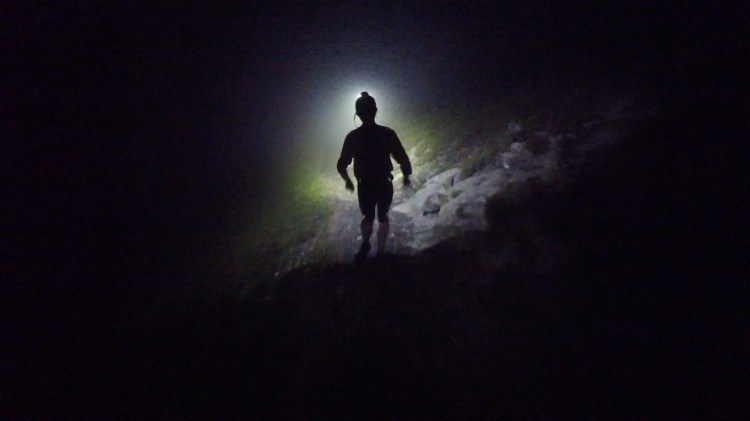
As we had climbed, the lights of Keswick fell away, replaced by the waxing moon. Steadily we entered the cloud, the shimmering interior dancing across our head torches, sticking to our faces like cobwebs on a Spring morning.
Thank goodness for Steve. I dropped back to ask Dan if it was indeed the Steve. “Yeah, that’s Steve Birkinshaw,” he replied. I was running with a legend, but in this sport it mattered very little. It was because of this I laughed out loud when Steve relayed a story to me from a train journey of a woman asking for a selfie.
“It was really bizarre,” Steve chortled. “I only published a book about a big run I did. The rest of my time I run in the fells and study hydrology. Hardly the celebrity lifestyle!”
It was a “big run”: 214 Wainwrights in six days and 13 hours, a record that stood for five years until Paul Tierney knocked seven hours from it. Besides setting enormous long-distance records, Steve is an incredible mountain marathon runner. Therefore, his resumé certainly matched the requirement we had descending Skiddaw for someone who could navigate at 01.30 in thick clag across an unmarked moorland.
Often, the temptation of running in the hills is to conceptualise it from a detached position: Running over, on, across, on top of.
In thick cloud, landscape is everywhere; it’s in your shoes, brushing your knees, sticking to your clothes, closing in on you. What was a plain beneath you is now an entity around you. No edges, no borders.
The glory is in the doing, but sometimes the finish is just as sweet.
We moved well. Lewis was eight minutes up on schedule as we touched Great Calva’s summit before entering the swirling air again. The moon shone just brightly enough to cast a moon broach around it, watching us as we covered yet more undefined ground.
In sleep, your body carries itself through rhythms. Running also provides that, perhaps heightened by it being 2am. I quite enjoy running through thick cloud (when I know where I am going), because there is no thought as to the next mile, the next summit.
All that matters is the 10 paces in front of you. For Lewis, that was all he was considering: One footstep at a time, one climb, not legs.
We left the cloud behind, which wallowed in the depression between Great Calva and Blencathra. Inversions are usually seen with the sun beating on islands in the clouds, but at night the shadowy outlines of the summits are like eerie silhouettes.
Summiting Blencathra bang on schedule, we began the descent to Threlkeld via Hall’s Fell. I was running blind, moving as quick as I could to catch the man who still had 80km to run.
Lewis’s floodlight upon his head caught the tendrils of the shimmering air, itself turned from transparent to tactile.
Within 30 minutes we were in the car park. It feels strange asking someone how they are feeling when they are barely one-fifth of the way through the event. How do you answer that? But this wasn’t a race; this was a journey.
“One foot after the other, that’s all that running is”, Billy Bland has said. At some point, though, you stop. Lewis stopped his watch at 19.22 at Moot Hall.
With that, he entered the Bob Graham Club, and I could not think of a more worthy member.
All of this meant only one thing: When would I do my round? Well, in October is the answer. My round won’t be the Bob Graham Round, though. I will be running the Abraham’s Tea Round* – 49km with over 3600m of ascent.
Think of it as the Bob Graham fun run.
It’s a distance I could muscle through, but I want to do it right. After the racing of the year is done, I will be turning my sights back to the Lakeland fells, a place that has sewn itself into my mind.
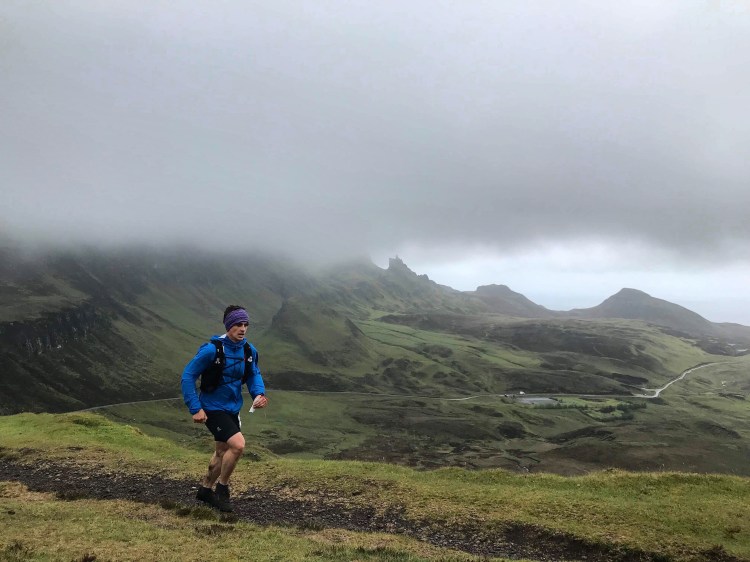
A moment of clarity on the Quiraing. Photo: Jordan Young.
“If you go near this gully – well, basically, don’t. We won’t see you again.”
“There are trods, but there won’t be anyone mad enough to be up there today.”
“There’s still time to withdraw if your navigation is sub-optimal.”
“Don’t think you can use the ridge as a handrail.”
…
The race organiser’s words drifted across the blank sodden grass as I stood, staring exasperatedly at a wagging compass needle on a damp square of map. It couldn’t be any more obvious where I was to go: a black, scouring line dragged itself across the map, heading from north to south – the Trotternish Ridge. Somehow, it was nowhere to be seen.
The compass needle settled – run!
…
As we stood in the dry sanctuary of the Portree High School, I was close to dismissing that parting comment that we shouldn’t use the ridge as a handrail. How hard could it be, really? The Trotternish Ridge cuts a striking figure on the landscape and if you remember to “not head east, or you’re going to meet a sticky end”, navigation should be a cinch.
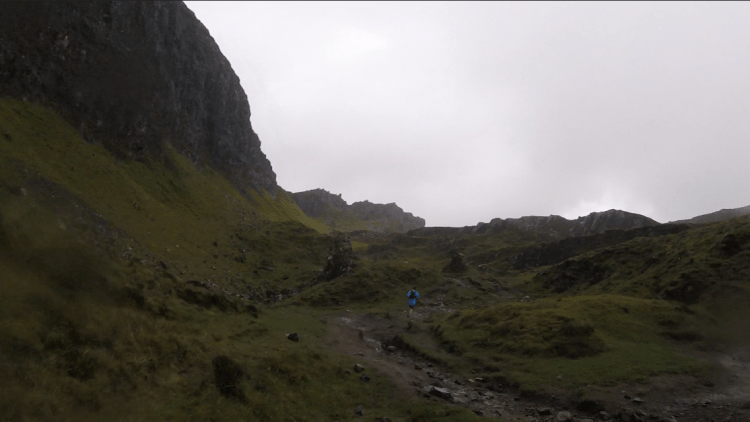
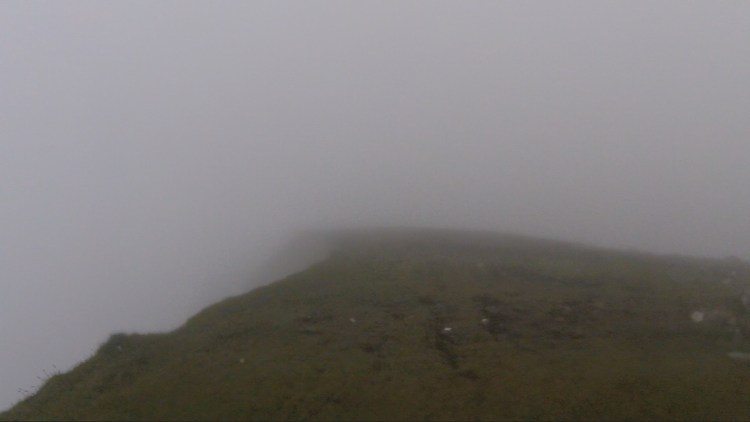
I can categorically say – as I stood at CP1 to take a bearing – it wasn’t. Around us, the squall and clag hang thick. This wasn’t a “veil” of cloud, this was a bucket on your head. I wrote in a previous blog on the Devil’s Burdens Relays that there is a point when running through poor visibility you experience the feeling of falling forwards; the compass needle in your brain loses its magnetism and spins, pointing listlessly in no direction at all. On that square inch on the North Skye map, the “handrail” of the ridge couldn’t be any more elusive, nor the needle in my brain any more wavering.
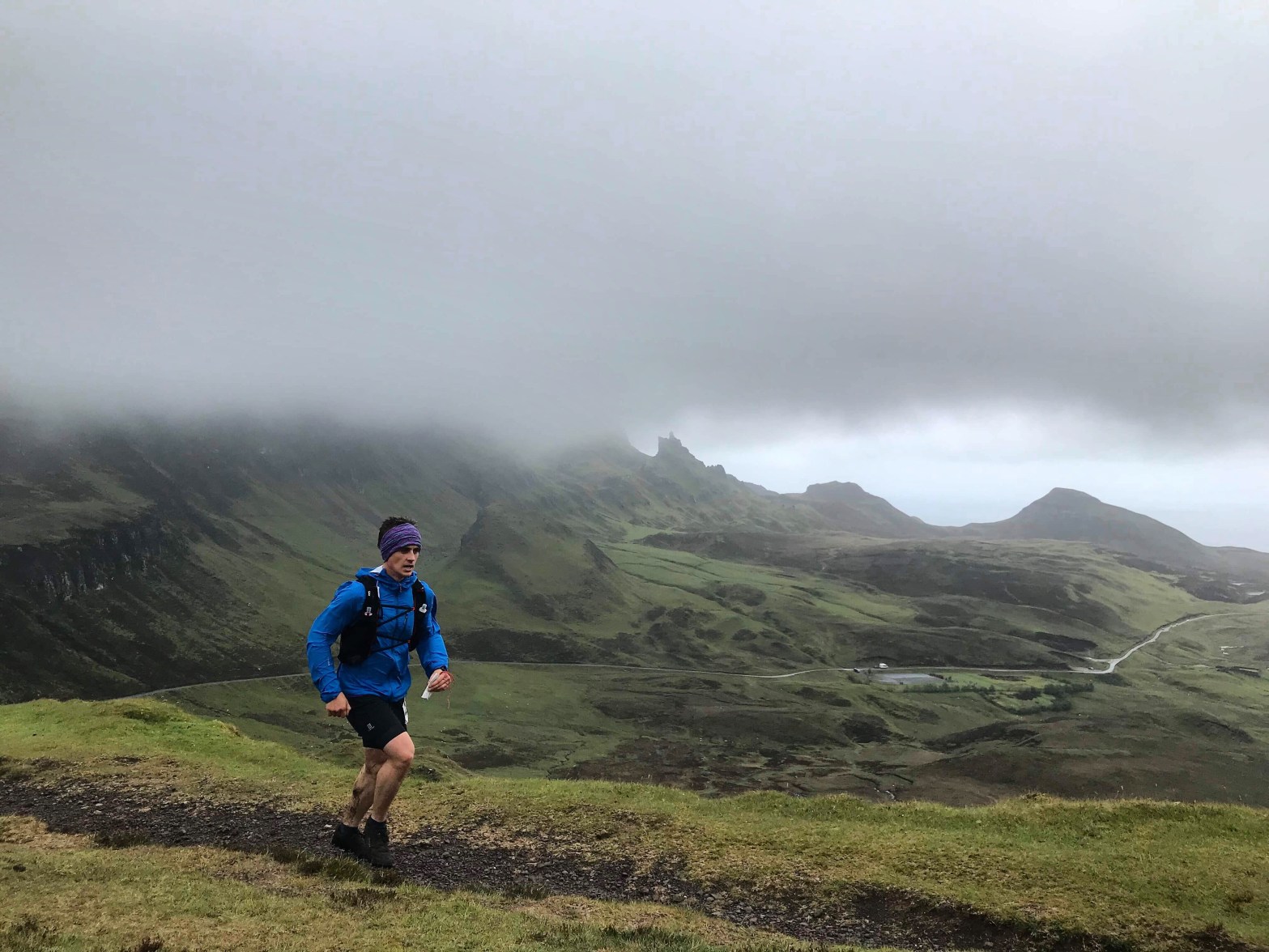
The Trotternish Ridge is like a natural museum: Often its contents – the Old Man of Storr, the Quiraing – get far more attention than the museum in which they reside. Driving along the meandering road past dozens of tourist groups seeking the sanctuary of lower levels, we peered nervously out and up to the wilderness of the ridge. The Storr leered out of the gloom, waves of cloud washing over the ominous crags surrounding it. The roaring scourge invited us to take to its heights.
From the bus. The white building in the distance on the right is the finish.
Walking off the bus, my number tags lifted and slapped my face in the wind. At each checkpoint, we were to drop a tag into the bright orange box. Behind us, a sweeper would be checking each box for everyone’s number. Interestingly, this wasn’t just a matter of safety or race rules; as the Scottish Natural Heritage manages the ridge, they stipulated where they wanted the race to run in order to protect the rare mosses and high altitude plants. Where they were is a mystery to me, given I could see only as far as my arm would stretch at times.
The weather was far brighter at the start than it would be in, say, 10 minutes. So much so that some people had taken the bold move to take off their jackets. Indeed, one runner – who appeared ethereally out of the pouring rain and cloud much later in the race – kept it off for almost the entire race, taking “skin is pretty waterproof” to a new level entirely.
Once out of the starting gates (in classic “three, two, one, go!” hill racing style), we snaked our way around Loch Langaig and Loch Hasco, before taking a sharp right up a scree slope and into an alien landscape. I had mentioned the gloom might add to the general atmosphere of the race, but I had not expected it so early. The landscape was one of wounded giants; large pieces of shrapnel stuck out of the ground; lumps of geological castles lay scattered by the faint path; deep bomb holes filled with freezing water peppered the earth.
About 4km into the race and we were on the ridge, a trail of wandering souls disappearing into the smoke from the battle below. Up there, though, the weather’s war continued. We were soon drenched, a wall of Atlantic air fell upon us – but not the warm type.
“We’re going up there?!” Photo: Lee Preston
The air was so solid I was doubling-up my compass readings with following prints, three of us following the trail like hounds. I stopped for a moment glancing at my compass.
“Look! There!” another called.
I looked up. Like something out of Pirates of the Caribbean, the cloud broke enough for us to spy the car park below us – the shattered rocks of the Quiraing to our left. It was a breathtaking sight. Ivividly recall running down the steep hill towards the second checkpoint and thinking, ‘Look left’, and catching a glimpse of this broken volcanic region. It has an almost supernatural quality to it.
I took the time in the car park to grab a drink, knowing it was to be a long 10-plus kilometres until the next checkpoint.
The ridge rose again, our interlude between the clouds brief. I recall one runner being at least 500m ahead of me at CP2, but somehow was behind me halfway towards CP3. It continued like this the entire day: Runners would emerge like zombies from the sea, drifting out of the cloud and joining me on my own journey. Runners would cross your path, fade in and fade out, take a left or right, fall back or surge on – the running peloton swelled and diminished like the movements of a beehive.
My legs felt good. Leaving CP4, a pack of us had reformed, a line of ghosts in what some people call hell but that we call ‘fun’. Several dropped off, four of us pounded on. We descended, trotting through pathless mush.
“Hold up!” one said. Even as he said it, my mental compass was whirring. We had gone wrong.
“We’ve dropped too far”, he repeated, his eyes scanning the terrain. I glanced at my watch. The elevation reading: Ballocks.
In a situation like that, the best thing to do is contour. We stuck to the 400m contour like glue, pulling ourselves below the crags we should have descended next to, hauling our way up rivers and tussocks. A figure faded into the distance – I cannot be sure I actually saw them. Either way, we pursued.
Up another climb we went, before it levelled off and a troop of half a dozen other ghosts charged out towards us and headed to our right, evidently leaving CP5. We found it. Dropping our tags, we went on, our gang of four breaking as the watchful one and I fell in step with one another.
We couldn’t make the same mistake twice…right? Well, we did. Ian (as I learned) and I once again followed a spur too eagerly. Before we knew it, we’d added another 2.5km to this 28km race.
Ian, from Inverness, has done the race three times previously. In sticking with him, I hoped we would find our way back.
I took some bearings, made suggestions. “We’re looking for the green burn”, Ian said sagaciously. “I remember it. Bright green river down a steep slope”. By this point, I was losing the fun factor: I was wet, cold, cramping up – fucking lost.
Well, not lost. I rallied myself: We knew where we had gone wrong and, although no one was near us, people are there to help. Later I learned some had made far bigger errors than us (or had bailed out), dropping off the ridge towards the villages in the west. Someone down there would find a bedraggled runner pounding on their door asking, “Can I use your landline? Also, do you have a bathroom?”
We pounded back up to 500m, found a steep gradient and took it, finding the green burn in the process.
An alien battlefield
“I remember this: 10 o’clock after the burn”, Ian relayed. After dying down a bit, the wind returned with a vengeance. So did the rain. I hadn’t removed my jacket the entire race, but Ian was exposed. We had both slowed down on the climb, the cold drawing our strength like a Dementor. Everywhere we looked was wet, surrounded by our white prison walls. After battling to put his jacket on, Ian and I followed a set of cairns, knowing the next checkpoint was by one.
As we reached a plateau, there was an odd sense that there was no up or down: The grass was cropped completely level, the ground pan-flat, giving this odd sensation that one was floating. Apparently Storr was next to us, but we never saw it. What I did see, for the first time, were sheep. I knew I was getting delusional when I actually wanted to ask them for directions.
Chucking our tags into CP6, we quickly covered the ground to CP7. After about an hour of seeing nobody else, a meandering soul appeared, hooded and moving well.
“How are you doing, mate?” I asked.
He looked at me grinning: “Yeah! No bad! You?”
“Aye – as good as I can be!” I shouted back.
We marched on. Mercifully, the ridge was now parallel to us, its teeth jutting out of the clag. Our companion dropped off, so Ian and I reached the last two marshals alone. Just as we got to them, though, a perfectly foot-shaped hole appeared below Ian and he dropped right into the thing, instantly cramping up and collapsing.
“I’m alright!” he cried, the marshals moving in to help. “Just cramped.”
He got back on his feet. We dropped into Bealach Beag, the last descent of the race. After 30km of non-stop effort, the shattered rocks of the Bealach Beag were treacherous. Picking our way down, we could see the final couple of kilometres ahead.
We stuck together, reaching the road we had driven along – oh, so very long ago. Marshals clapped as we turned right towards the dam.
“Stick to that ridge line!”
Ian groaned, removing his cap to reveal his almost bare head: “I am not looking forward to the drive home after this.”
“You not staying up?” I asked, words not working correctly.
“Nah. Working tonight.”
“What?” I blurted.
“Aye. Firefighter. On the late shift the night”, he said.
I was full of admiration for him.
I recalled, then, seeing Ian just behind me since the start of the race. We had got lost together, found ourselves together and were going to finish together.
The most treacherous part of the whole race, I argue, was the 100m stretch across the dam. That thing was incredibly slippery. I am surprised nobody decked it at the finish line.
Speaking of which: “Where’s the finish?” I asked, looking down the path for a marker.
“That van”, Ian nodded towards the vehicle at the end of the dam.
I laughed. Classic Scottish hill racing.
“Well done”, the organisers said as we crossed the line in 4:26.19.
“How many have finished?” I asked.
“That’s 18 now.”
We staggered. That was less than expected. After all those hiccups, to finish join 17th was nothing to be sniffed at.
That evening… Can’t win them all!
Tottering our way back across the lethal dam(n) wall, we opened the door into the hut where there was a mountain of cake, bread, soup and tea. In there were people we had seen on the ridge, some who asked, “Where the hell did you guys go?”; others who said, “I think you win the prize for the furthest distance ran”; but almost all of them shouted: “How good was that!”
After 32km, 2100m, four hours and 26 minutes in the rain and wind – how good was that? Incredible.
Running in Glen Etive with Stob Coir’an Albanaich behind!
Scotland is a wild and beautiful place. For as long as I can remember, I have been walking, climbing, running through its beautiful landscapes, often without a trace of human interference. That grandeur and ancient energy is my inner peace.
That peace is being shaken, though. Our behaviours are changing the places I love. I wanted to know how climate change is affecting the outdoors, considering UN SDG 15 – Life on Land.
Like Egypt, Scotland has its own Sphinx. Unlike Egypt, ours is a snow-patch. In the last 300 years, the Sphinx Snow Patch has disappeared just six times. In 2017, Iain Cameron, an expert in snow patches, said the patch is now in its death throes. Despite last year’s cold snap, which was a boon to the struggling snowsports industry in Scotland, highly variable seasons lie ahead of us.
This variability has dangerous consequences. The Scottish Avalanche Information Service (SAIS), predicts such rapid snow to thaw fluctuations will result in an increased avalanche risk, putting in danger the lives of walkers and climbers.
Mark Diggins, co-ordinator at SAIS, said he predicts “a more volatile weather pattern with extremes providing persistent snow pack weaknesses during cold phases. Perhaps there may be more erratic weather patterns within a winter but also from one winter to the next. This is challenging to forecast for and also for the public to gauge.”
For walkers and climbers, being able to rely on the snow you are walking on is crucial in the winter. With deep fluctuations in temperature, this could mean snow has hardly any time to consolidate.
One such place that has some of the highest avalanche rate in Scotland is Ben Nevis. The biggest of Scottish mountains, Ben Nevis (or The Ben) has a split personality.
Every year, 160,000 people will climb Ben Nevis. In summer, great pilgrimages take place up its main mountain path, sometimes taking washing machines and ironing boards to the summit (one man took a boiler to the top of The Ben and its sister peaks Scafell Pike and Snowdon). On the other side, though, lies a world of incredible ferocity and beauty.
Within the crannies of Nevis’s North Face, ski-mountaineers, rock climbers and runners can be found snaking their way up Tower Ridge, Castle Buttress and the ominously titled Don’t Die of Ignorance climb, immersing themselves deep into the recesses among some of Scotland’s retreating wildflowers.
The Nevis Landscape Partnership (NLP) produced a study showing how some of these rare and beautiful plants – like Iceland purslaine, snow pearlwort and Highland saxifrage – are retreating up and in to the mountain, seeking the consistent cold corners The Ben has to offer.
It isn’t just on Ben Nevis: Further south on Ben Lawers, the snow pearlwort is at breaking point; while on Mull, Iceland purslaine has been severely hit by warmer weather. It is easy to dismiss these seemingly small changes to our natural environment, but I don’t know any lover of the mountains who would ignore these signs.
“On top of ecosystem changes,” said NLP’s Iona Skyring, “One of our biggest concerns is the erosion of paths and the nearby parts of the land.”
Alongside organisations like the John Muir Trust, NLP maintains the tourist route up Ben Nevis, as well as its conservation efforts across the 4300-acre mountain. For Iona, it is the milder climate and sudden weather changes that can affect not just the snow, but the traffic to the hills.
She said: “There is a definite effect from sudden weather changes on soil and paths. Long dry spells, like we had in June [2018], followed by wet weather means soils cannot absorb water, and it can cause damage to areas of already eroded land.”
With potential extensions to the peak season due to milder winters, there will likely be increased traffic on the main path, which is something Iona and the NLP team are considering as part of the future management of the area.
“People should be aware of their impacts when enjoying the outdoors,” she added. “If people are coming to enjoy this area, they need to give back and consider the sustainability of their activities.” Other initiatives, like Mend Our Mountains, also seeks to protect mountain paths from erosion from humans and climate.
If whole paths or rock features are eroded, it could result in landslips and changes in mountain terrain and topography, which leads me to one industry that is often overlooked in climate change discussions: cartography.
Harvey Maps has made maps for walkers and runners since 1977. Glacial melt has huge impacts on mapping, but here, it is rising seas which cause problems. The high tide lines on maps will have to be redrawn, meaning some paths affected by the tide could become more regularly submerged.
Nigel Williams, Harvey Maps ambassador, added: “Should sea levels rise then not only would those lines need to be recalculated and re-drawn, but every spot height on our maps would need to be changed. Whilst contour lines would remain as they are, all the contour numbering on every map would have to be adjusted.
“Could Ben Vane become a Corbett? Will the Munro, Corbett, Donald and Marilyn tables all have to be re-written?”
Questions will only grow. Uncertainty is slowly becoming the norm for those close to the outdoors, and we have barely touched on wider bio and geodiversity questions.
What can we do? When travelling to the hills, car share or take the train and cycle the rest of the way – it can open a whole new adventure. We love to buy outdoor gear, but what could we reuse, repurpose or mend? When on the hill, stick to the main path where erosion is likely to occur. Take your litter and climbing gear home to stop it entering the rivers.
Other things you can do is support charities who are campaigning and working to protect woodlands, peatlands and other wild places in Scotland in order that they can continue to tackle global issues at a local level.
Climate change will affect life on land in Scotland, for both plants, animals, rocks and humans. How we ensure our outdoor pursuits are sustainable is critical to achieving the aims of UN SDG 15.
The Beinn a’ Ghlo circuit of Munros is a favourite amongst the outdoors community. Meaning hill of the mist, this rolling, meandering, swooping massif is a touch of wilderness right next to the A9.
For two weekends we had been thwarted in attempts to visit the three peaks above Blair Atholl: first due to forecasts of 60mph+ winds, second due to high avalanche risk and whiteout conditions.
When the prospect came of bright, breezy and brisk (making a “brrr” combination, if ever there was one) weather, it was hard to resist.
Three giant mountains played host to a giant of geology in the nearby glen of Tilt. James Hutton, the father of geology, studied the granite in Glen Tilt, which featured marble protruding from its surfaces, indicating volcanic activity in the area.
Not only is it a geologically fascinating place, but botanically, too. Declared a ‘Site of Special Scientific Interest’ and ‘Special Area of Conservation’, the 40km-square range is the home of dozens of alpine and marsh plants like mountain avens, yellow oxytropis and many more. In summer, Beinn a’ Ghlo’s black skirt is turned vivid purple as the heather blooms on its lower slopes.
Carn Liath’s reversed S swooping behind us.
Leaving the gushing River Tilt, we drove to the start at Loch Moraig. The loch was like an overly filled basin in one’s kitchen which, if lifted – despite all manner of precautions – would spill instantly over the sides. I have never seen a loch so definitively at its absolute rim.
Ahead, the great pale scar of Carn Liath winds its way skyward, like a lightning bolt. The white granite is crumbly and dusty, and – at its widest – the crack can be a dozen meters wide. Work is in the process of building a viable alternative to protect the heather and flora on the hillsides.
As we ascended, the “breezy” combined with the “brisk” joined the “bright” morning. On each switchback of the Carn Liath climb we had a lift followed immediately by a brick wall as we made the hairpin. The slope takes you up 604m in just 2.6k!
With such a steep slope, it allows you to rest and look back. Behind, the rolling hills of Perthshire galloped across the landscape, no one significant peak but all flowing together into a painting of the southern Highlands. Shadows flew across the ground below as cumulus clouds zoomed past like great birds above.
When the wind is up, looking out at a wide vista is like watching it on a timelapse: trees jostle with one another, grass ripples, clouds are on the A9 of the jet stream and pockets of rain rush smartly over the hills like feather dusters.
Atop Carn Liath, we could see the rest of the round ahead of us. Having visited these hills a few years ago, my memory was slightly hazy on the view from the first trig point. Because of this, I could not recall the spectacle these hills provided, especially the snaking line above the corrie sat behind Carn Liath. If there was every an underrated view, it was this one.
With 19 corries, there are few ranges which can match the scoured look of Beinn a’ Ghlo. Beinn a’ Bhuird, near Braemar, has half a dozen or so large corries appearing like letter Cs on a map. Those in Beinn a’ Ghlo are like the blasts from cannon fire, the contour lines utterly perplexed at the sudden changes in the topography.
A descent into a small elbow joint by Coire Crom precedes the sloping descent up the back of the more complicatedly named summit of Braigh Coire Chruinn-bhalgain, meaning the upland of the corrie of round lumps or (if you want to be crude) upland of the lumpy corrie, or (if you want to use Google Translate for a laugh) strike the pearl of a pearl.
A rather innocuous summit, in nonetheless provides gorgeous views back to the humped back of Carn Liath, a side of it impossible to imagine from the car park. The snow had all but vanished from the hills but for some icy and sticky skirving hugging the corries’ edges.
The real wonder of the day the frost. Off Braigh Coire Chruinn-bhalgain’s back, the ground was like the moon’s surface, covered in a dusty grey colour. It covered the grass and heather with an eerie veil, lifeless and benign.
The final climb of the day rose slowly from the base of Airgiod Bheinn, into the anti-ankle terrain of Carn nan Gabhar*. All across this plateau are rocks of all sizes waiting to twist the unwary foot out of place, covered with that thin layer of frost to render any amount of sticky shoe technology utterly redundant.
The trig point of Carn nan Gabhar is about 2m shy of the summit proper, over yet more rocks. We returned to the base of Airgriod Bheinn to catch the outward path
The usually purple-blazed path is a charred-looking bog from autumn into early spring, but glimpses of buds could be seen amongst the heather. Sadly, grouse shooting is popular in this part of the world, but in a way the relationship is a love-hate one, with well-constructed paths keeping visitors off the heathland which – as seen on Carn Liath – can be destructive.
It was at this point, with about 5k to go, that the legs began to feel very heavy. After a tough week of training and a hard weights session the night before, that path was definitely in the ‘hate’ zone by the time we reached the old outhouse about 1k from the car park.
A last burst took us back to the car, from which we headed to Pitlochry and into the Escape Route Cafe for scrambled eggs and coffee! After a day leaning at 45-degrees into the wind, 45-degrees into a climb and 45-degrees down a slope, I couldn’t help but miss it when it was done.
*And so the rabbit hole begins! Gabhar means goat. Gabhar – sometimes gobhar, goibhrian or ghabhar – can be found across Scotland. Upon our return, I was intrigued that this area was the home of wild goats. I knew they had been a common feature in Scotland, but know them mainly from the inhabitants of Glen Shiel.
I stumbled upon Hugh Boyd Watt and F. Fraser Darling’s observations of 1937 in the Journal of Animal Ecology, titled On the Wild Goat in Scotland: With Supplement “Habits of Wild Goats in Scotland”.
According to their research, the wild goat was an extremely common animal in Scotland, brought as a domestic creature in the Stone Age. As their usefulness was eclipsed by sheep, goats were cut loose or killed. In their inimitable words: “Coming to Perthshire, a story dating back to 1829 says that the “only novelty from the hills this season is the murder of half a dozen goats by anEnglish party in Atholl, who had mistaken their prey for deer”. In central Perthshire there was, and still may be, a herd on Schieallion [sic]; the fine bearded head shown in the Natural History Museum, South Kensington, marked “Scotland, 1894, presented by Sir Donald Currie “, may be from that locality.” (p.16)
What truly pricked my ears then were the etymologies found in places such as Ardgour. When people complain of Gaelic roadsigns, they should consider how much we can learn of botany, ecology, topography and anthropology through them. In Gaelic, Ardgour is spelt Aird-Ghobhar – aird meaning headland and ghobhar goat. The headland of goats!
Two important days occurred this week: World Book Day and International Women’s Day.
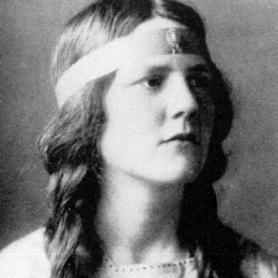
As I left my desk in the office to answer the horn of the coffee van, I pulled a £5 note out of my pocket. Looking at it, I saw a woman gazing strongly to the left of the note – an expression of indefinable strength and mystery.
To the untrained eye, she appears as a Native American woman; a band across her head, full, braided hair and caring eyes with a touch of the wild in them. Her chin is lifted, jaw set and cheeks youthful.
This is a face I became fascinated with during my postgraduate. Who is she? Well, I have asked that question to many people.
“Not a clue,” the coffee man said, eyebrows raised apologetically. I showed a fellow customer: Nothing.
The ironic thing about this now well-used photograph of this woman – often described as “enigmatic” and “far away” – is how contradictory it is to her overall character.
If memory serves me correctly, a friend with a camera had a bit of old film, which she took and placed upon her head. A small brooch was added, her hair curling effeminately over her shoulders. It could not be a more deceiving picture.
Her name is Nan Shepherd – ‘Scotland’s answer to Virginia Woolf’. To give you an insight into her personality, there is a telling story from the Easter of 1941.
Sitting on the train on Easter Monday, Nan met Jessie Kesson. At the time, Nan was teaching in Aberdeen and was on her way to the hills. During the war, the hills were quiet – just how she liked them.
“Arriving at Inverurie station just as the guard was about to raise his green flag, Jessie scrambled into the carriage, falling over the long, slim, brogue-shod feet of its only other occupant. Gathering herself together, as she dusted herself down, she surveyed the woman sitting opposite.
“Pale skinned, with clear, hazel eyes, her auburn hair wound into ‘earphones’ either side of her head in a style harking back to the 1920s, the woman was dressed in clothes matching her tawny colouring: browns, russets and muted greens. Below a flowering, calf-length skirt, her slender legs were uncrossed, nearly pressed together ankle to ankle. This, Jessie decided, was ‘A Lady'”.
Charlotte Peacock writes in her recent work Into the Mountains: A Life on Nan Shepherd, of how the two women spoke rapturously of poet Charles Murray, Dorric phrases blazing sparking through their conversation.
Three years later, Jessie made a discovery: Nan was a published author. Not just of one book, but three, published a decade earlier. She didn’t even learn the fact from the woman herself. Nan put the book aside when Jessie mentioned it and “immediately began to talk of other things”.
There’s a lot to be said for modesty, but perhaps Nan’s elusiveness is the reason few have heard of her outside of the vernacular, outdoors and literary spheres. There are few who you can talk to about books and have read TheQuarry Wood, The Weatherhouse, or A Pass in the Grampians, published between 1928 and 1933.
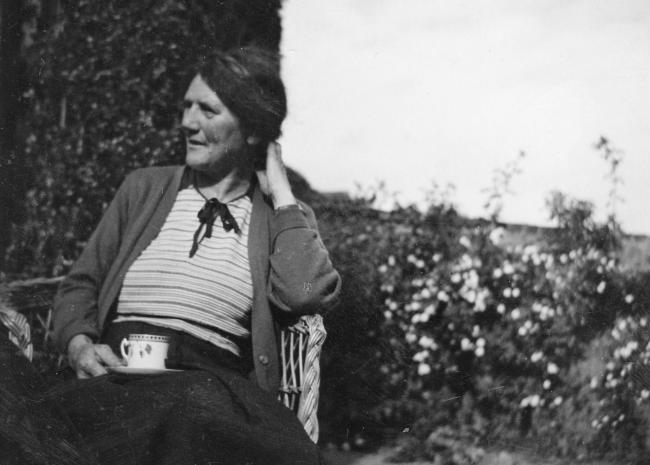
Nan in the garden of the family’s Dunvegan cottage.
And yet, perhaps that is how Nan would have wanted it. Her books did not follow grand adventures, feats of bravery worthy of world-wide recognition or heroes and heroines of our time. They don’t even follow a definitive plot, instead following her characters and communities through life.
What they do look at are the adventures of the ordinary folk, people like you and I whose bravery and heroism is borne out of everyday actions and emotions. They are heroes and heroines to us because they are us, albeit we now look upon them with a view decades later.
Each of her books are somewhat autobiographical; Quarry Wood particularly so, which sees the protagonist Martha (Marty to her friends) follow her dream of going to university and teaching, a path Nan followed to teach at Aberdeen University.
In The Quarry Wood, though, we see the burgeoning of what would become the work Nan was most proud of. Her three novels may be of people, but it was of people and their connection to landscape that makes her stories truly gripping. Even The Quarry Wood is, as Martha’s fancy describes it, “Marty’s wood – the Quarry Wood”.
Take this, for example, from the novel: “May was a frail blue radiance. Was there ever such a summer? Day after day the sun rose softly and night after night sank in a shimmering haze. The hills trembled, so liquid a blue that they seemed at the point of dissolution; and clouds like silver thistle-down floated and hovered above them. Stifling one night in the low-roofed bedroom, where Madge’s cheap scents befouled the air, Martha rose exasperated and carried her shoddy bed outside. There, she watched till morning the changes of the sky and saw the familiar line of hills grow strange in the dusky pallor of a summer midnight. Thereafter she made the field her cubicle and in its privacy she spent her nights.”
One can see Nan’s familiarity with the scene. There is an understanding in the lines that can only be written by someone who has experienced landscape as Nan had.
It was not until almost 50 years later that her seminal work would be published – The Living Mountain.
I wrote on Shepherd a number of times during my postgraduate, eventually being refused the chance to write about her for my final thesis to attain my Masters degree. I refused to write on another writer, taking my love for her work to the hills with me.
It was this book, The Living Mountain, which captured my imagination. In his preface to the 2011 version of the book, Robert Macfarlane plays on Descartes’ “cogito ergo sum” – I think therefore I am. For Macfarlane, Nan changed that – I walk therefore I am.
A lot of interpretations of the famous book that lay dormant in a drawer for nearly four decades touch on metaphysical and Buddhist references. Albeit these are present, there is something more touching.
Nan writes of the simple things on the hill, as well as its beauty and the sensuous experience gleaned from being in the presence of nature. She not only understands how many of us experience the hill, she identifies the things we can never understand.
The simplicity and innocence she wrote of in The Quarry Wood she recreates here: “No one knows the mountain completely who has not slept on it. As one slips over into sleep, the minds grows limpid; the body melts; perception alone remains. One neither thinks, nor desires, nor remembers, but dwells in pure intimacy with the tangible world.
“Loch A’an, Loch A’an, hoo deep ye lie! Tell nane yer depth and nane shall I.”
“These moments of quiescent perceptiveness before sleep are among the most rewarding of the day. I am emptied of preoccupation, there is nothing between me and the earth and the sky. In midsummer the north glows with light long after midnight is past. As i watch, the light comes pouring round the edges of the shapes that stand against the sky, sharpening them till the more slender have a sort of glowing insubstantiality, as though they were themselves nothing but light.”
As you might imagine, I could wax lyrical about Shepherd’s work for days. Her adventures through the Cairngorms, including her novels set in the north east, can teach us a few things when in the hills.
What can we take from Shepherd?
Not the metaphysics, that your self can be elevated to higher planes (even if her students described Nan herself as such). No. It is to go to the hills to feel them.
It is easy to just use the eyes when in the hills, but every sense should be deployed. Feel, truly feel, the moss and the water at your feet. Learn about the bog cotton, the ling, the purple saxifrage, the skylarks and the granite.
Stay curious. Taste things if it seems safe! Smell widely. And, if you do look, look differently. As Nan wrote: “By so simple a matter, too, as altering the position of one’s head, a different kind of world may be made to appear. Lay the head down, or better still, face away from what you look at, and bend with straddled legs till you see your world upside down. How new it has become! From the close-by sprigs of heather to the most distant fold of the land, each detail stands erect in its own validity. In no other way have I seen of my own unaided sight that the earth is round.”
Here is to Nan this past World Book Day and International Women’s Day. You took to the mountains in your way, and helped to make sense of the way I go to the mountains.
To finish with the woman herself: “Knowing another is endless. The thing to be known grows with the knowing.” I feel we can take a lot from those words.
Night has fallen. Halfway up Kirk Craig’s, a man ascends up and up, nothing with him except a pair of short, a jacket and a pair of shoes – plus a sheep.
One, two, three, one, two three. The rhythm repeats itself. Behind him, lights dot a black landscape like islands aglow in the dark sea. The bracken lies like thick fur on the hillside, the wind murmurs something about the time.
One, two, three, one, two, three. In the past, this hill would have reduced him to bent-double walking, hands on knees, legs and lungs on fire. Tonight, a spring propels him skyward, the silent beat of the footfalls providing the timing of the dance.
One, two, three, one, two, three. The final hairpin arrives and he puts in an effort to the summit. His world has shrunk to the size of a dinner plate, his head torch lighting a small circle of grass just ahead.
Onetwothreeonetwothree – his pace quickens in the final few meters, the rock of the summit ahead of him and just as the fire in his lungs reaches boiling point…
…
We all know that narrative. Effortless bounding up a hillside told through a supernatural experience of apotheosis. Then there’s the other version: Snot, phlegm, a pot of frustration swirling in your head, a cloud over you and a black dog on your back.
Kirk Craig’s has been the measure of my fitness for years. I remember one of my first hill runs with my uncle and him saying: “You’ll know you’ve got good when you don’t have to stop going up it.” At the time, I asked him if he had done that, but I cannot remember the answer – maybe I was suffering too much on its 40% incline. Soon, the aim became to get from the house to the summit in sub-20 minutes, then sub-18, now sub-17.
The final push up Kirk Craig’s. Photo: Mark Johnston
This morning, I headed from the backdoor and on to the Bunnyhill. Once called the Cunninghar – an old Scots word for rabbit warren – it naturally developed the modern epithet. Nearby, several standing stones were found, with cup and ring markings on surrounding stones. Stobie, in his 1783 map, wrote ‘Druid Stones’.
According to a 1933 publication: “Stone circle, measuring about 60 feet in diameter, once stood here but was completely removed many years ago, when the stones, which are said to have been 5½ feet in average height, were taken to cover a built drain at Tillicoultry House.” Although, Canmore quotes a local forester who attests none of the stones were over 3 feet tall. Who can be sure, for now most of the stones have been destroyed for building material or, in the case of one, to cover a drain at Tillicoultry House?
I can guarantee none of us knew of the historical significance of the place we played as kids.
Within four minutes, I am under the bows of the yew trees, their roots running along the ground like the veins across the back of a miner’s hands. Further up the path, two of their kin lie fallen across the burn. Yet, even in his reclined state, they remain strong and a Kirk Burn’s eco-system.
Until here, I had been swishing easily up, but as soon as the path steepened I was puffing hard. ‘Strange’, I thought. ‘Normally feeling pretty good here.’
I looked at my watch as it bleeped. It was angry with me. Red glared from my wrist and a big fat ‘-12 Performance’ appeared on its face.
I reached the wicket gate, marking the start of the open hillside and the proper climb of the day. I took a minute to get my breath back, pausing my watch. I coughed up some phlegm and grunted.
Sometimes it just isn’t your day!
The next 10 minutes consisted of 300m of vertical gain. ‘Why do I do this?’ I asked myself, huffing and occasionally thinking how rubbish it might look on Strava. On a bad run, your mind starts to run away a bit, asking questions like:
How did I get so unfit?
Am I gluten intolerant?
I should have drank more water.
This totally ruins my weekly target.
Do I push through and ignore how I feel?
I really just want a cup of tea. No, you have not earned it. Push on!!!
What do you do, then?
Quite simply – stop. We all have bad days. That run I described at the start of this blog? That was two nights ago. I felt amazing. Perhaps that was in part down to the runaway, make-it-up-as-you-go nature of it, with a head torch at 3% battery and just using its red mode on the ascent before resorting to its 20 lumens ‘survival’ mode on the descent.
As one Strava follower described it: Running by candlelight.
Today was another day. Who really knows why I felt rubbish. I turned my watch off, sat down, and just enjoyed the fact I was out.
Some of us feel we are trying to squeeze as much out of life every moment, using the quality of our running performance as a measure for the value of a run. Yet, what value is there is forcing yourself to run, mind performing a form of self-flagellation, hardly taking in any of the surroundings.
That type of approach results in a few things:
You don’t enjoy being outside
You feel frustrated because you are still trying to achieve something you won’t, because it just isn’t your day
You are likely in need of some recovery time, and pushing yourself when you feel rubbish just extends that recovery time.
Now, there is merit in pushing through a ‘hard run’, but when the ‘hard’ turns into ‘downright miserable’, try to find the perspective again.
There is so much value in the appreciation of being outside, of having the opportunity to run or walk at all. Turn off the watch, there is no need to perform for a handful of followers on Strava. We all have bad days, so embrace them.
I got back up, hiked up the hill, jogged the flat and practised some descending. You can always find value on the hill.
At some point, we touched on the topic of why we run.
“Some people go to the hills for the view”, I noted him saying. “I mean, I don’t know about you, but I don’t run for the view.”
At the time I crinkled my nose at this in a rather snooty way. I was not much of a runner then, having only been seriously at it for about 4 months and on the cusp of running the Lairig Ghru marathon – not your classic out-and-out fell race to say the least.
Since that conversation, a lot has happened. For a start, I have ran 1,132km and climbed around 42,131m, and even at that feel I am only just getting the hang of it. But, more than that, my relationship with the hills has changed.
Coming as a hillwalker of nearly 20 years, my perception of a hill was one of a slow birth, the aim being a summit and a view with a piece in hand and a cup of tea in another. In boots, your feet are in armoured tanks (of varying quality), designed to keep your feet warm and the water out.
In your rucksack, everything is there to make sure you are well prepared and the experience is comfortable.
Running changes all of that.
Instead of an outward-facing view, I am now privy to a 360-degree perspective. Albeit, when running, your head is at a 45-degree angle for much of the time to mark the next foot placement, there is a certain spatial awareness that comes from the higher pace.
Perhaps you are less concerned about your own bodily receptors of being wet or cold. Moving fast and light does away with that concern. I’d more readily be soaked to the bone on a hill in a pair of shorts and running shoes than cocooned in a £400 waterproof jacket, Gore-Tex boots and hauling a rucksack.
A lot gets bandied about these days about barefoot running. Books like Born to Run and Footnotes (a book I just finished) expound the virtues of barefoot running, but I never managed to connect with these because of where they ran.
A lot of the running was dusty trails or roads. However, my perception of running changed significantly when I moved to minimalist shoes in the hills. As soon as I started running through bogs, soaked grass, heather, moss and snow with them, my feet became immersed in the landscape. They added to my impression of the hills.
The perception is not just in that ‘connection’ to the ground – that ‘earthing’ – but I found a strange sense-heightening through running. Everything seems to become spatially and temporally concurrent; I have a distinct sense that the world is alive around me, that I am not the only one in it (and I am not just talking about sentient life forms), nor that the area beyond my visual extremities ceases to exist.
The wind and rain and sun that casts itself against me and with me is not just isolated to my experience of it, but adds to the essence of the landscape. When wearing nothing but shorts and a set of flimsy shoes, the way the elements play on your senses immerses you in the landscape.
In a sense, I do know what Jonny meant: the view is no longer that which is directly in front of me anymore. The approximately 210-degree horizontal by 150-degree vertical perception of our eyes is widened to a 360-by-360-degree view – a sense that the experience covers us.
Somehow, the view now goes beyond my visual boundaries. The effort, the movement, the senses are all contributors to the perception. As Merleau-Ponty wrote: “The body is our general medium for having a world.”
After all, how often do you get a view from the Scottish hills?
Teammate Dave making his way up one of the Kips. Credit: Bob Wiseman
“The mountain rescue team can’t stand on the side of Black Hill because of the wind.”
This message was read out to us with a tremendous gravity by the race organiser as we stood – scruffy and, to some, underdressed – in a nondescript field outside of a small Scottish town off the A702.
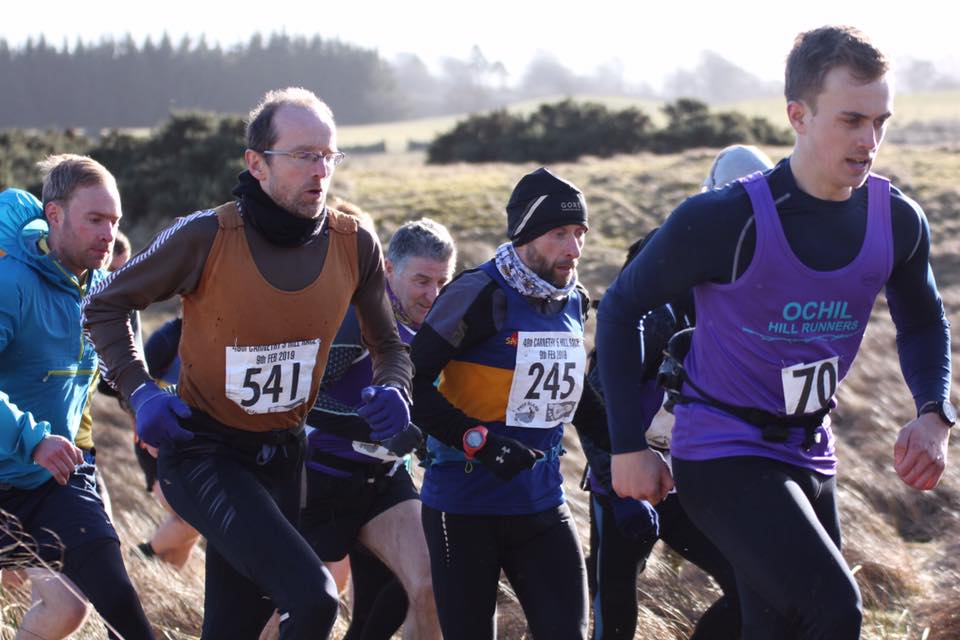
Ninety-nine percent of the year, this field sees only a few souls out for a weekend meander. Then, on one day, 500 ‘crazies’ appear to run over the five peaks that make up the Carnethy 5 – an icon of Scottish hill racing.
Albeit this was my first Carnethy 5, I knew its place in the annals of Scottish hill racing history. On that start line, you are surrounded by the big hitters of the sport’s modern age: James Waldie, Jonathan Crickmore, Sam Alexander, Jacob Adkin, Angela Mudge, Sarah McCormack and many more.
I turned to Hamish Battle: “Excited?”. “Excited for it to be over,” he laughed.
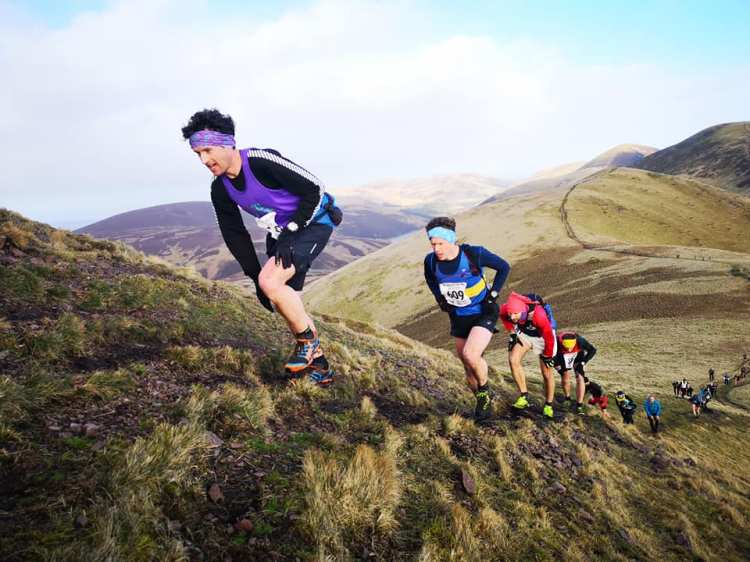
With bag pipes playing, the gun was fired and the battle charge commenced to the base of Scald Law. A fast track out from the start turns into a steep heathery climb, where everyone is reduced to a walk with hands on knees.
Lungs were already burning and calves protested in this brutal baptism of fire to the race. The summit of Scald Law appeared and as soon as it did, the wind slammed into us like a brick wall. I was running, but I wasn’t going anywhere, and even in the descents the effort that was put in to keep moving forward was like towing a car.
Most of the inside of my lungs was on my face by the climb to East Kip’s summit, and by West Kip I couldn’t feel my legs.
I think at each summit I could have put my hand up and said, “Just take me home. I’m done.” But you don’t. You keep moving. You keep ‘that guy with the red bandana’, or ‘the person with the blue bag’ in sight. That’s your marker. Hold it. Try.
Descending into the Howe should have been a chance to let loose, but the battering from the wind and climbs gone turned it into what a teammate described as “a controlled fall”.
A flat section in the Howe and the final ascent was upon me. The breathing is rasping now, phlegm and snot covers my sleeves. At least the wind was behind us at this point, and any gusts we tried to use to carry us further.
More heather, then a relentless grassy climb until we were thrown back onto the plateau to make the final ascent of Carnethy.
Mary of the Ochil Mountain Rescue Team called, “Hey, Ross! Come on!”. All I could do was feebly lift my fingers in response. At the summit, marshals were being battered by the wind, and in a way I wanted to go faster just so they could get home quicker!
At the summit there is a never-ending bend to make around the cairn, before – like a pinball – you are pinged down the side of the final summit into more heather.
I had the strange sensation of seasickness. I was on a ship. The sea was purple and brown and black. Wind crashing into me. Eyes watering. Sea swelling.
Everywhere was movement, and there I was in another “(un)controlled fall” down the side of Carnethy, knees to chest just to stop the heather pulling me into their purple depths.
A touch on the scree and I gained a few places, thankfully! At last!
At the gate, Lee stood cheering something, before the final stretch opened ahead.
You never remember the last 500 metres, but the 501st is just sheer relief. I toppled over into the grass – never has such soft, comforting grass existed.
Fellow Ochil Hill Runner Ross. Credit: Bob Wiseman
We started in army formation, had entered the battle, and here we were strewn across the battlefield. There is an odd sensation at the end of a race, when you close your eyes and are in this half-sleep zone where it feels like you leave your body.
Carnethy 5 lived up to its reputation. According to its description on the SHR website: “Although a relatively short race, the route can be exposed to full winter conditions.” Today was the year of the wind for Carnethy, and what a race it was.
At the end, I was downhearted, but upon reflection to come 92nd in a strong field with 478 other runners, I can only look forward to the faster times in the years to come.
In the end, though, nobody wins: The hills always win.
Thank you to the race organisers and marshals for an incredible event that nearly had to get called off. Appreciate all the effort you made for us! Congratulations to my fellow Ochil Hill runners – Adam, Ross, Dave, Thomas, other Adam, Jon and David.
You roll out of bed. It’s 6am. Outside the hills stand out big towering shadows against the sky which is slowly turning from black to the lightest shade of blue. After some porridge and a cup of tea, you’re out the door, feet patting against the grass.
The ground slowly rises. Around you, the world mimics the feelings of your own body – the blackbird shakes itself out, breathes heavy – swelling his chest and shrugging his wings up – and begins his dawn call. Slowly.
You touch concrete, but it isn’t for long. You shake your arms and the blood starts to flow. You duck to avoid the branches of the yew tree as you run beside the chuckling burn. As your heart rate increases, you leave the trees and the climbing starts in earnest.
Hard breathing. Short. Sharp. Breaths. Skies purpling. Horizon bronzing.
There is a time before dawn in which the atmosphere holds the potential to do two things, either to reveal a glorious world or to explode in thunderstorms. The waning snow crunches underfoot.
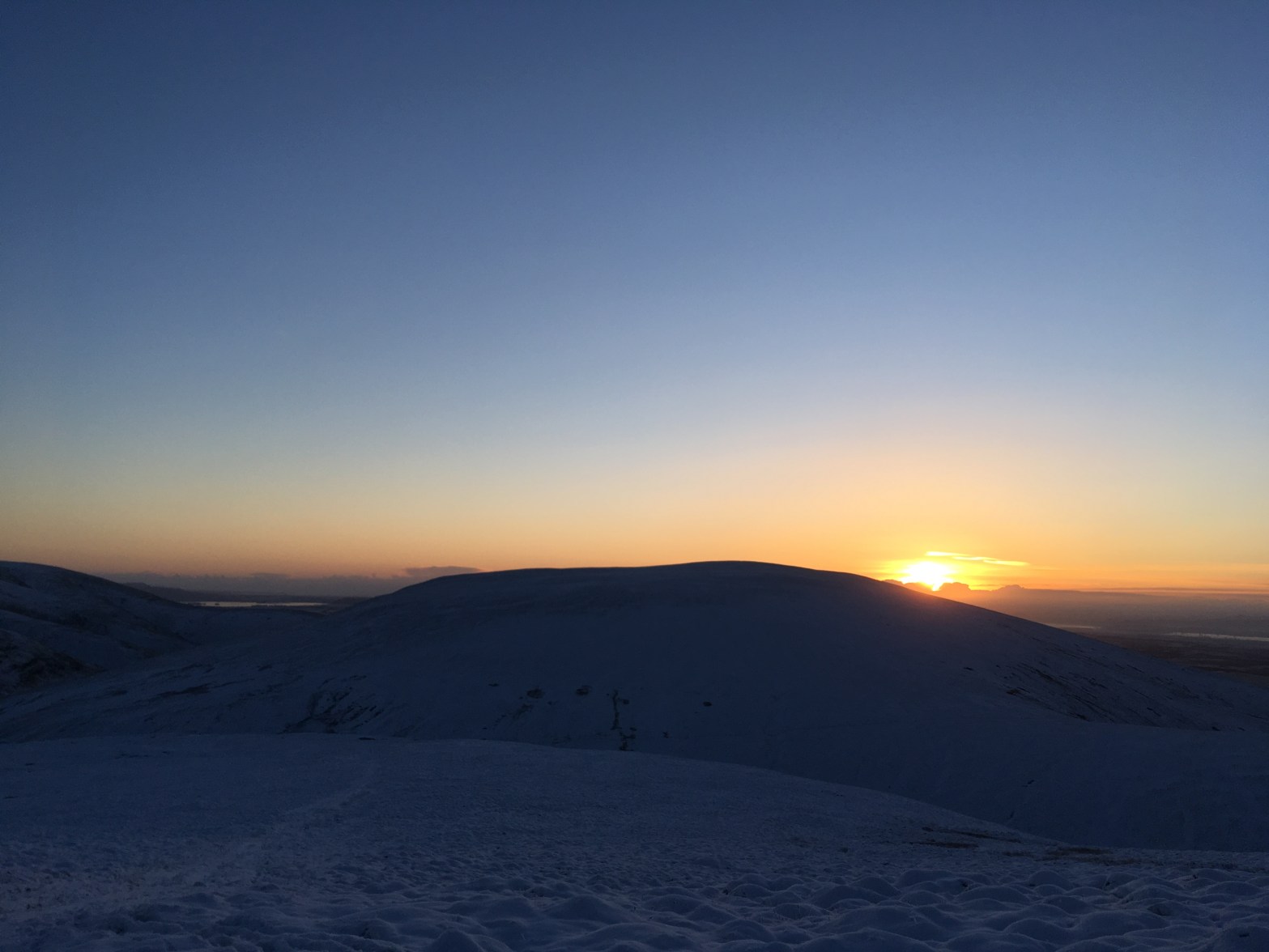
Suddenly, the summits are bathed in hot bronze, which slowly spreads down their sides, throwing into sharp relief the shadows in their creases. I remember once looking at Beinn Dorain at sunrise and marvelling at how it appeared to be covered in a giant’s blanket, the ripples on the ground like the lumps and bumps of some enormous creature beneath the earth.
This is how I like to start my mornings.
Atop Kirk Craig’s – one of the least significant tops in Scotland – is a special place for me. It’s just a rock. It isn’t even the summit. It just sits at the end of a trod around 300m above sea level. I have sat here countless times – most likely into the hundreds.
And I sit.
I sit sometimes for 10 or 20 minutes. That’s all. Sitting. Breathing. More often that not, the hills breathe around me, wind swirling about me and carving around the East Craigs, which constantly feature tiny white cotton balls across their steep sides. How sheep end up in such places is beggar’s belief.
Always worth it…even if it is -10C
Moments like this are hard to get for many. We live in cities, sit in cars and offices, watch television and browse the Internet. The majority of adults can no longer stand up straight thanks to hours and hours spent sitting, and our sleep is scrunched up and thrown in a dustbin thanks to the pervasiveness of artificial light.
Even without all that, and with all the opportunities to spend time outside and in glorious places such as I experience on my doorstep, chaos can ensue.
Today, the hashtag #TimeToTalk is piquing the interests of many, and rightly so. If you go through that hashtag, you will find countless examples of people sharing their stories about the struggle for a healthy mind. Why?
Perhaps thanks to our modern condition, as I have outlined, our loss of connection with the wild, or simply our overcomplicating life with expectations and standards we have seen mental illnesses sky rocket. A large majority of us, too, have a lot of leisure time; as a student, I had a lot of free time, and I think that can be quite dangerous for young people with energy who end up spending too much time overthinking things.
I speak from experience. I am not entirely sure what caused my spiral, even now. I distinctly remember the first time I saw the scales show a number lower than the previous week, and soon it became almost a competition.
Less fun times. Lighter didn’t mean fast, either!
‘Let’s see if I can get to 65kg, 63kg…OK, I just want to be 60kg and that will be fine’. It just snowballs like that until you are 53kg, hopelessly lethargic, depressed, anxious and about to start university with a tidal wave of emotions following you.
Anyone who hears my story is usually blown away by it, because they don’t expect it from someone ‘so positive’. But that’s how it is – mental illness is indiscriminate.
I am immensely proud of the journey I have come to be where I am now. My relationship with exercise has changed throughout my life. When I came back to running last year, it was with trepidation, remembering that the last time I became obsessed with this form of exercise I ended up emaciated. Thankfully, I am a different person now than I was then, and I have the character not to fall into that spiral again.
I commend initiatives and hashtags like #TimeToTalk and Trail Magazine’s ‘Mountains for the Mind‘ campaign. However, we should be cautious about making mental illness almost a trend. We saw this recently in the news with a 14-year-old taking her life due to self-harm images on Instagram.
Of course, the message is always ‘speak to someone’, but there is a risk that some minds will latch on to the idea of mental illness being a popular concept that people suffer from the very thing these campaigns seek to avoid. This may be an unpopular view, but brains are fickle things and trying to understand why we latch on to cults and trends is merely part of human nature – we want community, and sometimes those communities are not the ones we should be associating ourselves with.
My journey through mental health has been an uphill battle. I have made it beyond the trees, the sun has come up, and for now my rock is still and silent. But, there will always be times when the wind picks up and you are knocked from your place. It is your job to train the mind like your body to withstand those blows, understand your weaknesses and your strengths to be able to stay on your rock, wherever it may be.
If you have any questions, comments or concerns, please get in touch. Otherwise, if you are struggling with mental health issues, speak to someone. I let my problems fester until they took over – don’t make that mistake.







 Two important days occurred this week: World Book Day and International Women’s Day.




 Ross Runs Wild