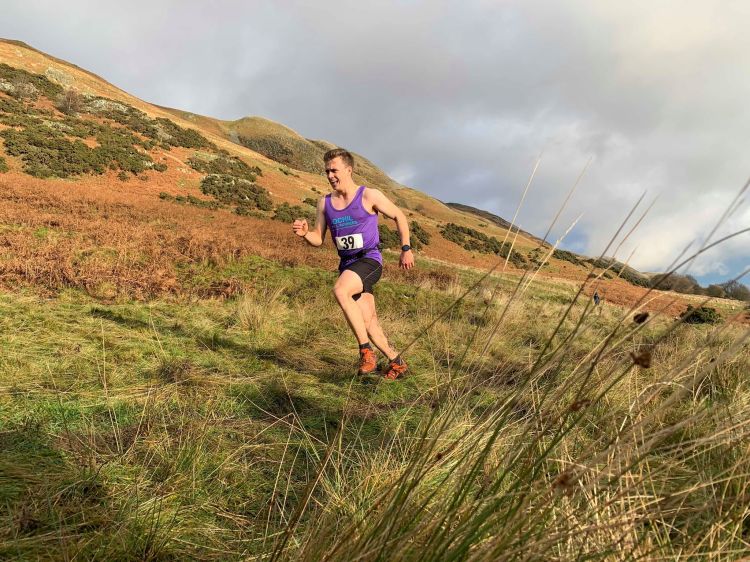
Devil’s Burdens – ‘Total chaos, but just brilliant’

“Total chaos”.

That was how the Devil’s Burdens relays was described to me, but it contained a caveat…

“…it’s just brilliant.”

I was reminded of those words as, on leg three, my partner David and I flew helter-skelter down into Mapsie Den and into the natural amphitheatre created by the trees. Ahead of us, the changeover for leg three to four was marked by a wall of vest-clad individuals, all bouncing on their toes to stay warm on that damp January day.

A steep right-hand turn threw us into this venue and a marshal at the corner cried: “What’s your number?”.

“154”, I rattled through sharp breaths. He then bellowed: “ONE-FIVE-FOUR!” to the waiting runners as we sprinted towards our purple-clad Ochils leg four runner. As fast as lightning, David handed the sheet of hole-punched paper to Lee who disappeared back up the way we had just come to tackle the 5.8km/390m final leg.

This is the Devil’s Burdens, Scottish hill racing’s only relay race.

Almost exactly an hour before, Dave and I were stood in a large bomb hole just above the Fife town of Kinneswood, waiting for Adam and Brian, our fellow senior men’s Ochil Hill Runners, to pass us the punched sheet for our leg.

The Burdens is a buzzing event, with around 1200 runners (according to some reports), making around 200 teams of six in a 26mi² area of the Lomond Hills in Fife. The three main summits of East and West Lomond and Bishops Hill are criss-crossed over four legs – one trail, three hill, two of which are paired.

We watched from our small knoll towards a gorse-flanked bump just 500m away, watching for purple vests to appear. Behind us, dozens of other runners and spectators stood waiting for their changeover.

The weather changed with every minute: the crags below Bishops’ summit came and went as clag enveloped and then released them constantly, and all the while rain and wind cascaded over Loch Leven towards us.

I saw a great tweet from Jonny Muir describing the scene of “loons” streaming through the hills in “little else than shorts and a warm hat”. That was us – minus the hat, but staying civilised with a vest over a t-shirt. After all, it was “fair windy up top, aye”, as any other runner who had just finished leg two would say.

We stood next to Grant and Gary, the V40 OHR leg three runners who – in the spirit of healthy intra-club competition – we wanted to beat.

At 12.05, purple appeared on the horizon and Dave and I dashed into the changeover. Adam came fleeing over the crest of the hill into the hole where we stood and we took up the slip of paper we had to punch at the checkpoints.

“COME ON OCHILS!” he screamed at us as we sprinted away. Immediately, though, the sprint turns into a hands-on-knees effort up Bishops Hill. Ahead of us, a steady stream of vests could be seen from the other leg three runners, most of whom’s leg one runner been set off at the earlier 09.30 start versus our 10.30 start.

Because of their size, larger clubs have sometimes several teams in each category, with the ‘second’ team heading off for the earlier slot. It was because of this arrangement we had some added motivation, passing some of the slower pairs on the mind-bindingly steep slope – averaging 40%, but with a solid section almost 50%.

We popped above the crags and started to head north-ish, and soon became swallowed in clag. With nothing to go on except our noses and a hazy knowledge of the land from a recce last week, we ploughed on.

“Does this feel familiar?”, David called, his voice distant in the wind. “I think so”, I mused. “We came up a different way last week.”

Soon, though, as always happens in poor visibility, you get the treadmill effect; you are running, but you aren’t really going anywhere. I pulled out my compass, which showed we were heading east, not north as we should.
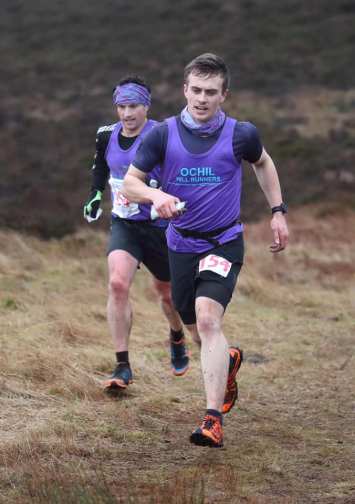
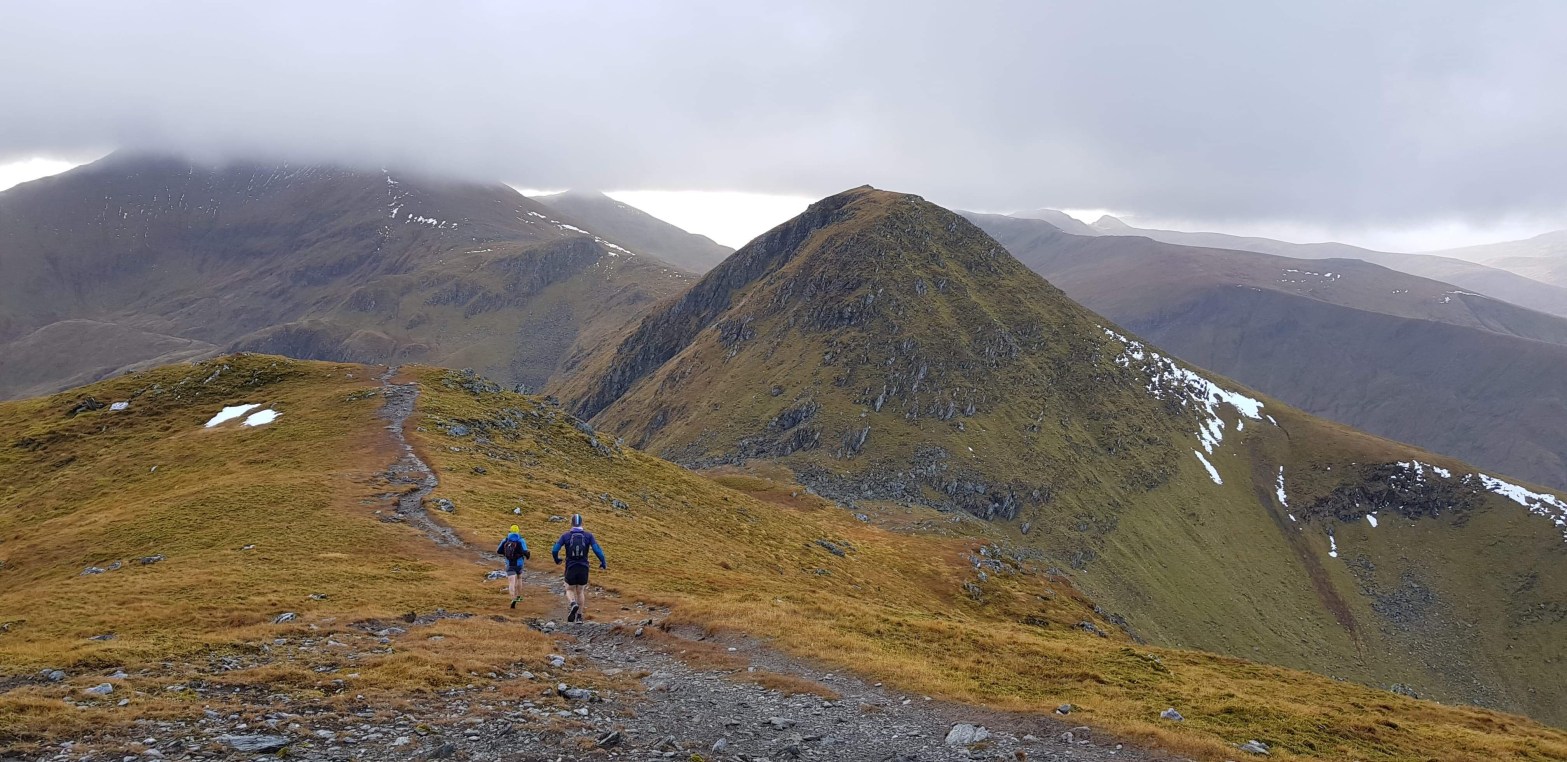
Two hill runners running side-by-side in purple vests
Leaving CP10 on the way down into Glen Vale. Credit: Fife AC

“What do you reckon?”, Dave asked. And then I gave him that look that said, “Bugger”. “The path will probably bend round”, Dave posited. “True, either way, if we don’t hit checkpoint nine and start going steeply downhill, we know we’ve gone wrong.”

We continued and, sure enough, a moment later the path did bend round and the gate with the punch appeared. Punching the hole into the box labelled for nine on the sheet, we headed on.

As we ran along the path we quickly picked up speed, going into full steam train mode as we covered the ground to checkpoint 10. Nothing could hold us back: bogs? Straight through them. Mud? Dive down it. Rocks? Jump. We just kept running in this exhilarating dash across the hills.

We soon found a good pace that we could settle into equally, matching strides well on each landing. Being made of Old Red Sandstone, the mud turned to clay on the descent into Glen Vale, but with limbs everywhere we just careered onwards.

After hitting the tourist path for 1km or so, it was back up a steep grassy slope to just below West Lomond. At the point, we were covering the ground leg two had done in the reverse, so by now the ground was well-trod and muddy.

Because we had found a rhythm, we were slowly picking runners off, but it was unclear whether they were 09.30 or 10.30 starters – we took the overtakes regardless. We did lose a spot to some HBT runners as we contoured West Lomond to the penultimate checkpoint. A pair we had not seen was Grant and Gary, who had still been at the handover when we left.

By now, the clag had lifted entirely as we turned to face East Lomond on the long tourist path ahead. One runner commented to me in the hall later, “I hate leg three. That tourist path afterwards? It’s just rubbish. That’s not hill running. It’s trail!”

Whatever it was, it was fast, with the two of us settling into a leaning gait, legs turning in a full bicycle motion, arms propelling us forwards. Bizarrely, I got a 5k PB in a hill race, but it was all thanks to this slightly downhill (and subsequently VERY downhill) section of just over 5km to Falkland.

On the final left turn we entered the Mapsie Den, a brutal trail descent, legs getting a beating on the hard surface. As we descended through the final forest section, a purple vest came towards us. Nick, the V40 leg four runner for Ochil was on his way up.

In my haze of exertion, a small thought appeared: ‘Ah. Something’s gone wrong.’

We made the right-hander, sprinted to the changeover and let Lee loose.

When we could see properly again (our eyes being out the back of our heads as we sprinted down the last descent, legs and arms flailing everywhere), we looked to see who had arrived.

“Where did you go?”, Angela asked (she was running for Carnethy’s mixed team). “Grant and Gary came about three minutes ago!”

“Gah!” we exasperated, jokingly. Grant came up to us. “You must have passed us in the clag”, we said. “We dithered about quite a bit up there”.
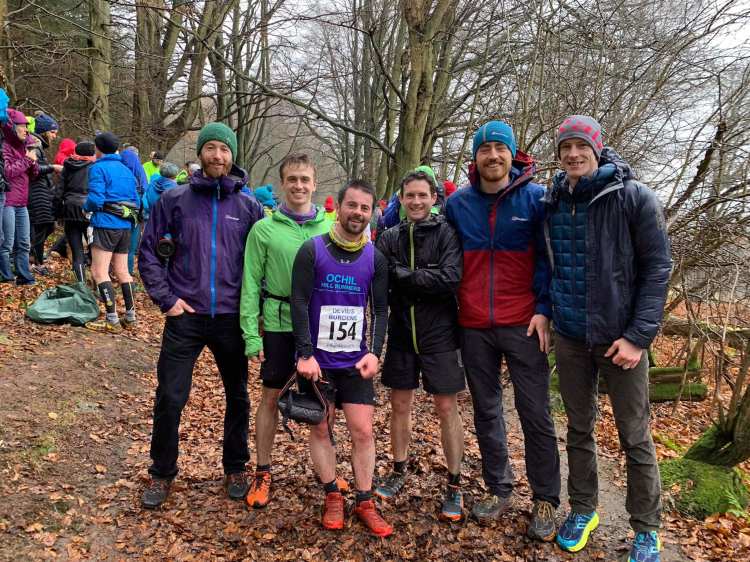
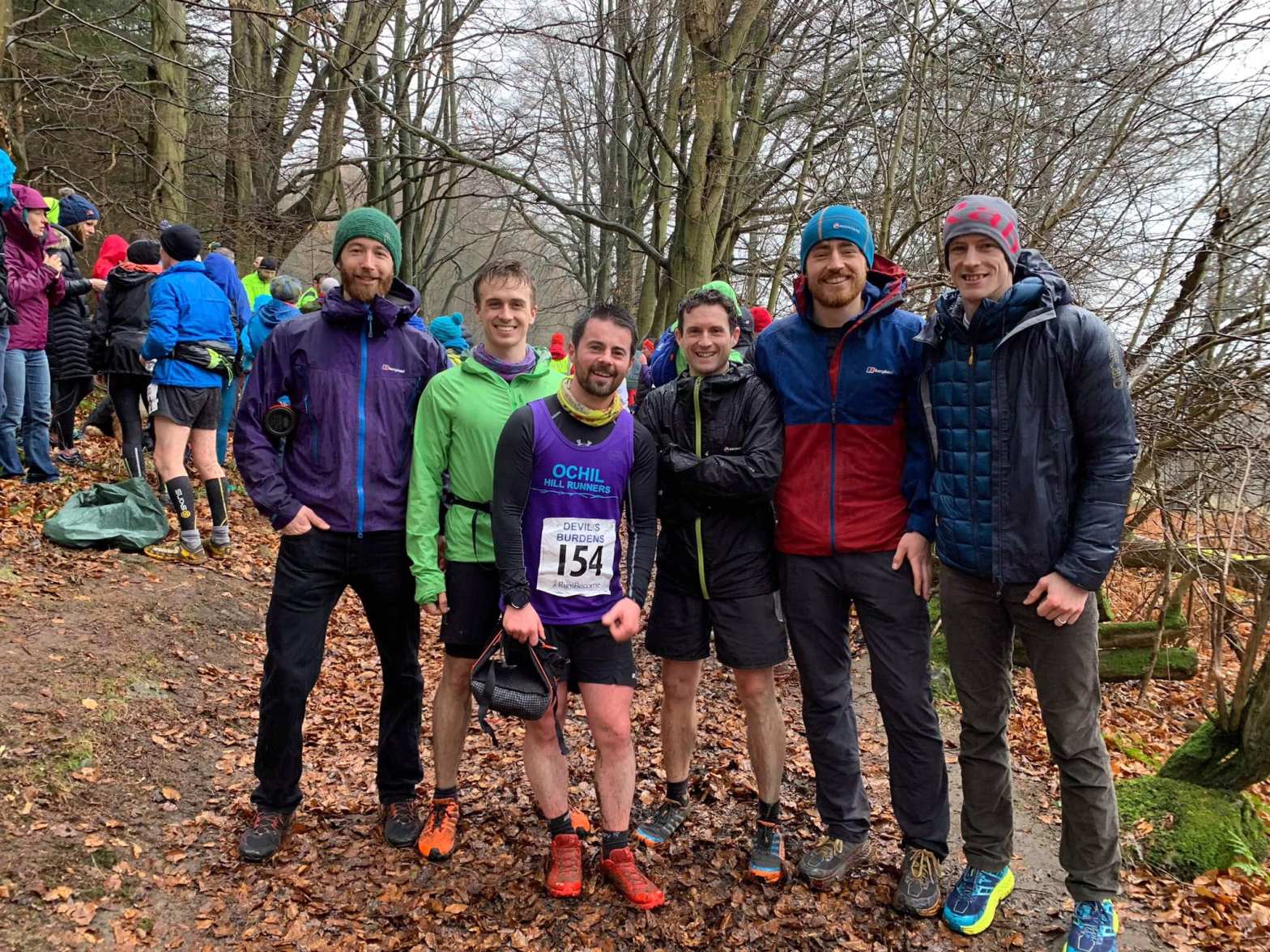
Runners posing after a race as a team.
The Super Six: (L to R) Adam, me, Lee, Dave, Ross and Brian.

It mattered very little. We were all grinning like mad, endorphins sky-high. We jogged easily back into Falkland and up into the woods to see Lee arrive. The wee soldier came flying into the finish straight, giving it all he had.

That’s what made the Burdens a special race – everyone was giving their bit for the team, and however well or badly the team performs, you all worked together to make the best of it.

In the end, that team effort made us 14th of 163 teams (the V40s came 11th, while the WV40s won their class! These V40s are quick!), and earned us a cup of soup and a roll. Get in.

What a way to start 2019! Next up is Carnethy 5 on February 9.

Thank you to Ochil Hill Runners for supporting the teams, to our club captain for building them, to the race organisers and marshals for their work, and to the Ochil Mountain Rescue Team for helping an injured walker on East Lomond during the race.
Feet above the clouds – Creag Mhor and Beinn Sheasgarnich

It’s Friday, 11am. Your manager walks past and heads towards the kitchen and – looking over your shoulder – you furtively open the window on your browser which has half a dozen tabs open: MetOffice, Mountain Weather Information Service, BBC Weather, MetOffice for potential location number two, Google Weather (just to cover your bases), Mountain Forecast…

Tabbing through each, I grumbled. Just yesterday it was forecast to be glorious blue skies; now it looked overcast and driech. Refresh. It changed. Refresh. It changed again. I huffed, exasperated, looking at the solid grey blob on the screen – cloud. Over the next few days was forecast some of the first proper snowfall of 2019 – even today there were photos on social media with snow-capped peaks and whispers of a white band descending from Sutherland.

Running in the mountains in snow is phenomenal and my dilemma wasn’t borne from wanting the lovely weather, it was from the question of where had the lovely weather gone? With everywhere now a similar grey colour, the choice was where to go now? You might snicker, ‘Fair weather runner’, but don’t lie – we all do it.

Earlier in the week, I had sent a link to a fellow Ochil Hill Runner of a route outside of Killin. Creag Mhor, the partner of Beinn Sheasgarnich, sat as an insolent red blob on my lovely map of blue completed Munros in the southern Highlands. It stuck its tongue out at me every time I opened the map on Walkhighlands.

I thought about that little red dot, that little grey cloud. Red dot. Grey cloud. Red. Grey. I punched a furious message into my phone: “Tomorrow. What’s the crack?”.

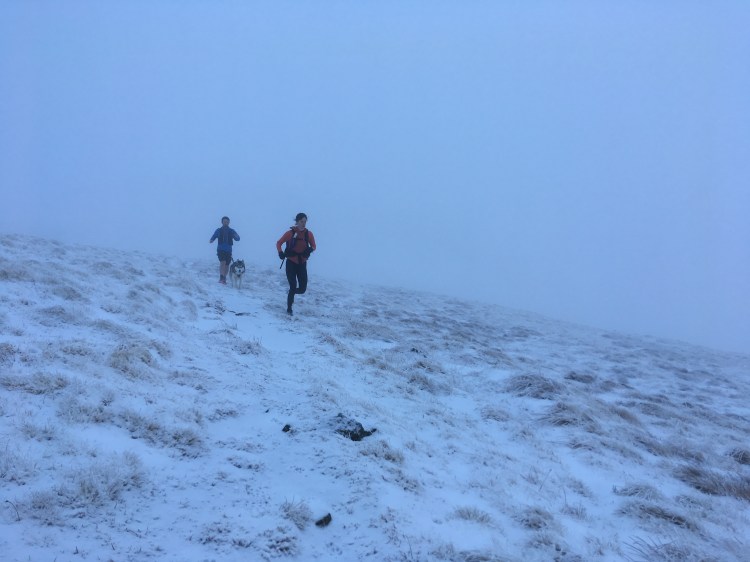
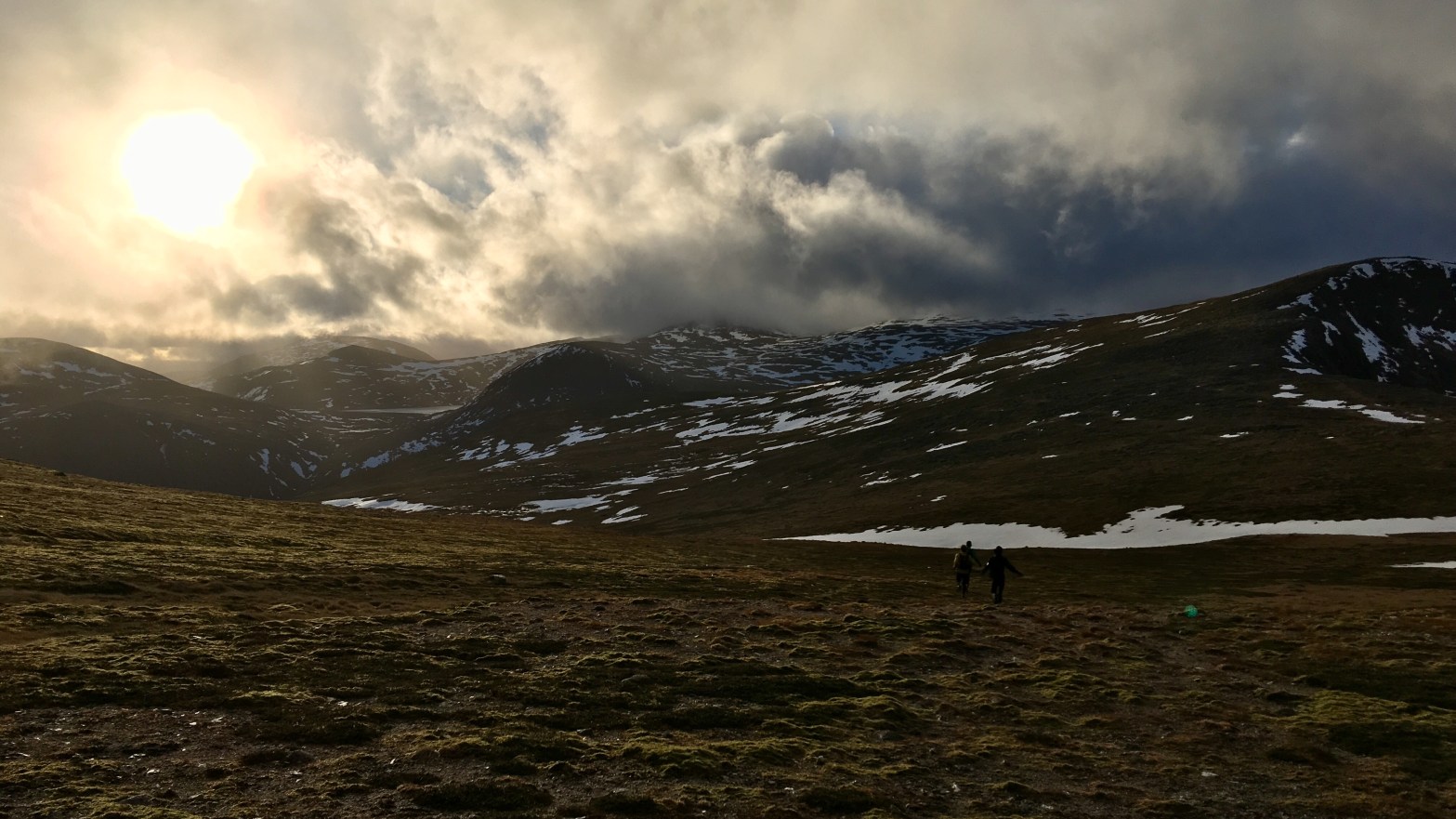
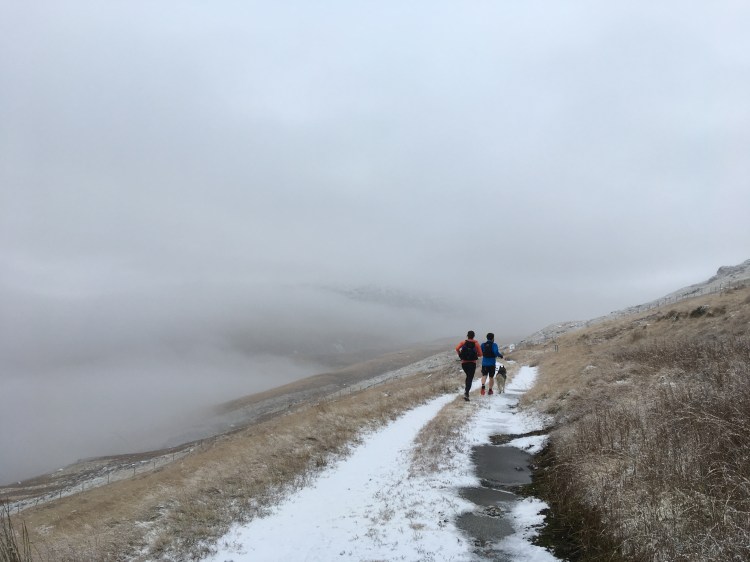
Runners and a dog running away from camera on a snowy track with lots of cloud above
Not much to see yet!

On paper, the route is 27km with 1400m of climbing. What those numbers don’t take into account is what is underfoot: heathery bog is pervasive in these hills and – somewhat counterintuitively some might believe – this meant the best time of year to tackle these two often-spurned summits was the height of summer or winter.

Why winter? In the right conditions, that squelch of a bog hardens up, making it easier – but not easy – to run through.

As we left the Central Belt, we looked out to thick clag hanging at just 300m above sea level. Ben Ledi was awash with an overgrowth of grey cloud, and with sunrise still 45 minutes away, the snow stood out stark against the gloom. Finally, a sign of winter!

At 9am on the dot we pulled into the car park at Kenknock, a farmyard peering out through the fog. We settled into an easy plod but were soon met with the steep zig-zags of the old road connecting Kenknock to Pubil. I remember cycling up it when I was much younger, and to the best of my knowledge think it serves as an old road for servicing the hydro dam at Loch Lyon. Our path shot west off this road on its final, steep left turn.

“This weather could go either way,” someone commented. Indeed, above us the cloud was not for shifting, but under foot was lethally slippery at times. After passing through some gates, the back of Meall Glas drew level with us to the left, and eventually we came to a study bridge over the Allt Bad a’ Mhaim.

Runners emerging from cloud on hill with lots of snow
The flat stretch of Creag Mhor

We rounded the shoulder ahead of us and paused after another gate. Working on navigation, we took a bearing straight up and between the crags that snarled at us from above – a characteristic of Creag Mhor which provides us with its name: the big crag.

The going is steep, and with the additional snow it made slow progress. As we climbed, though, forces were at work around us. Something was shifting in the heavens as some struggle took place above. Though the cloud did not thin, it creaked with the struggle that only those who spend a time outdoors can sense. All three – maybe even four – of us could feel it.

At 840m, the ground levels somewhat, before a final 200m ascent over what felt like an impressive spine. In those conditions, it is impossible to tell exactly what the land is like, but the crags, snow and infinity of cloud created the sense we were crawling up Creag Mhor’s great back.

Suddenly, as if we were children not quite tall enough to peer through the letterbox, the top of the clouds appeared some 50m above us. Just above us, blue skies were tantalisingly close, but just out of reach. As the day warmed, we knew there was a chance of something spectacular. We headed down Creag Mhor and looked back to see its great rocky prow emerging from the spray of cloud around it.

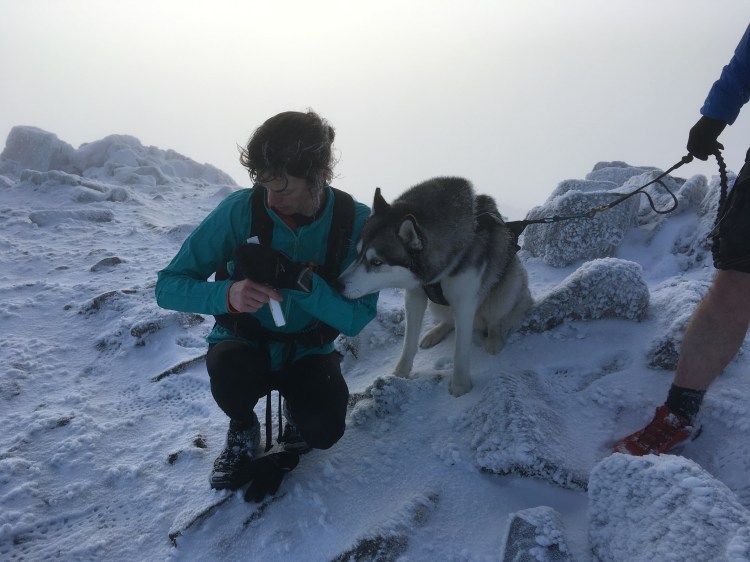
Husky sniffing the arm of a crouched runner in the snow
“Whatcha got there?”

Despite their lack of movement, weather can make mountains appear like terrifying giants, pushing inexorably through the sea of cloud which ensnares them. In rain, they push back the curtains; in sun, they sigh in its warmth and extend their crags to shade their gullies. I remember sitting in the same place in Aviemore and looking up to Braeriach and Ben Macdui on two such different days and being transfixed by this strange animation of meteorological shifting and geological metamorphosis.

We ran below the now-obscured rocky face of the first Munro into a bealach, which acted as a meeting point for two glens. Ahead, Beinn Sheasgarnich’s climb – equally steep as the first – rose.

We made our ascent, climbing out of the overcast plain into the band of grey again. However, as we got to 800m, I called: “I think something is about to happen!”. Here it was. Excitement took me and I started off, the sheen of gold now pushing through the thinning cloud. My heart was pounding in my ears and as I turned…

Mountain emerging from cloudsin background with blue sky above and runner in foreground looking out
These are the moments worth waiting for.

Nothing. Nothing seemed to matter. Not a breath of wind sounded save for that in my own lungs. Below me, like tiny insects emerging from some giant cushion, my three companions joined me to marvel at our world.

We were the only ones there, but in that moment, I knew a handful of others stood upon the summits we could see – Stob Ghabhar, Ben Cruachan, Ben Nevis – were sharing in it too, almost like looking to another star in the night sky and waving, imagining someone was waving back.

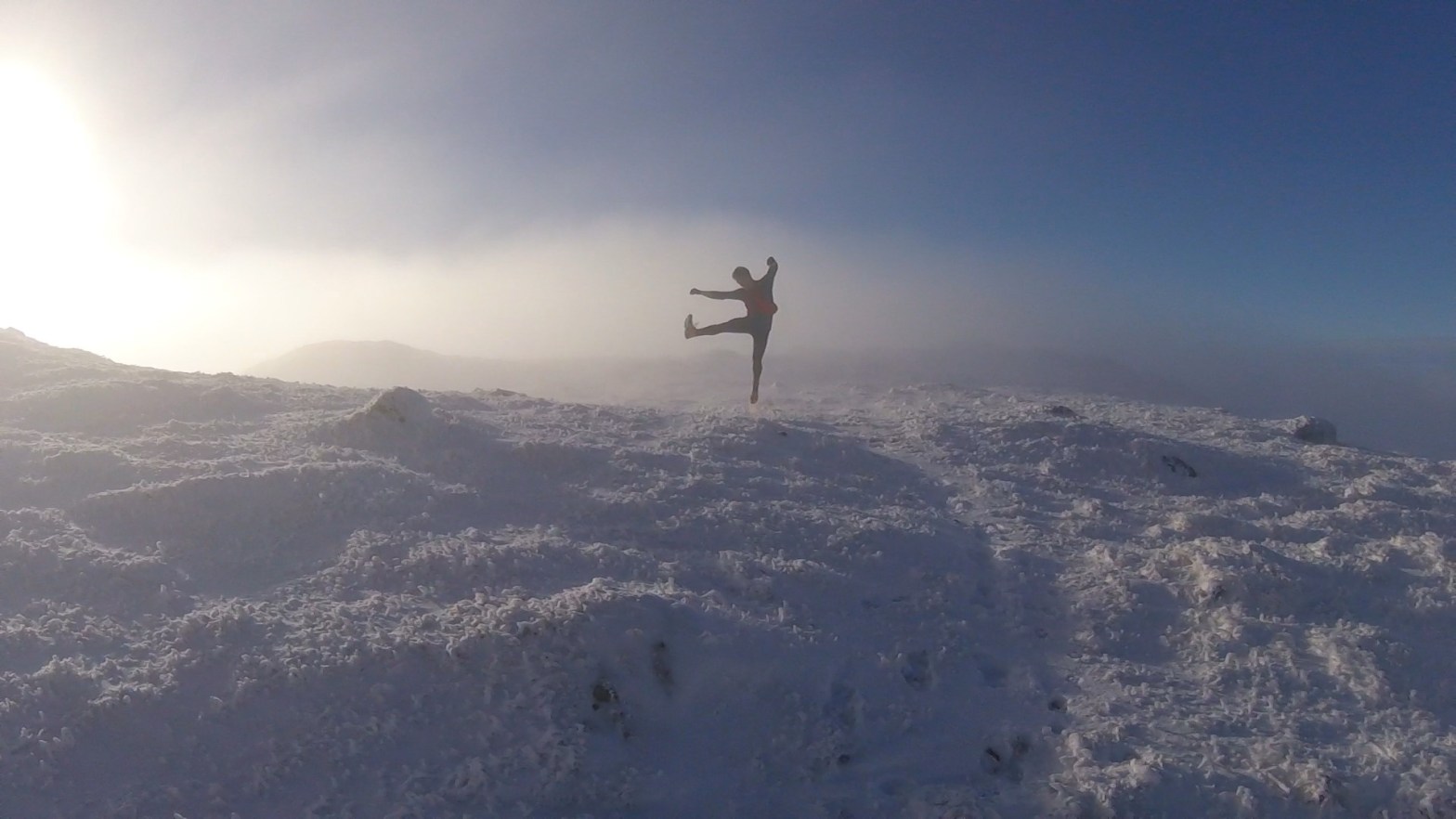
Our only other companion was a brocken spectre, a rainbow halo which followed us until it could follow no longer, and we made our way through the snow to Sheasgarnich’s summit. It was so warm up there I even ran with my shirt off for a time, exuberant at the freedom given to me by the mountain.

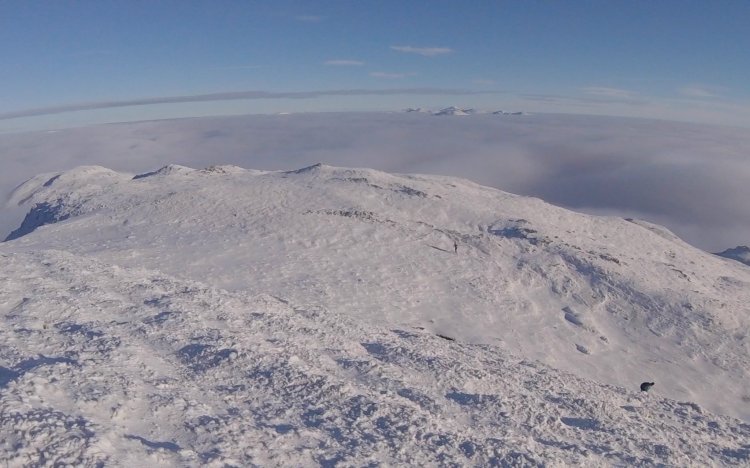
Blue skies, a sea of cloud and snow capped mountains emerging
Isles of mountains

We could not look down, like gods, on some dominion below. Instead, we looked out, for miles upon miles at the other ranges of hills – some still red dots on Munro maps, waiting to be explored.

Grey and red had turned to white and blue. The blue above us stretched to infinity, as we stood on this disc of white seas and jagged islands. Just 200m below us was the realm of the living, but up here time did not move.

There is only so long you can drink from the cup of immortality, though, and soon we waved goodbye to our home above the clouds and descended back to earth, into a knees-to-chest bog and back onto tarmac.

Next stop – an appointment with a bacon roll and large slab of carrot cake, washed down with a cuppa in Killin.

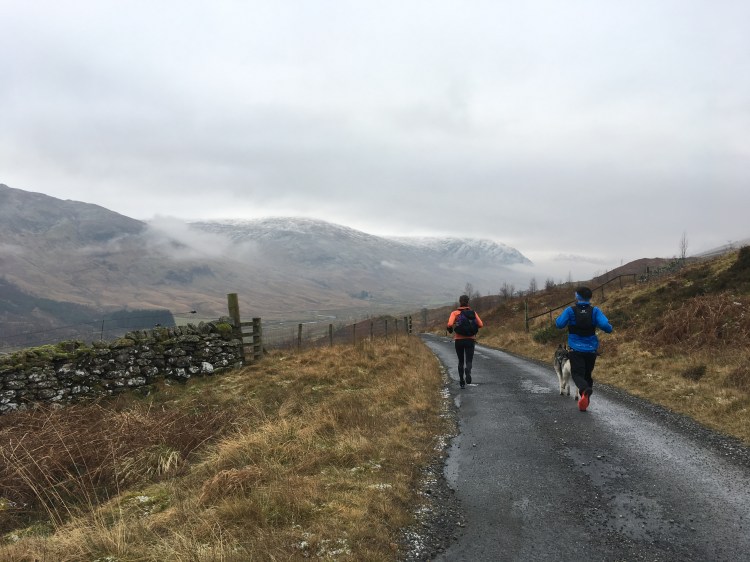
Two runners and dog running away on a country road with mountains ahead
Back in the land of the living

Sugary gales to Loch A’an – Cairn Gorm Loop

The wind on the morning of Hogmanay made the world smaller. It was a strange thing: on a clear day, you look up and see the cirrus clouds being stretched by the winds up high.

However, in our sheltered pocket in the Sugarbowl car park on the road up to the Cairngorm Mountain, we watched as the trees bent sideways as the fierce winds just above our heads roared through the Spey Valley.

2018 was being well and truly blown out of town, but before the fireworks, we had mountains to climb. Our route would take us from the Sugarbowl car park, up Fiacaill a’ Choire Chais and over the forehead of Cairn Gorm before making a return descent around Loch A’an and back via Strath Nethy.

The night before had been a restless one; I don’t remember falling asleep, but at no point did I recall that I was awake. I was in this strange limbo wherein I was aware of everything around me but had no sense of being awake.

Because of this, I crawled out of the sheltered tent groggy and dry-mouthed after a beery evening in a van. I love looking back on pre-run banter after an uncomfortable night’s sleep – everyone looks just a bit rag-tag and repeatedly shake out their legs to fire some life into them.

At the time, though, you feel – in a word – crap. To be sure, the first third of the run was rough. We set off after 0900 and made our way up a disused trail to the ski centre. Four multi-coloured dots on the purplish-brown and grey typical of the Cairngorms.

Despite breathing out my backside, I did have to admit that I was running with two Bob Graham finishers and Commonwealth Games medallist Marc Austin, so I cut myself some slack. The guys were great in hanging back when I dropped off the pace, and it was quite nice to just shuffle along at my own speed at times.

We followed the out of action funicular railway line until we passed underneath it and made our way up a stretch towards the coire. Stick Fiacaill a’ Choire Chais into Google Translate and you get the hilarious translation of Dentist Kettle. It’s close, but it likely translates to mean the Cauldron of Teeth, given the jagged and sharp-edged teeth that make up Fiacaill Ridge.

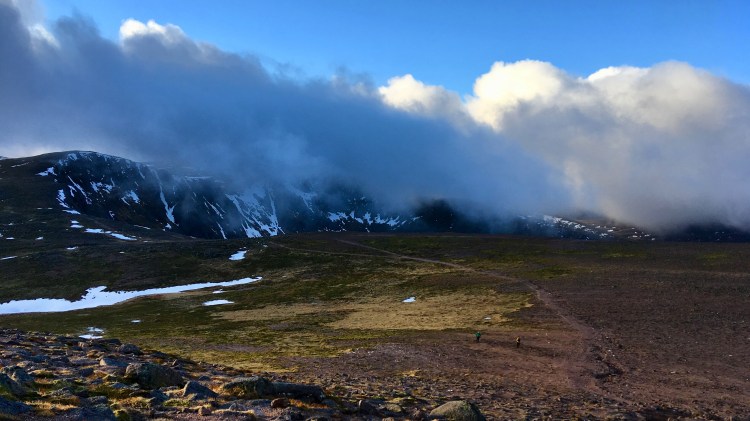
Clouds flowing over mountains with blue skies above and bright foreground of rocks
Break in the clouds.

From this shoulder of Cairngorm that views over to the ridge were breathtaking – literally. The wind was now gusting something ridiculous, and at times we had to grip onto rocks as we were buffeted by what felt like 80 to 90mph gusts. However, through watery eyes we could glimpse an incredible view of the famous fangs.

Stopping for a brief moment to shelter from the gale at the summit, we dashed off into the crook between Cairngorm and Fiacaill a’ Choire Chais.  We vanished into the clag that swam about the heads of the plateau and began our ascent up Cairn Gorm.

Had there been a Strava segment up there, we would surely have taken the record – the wind practically acted as a conveyer belt, sending us straight to the weather tower in jig time. What with the swirling gale, uncontrollable laughter and effort from running it was hard to get breath! We stopped – again for very little time – before charging into the wall of air that forced itself against us.

It was at that moment that a degree of temperature change and a lift of the air cracked the barrier of cloud. Below and beyond us, sun poured across the plateau and the Fiacaill Ridge like foaming waves crashing against the granite.

The path which descends into Loch A’an is well trod, appearing like much of the trail in that area – sandy, tan and soft. Suddenly, the gods’ great trough appears below, surrounded by towering peaks. Beyond, the boils of Beinn Mheadhoin stood black against the clearing sky; to the west, the crags of Carn Etchachan concealed its like-named loch from view. It was truly a fantastic view, and the sight of the clouds slowly lifting added to their ferocious beauty.

What was also incredible was the descent to the loch’s shores – it was straight down from where we stood, explaining how we had such a window seat view from where we stood.

Nan Shepherd wrote of Loch A’an:

Loch A’an, Loch A’an, hoo deep ye lie!
Tell nane yer depth and nane shall I.
Bricht though yer deepmaist pit may be,
Ye’ll haunt me till the day I dee.
Bricht, an’ bricht, an’ bricht as air,
Ye’ll haunt me noo for evermair.

The nearby Loch Etchachan put a similar fear into Shepherd as she stared into “the depth of the pit”, a moment she describes as “one of the most defenceless moments of my life”. Rightly, although unassuming, the very remoteness of Loch A’an makes it appear to be a slumbering giant left to grow in the sanctuary in the mountains.

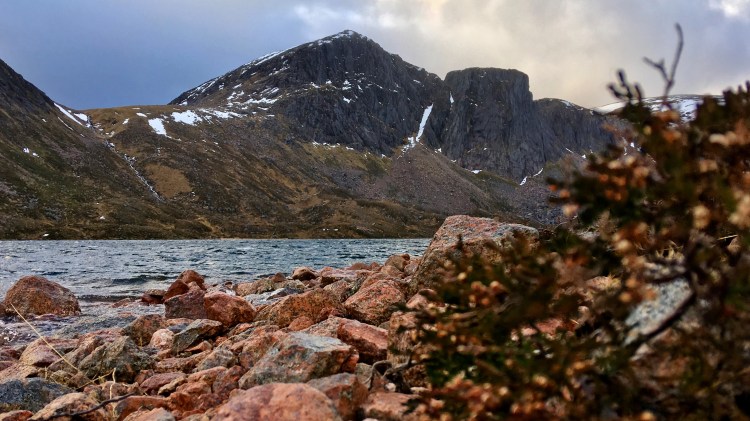
Lochside photo looking up to cragged mountain.
Goodness cragcious me.

We ran over the chossy ground that sits on the south bank of the loch, which slowly rose back up to a meeting point between several paths – one from Cairn Gorm, another to A’ Choinneach and another to the Fords of Avon refuge.

It was from this latter direction a fellow trio of runners appeared. I did not know at the time that was where they might have come from, being (once again) a little further behind the other three and missing the first bit of the conversation.

What was actually holding me back now was not anything bodily, but just an obsession with sticking my hands into rivers and heather. There’s a delight in tasting the water from the mountain, especially because it is the source of the rivers in the glens below. There you are, getting that first taste of all the water which follows – talk about a premium offering!

We left our compadres and made the winding descent into Strath Nethy. The ground didn’t allow for any rhythm to be maintained, constantly chopping and tossing you about, making foot placement tricky but keeping you on your toes. It really is top quality to have to be on the ball constantly with each footfall.

The mouth of Strath Nethy spreads wide from Meall a’Bhuachaille to Carn Bheadhair, a vast expanse of nothing spreading over 7km wide between the two hills before the rolling ground, wherein lies the River Nethy.

Peaty and heathery ground sauntered its way down the strath. It was tough going terrain, and soon it turned to shuffle mode as we headed around the Green Lochan.

The return trip is fairly straightforward: run straight past An Lochan Uaine towards Glenmore Lodge but bear left just before the bridge. This took us on, through the Scots Pines, to run parallel with the road to the Cairngorm Mountain.

As soon as we started to climb again, my legs seized up. Usually, I can easily handle 22km with over 1000m of climbing, but that day I think the combination of a rubbish start and tricky, short stride terrain meant they didn’t have that many beans left to give.

When we left the Sugarbowl in the morning, not a soul was to be found. Now, three-and-a-half hours later, we returned to something like a hero’s welcome! At least, that’s how I imagined it; it’s sometimes fun to pretend you’re at the end of some epic challenge like the Bob Graham or UTMB (Ramsay’s Round tends to be a quiet affair) when crowds gather.

Although there was no fanfare or champagne, there was a bowl of chips and a sandwich waiting at Mambo’s in Aviemore with my name on it, and a Hogmanay like no other in the evening.

Here’s to 2019 and to many more adventures!

Here’s the route!

Rounding off 2018 on a pie

IMG_8703
Breaking the lawers of physics. Photo: Sam Fisher.

2018 has been a funny year. Having taken time out of hill running (and, really, running generally) this year was my first bite of the Scottish hill racing apple, and it was as wild and amazing as I could have hoped.

The first race in May, Stuc a’Chroin was an incredible race: classic Scottish mist and drizzle, steep-steep climbs, scrambly ridges and bog. Finlay Wild was storming into the distance while us mortals slipped and slid down into Glen Ample, out of Glen Ample and back into it.

It all went to plan…until a rock decided to take a gouge out of my knee and land me in A&E. In a way, though, hospital was a minor thing; the race had been so much fun and so well supported that it didn’t even matter I had not managed to finish!

However, two weeks with five stitches just over a month before acting as a support runner in the infamous Celtman Extreme Triathlon and my first marathon was not ideal, but I do not think it had a massive effect.

IMG_8257
2018 left me in stitches 😅. Robin and I bandaged up at Stuc a’Chroin.

At the start of the year, a friend approached me with a proposal: “Do you want to be a support runner in the Celtman?”. At first I was reticent, but got in touch with the chap in question and eventually (within seconds) decided to jump aboard.

I had an opportunity to help someone realise their dream, and when I got to know Mark better I knew this event was more than just beating the course – it was a much more personal challenge.

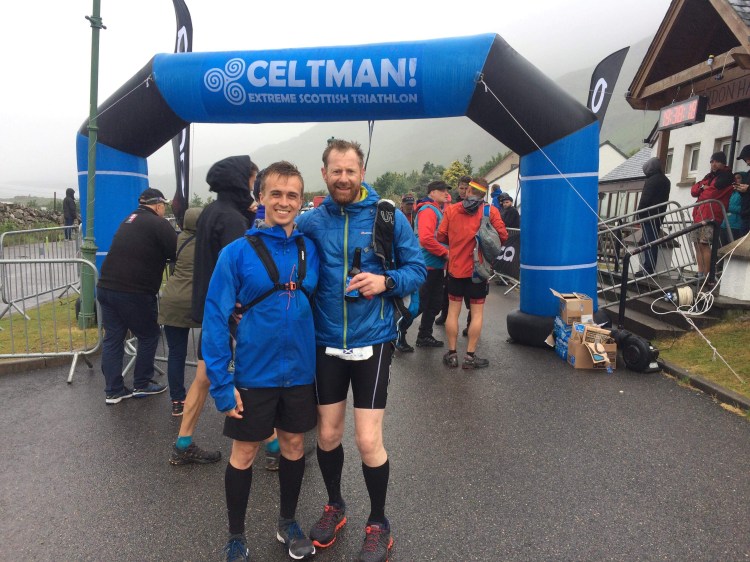
There we were – having ran through cloud, lashing rain and a persistent drizzle between the downpours – embracing at the finish line of one of the hardest triathlons in the world and grinning wildly after an incredible few hours running through the mountains of Torridon.

Celtman finish photo
The end of a journey with Mark.

There was a beautiful madness to it.

The Lairig Ghru marathon came towards the end of June, on the second day of a blistering heat wave for us in Scotland.

I should say for us in Scotland, because running in 30C might seem quite ordinary for many from warmer climes, but this was another challenge to deal with. Blisters 12 miles into a 26.7 mile race meant the day was going to be a physical and mental challenge as we entered the saucepan of heat that was found on the flanks of Ben MacDhui.

Again, despite all this, it was an amazing race. The mere act of running from Braemar to Aviemore and looking back from the finish line up to the Pools of Dee was one of the most satisfying things I have ever done.

The other most satisfying thing was getting a lift back to the start from fellow Ochil Hill Runner John and getting a chippy when we got there – absolute delight!

The cool June air that comes in the evening after a sizzling afternoon played across my battered legs, soothing the chaffing on my chest from my race pack. But more than that – I felt completely and utterly alive.

It’s strange that in those moments after the testing, your sense of life is heightened to a level of complete immersion with your surroundings. For sometimes hours you have put yourself through multiple challenges on physical, mental and emotional planes, but when it is over – that is what it is all for.

Bike standing against bealach na ba sign
Some rehab riding in the northwest.

However, the only way to reach that is through the challenge itself; the cake, the laughter, the drowsiness and buzz can only be achieved through this testing, and we reach a level of total contentedness.

After the Lairig Ghru I spent some time in the northwest of Scotland, before swinging by Fort William on another sizzling July day to run the Half Ben Nevis Race. I was carrying great form off the back of the marathon but hadn’t tested myself in a hill race since Stuc a’Chroin.

Dashing out of the playing field of Glen Nevis, it took about 500m for me to think, ‘This is going pretty well.’ Immediately ahead of me was Bob Wiseman, a neighbour and fellow Ochil Hill Runner who holds the Three Peaks record at 14 hours 36 minutes.

I knew this was going to be a fantasy position to hold on to (6th), but I kept with Wiseman right from the Nevis Inn and to the point the Youth Hostel path joined on. I let him go and settled in.

Allan Smith passed me. At the time I was not aware of who he was, but when I looked at the results later and learned more about him, I was pleased to have stayed ahead of him for just over half the climb!

A good few more passed, putting my back into about 13th, but I was consolidating; I knew my strength lay where gravity is one’s friend, so when we hit the burn turnaround I knew I had the edge. I started to soar down, overtaking two in quick succession.

Then – and I remember this so vividly – my right foot set down on a rock that was angling away from my trajectory. It slid down the flat edge, bending further to the right and I felt an electric shock fire up the side of my ankle as I almost left my foot behind as I dived down the mountain.

I thought little of it – really, I couldn’t; the taste of vomit and crippling lactic in my legs as we pounded the 1km of tarmac from the Nevis Inn to the playing fields definitely put it entirely out of my mind. Plus, a 10th place finish was more than enough to cure it temporarily.

The following days, though, it puffed up, but I just took it as a sprained ankle…which it probably was, until I decided to repeatedly run on it until I heard a horrific snap sound on Ben Lomond (coming from my ankle, of course).

38781086_10209756574264943_1642375153025286144_n
A 4am sunrise run on Ben Ledi in July. Photo: Robin Downie.

Rest, rehab, physio – easy! A few weeks spent riding my bike and in the gym and we were good to go. Right? Maybe not so fast. An attempted Glen Etive horseshoe ended with another snap.

That was it, off running again with an officially diagnosed torn peroneal tendon. Fast-forward a similar four weeks of rehab. In fact, after several weeks of very little running and a lot go gym work, the gym started to become enjoyable again.

What followed were some excellent weeks of training and some brilliant runs, culminating in a seven Munro epic with the Fellkour Squad over the Lawers hills. You’d think after snapping my ankle a few times in summer would dissuade me from anything stupid again. Well, it did…right up until I jumped off a three-meter rock and cracking my other ankle.

36709375_10215233838331820_6565990425524436992_n
The fateful day on Ben Lomond. Photo: Jordan Young.

But enough of all that! It fixed and I learned not to be an idiot on a mountain again because taking time off running is rubbish. Listen to your body and don’t jump off giant rocks if you want to have consistent training!

Last Saturday was an opportunity for redemption. For the past three years the Kirk Craig’s Christmas Cracker (KCCC) has eluded me  – what makes this all the more worthy of admonishing is it that KCCC is a family organised event!

In its first iteration in 2015, I wasn’t interested in hill running at all, and in the second year I filmed the race in a mini-documentary format (Adventure Show, I am still looking for my call).

runners going up a hill
Allan Smith just ahead on the KCCC. Photo: Mark Johnston

Last year, I did show up to the race, but as a total hill race novice had no kit with me, and as I dashed madly about the house 10 minutes before race start I realised I did not own a compass or whistle.

Finally, this year, was a chance to run the thing. The route is one I have stomped a hundred times this year in training, so I felt a little inside knowledge might help a little. The race start changed thanks to a bull being in the usual field, so we moved up the hill a little to run parallel with the field.

This meant it was a narrow, muddy start, meaning whoever was keen to win had to get up front early to come out of the tunnel in the lead. KCCC is a classic hill race: roll up at 11am, pay £5, stand in something representing an organised start line, and run off like head cases through the long grass and mud.

A friend asked: “So, where is the start line?”. “You’re looking at it”, I said, indicating the stretch of unmarked grass next to a tent.

Out of the gates I wanted to stay up at the pointy end to prevent the blockage that would occur in the mid-pack. I stayed in about 7th position through the technical single track alongside the fence – mud everywhere, hardly any secure footholds and rocks creeping under the sodden leaves.

IMG_9086
The brutal descent, but HOW MANY CHINS?

At the first martial point we made a hairpin turn up and left to start the climb. The climb is largely a hands-on-knees affair, with it pitching up significantly at points and long drags at others. About halfway up the climb I had surrendered two or three places, soon giving up a place to Angela Mudge – an overtake I have never been more honoured to be the subject of.

As we came to the last corner, Allan Smith passed me. This was it. We had come full circle: from that surprise good performance on Ben Nevis which started the ankle problems that would dog me all summer to this final race of the year back in good form, Allan and I were racing again.

We crossed the moss and made our first descent to the big boulder. Mark Baugh, another OHR member, came absolutely flying past me two-thirds of the way down. It was incredible to witness – he was flying, I mean flying!

When we turned around at the rock, though, he faltered, falling far back as I hopped back up the climb we had just descended. Having passed her on the descent, a woman in grey tights wearing a pair of orange ON shoes blasted by on the ascent. In the hall earlier I had joked she must be a triathlete.

Indeed, I had not expected to be right, nor had I expected she was, in fact, Lesley Paterson, the current XTERRA triathlon world champion. She gapped me, but I held her in view as we crossed back over the moss to the Kirk Craig’s summit again.

Now it was downhill all the way. ‘Ankles, stay straight, stay straight, please’, I was begging. ‘No more rolls, please’.

Although Lesley had disappeared now, I caught her just a few turns into the descent as we all slipped and bum-slid down sections of the steep descent. The last section to the hairpin is tricky: an off-camber, muddy single track with gorse on either side acting like magnets trying to draw you in.

In the summer time, they would absolutely succeed with their heavy aroma of coconut, but in their dried winter state they are like barbed wire to anyone unfortunate enough to become entangled in them. I could feel someone bearing down on me from behind and kept up a sharp pace back along the wall to the finish.

race sprint finish
The finish line grimace. Photo: Brian Sharp.

A feint up to the the left was an attempt to throw them off a little before diving back on the main track. They didn’t take the bait. In fact, a miscalculation put me on the lower, muddier track while he took the higher and drier line. I held on for a time, looked back and realised there was a fair distance between me and the next runner, so I put in whatever beans I had left and crossed the line in 45:49.

In the end, I finished 19th of 105 runners, making it my best (proportional) performance in a SHR race. I sat with friends in the mud, laughing at the sprint finishes and clapping as the other competitors crossed the line. We talked of the race – the people who passed us, the sections we slipped up, how it was “Aye, not bad!”.

Tom Vas – a former colleague and a good friend – and I jogged back in to Tilly Glen to stand in the freezing burn and wash the worst of the mud off our legs. It was glorious. The crisp December hill water rushed over my battered calves, delivering some sort of elixir to them.

In the registration hall, prizes were given, jokes were passed about and much pie and cake was eaten. So many pies – including macaroni pies!

2018 gave its fair share of emotional rollercoasters, but at no point ever did I think, ‘Sod this. Running in hills hurts’. If there is one thing I learned this year it is that the hill has so much to give when you’re in a pair of shorts with a bum bag, and nothing but your legs to take you where you want to go.

I have walked in hills for many years, but the wild and unshackled feeling of running through the mud, grass, rain, wind, sun and snow with minimal kit anchors you in a child-like time that many would leave behind them. To move thus is to run with the pulse of the mountains; they may be gargantuan entities which form over millions of years, but in those snapshot moments they are racing and beating with energy.

I like to stop and close my eyes to put my fingers into the crannies of the hill – feel my way into it. With blood pumping and breath rasping, it’s like a heightened awareness is achieved. And as your fingers reach into the dirt and merge with the landscape, new ways of experiencing the hill can be found there.

2018 has been my year of baptism, of stumbling to my feet; 2019 shall be the year of discovery, of searching with every part of me and having some amazing running adventures in Scotland.

More than myself and the mountains, though, everyone who I have shared this year with has made it one of the most amazing years of my life. You all know who you are, and some are featured in these photographs, but I will say again: thank you.

Larry Who? The Lairig Ghru Marathon

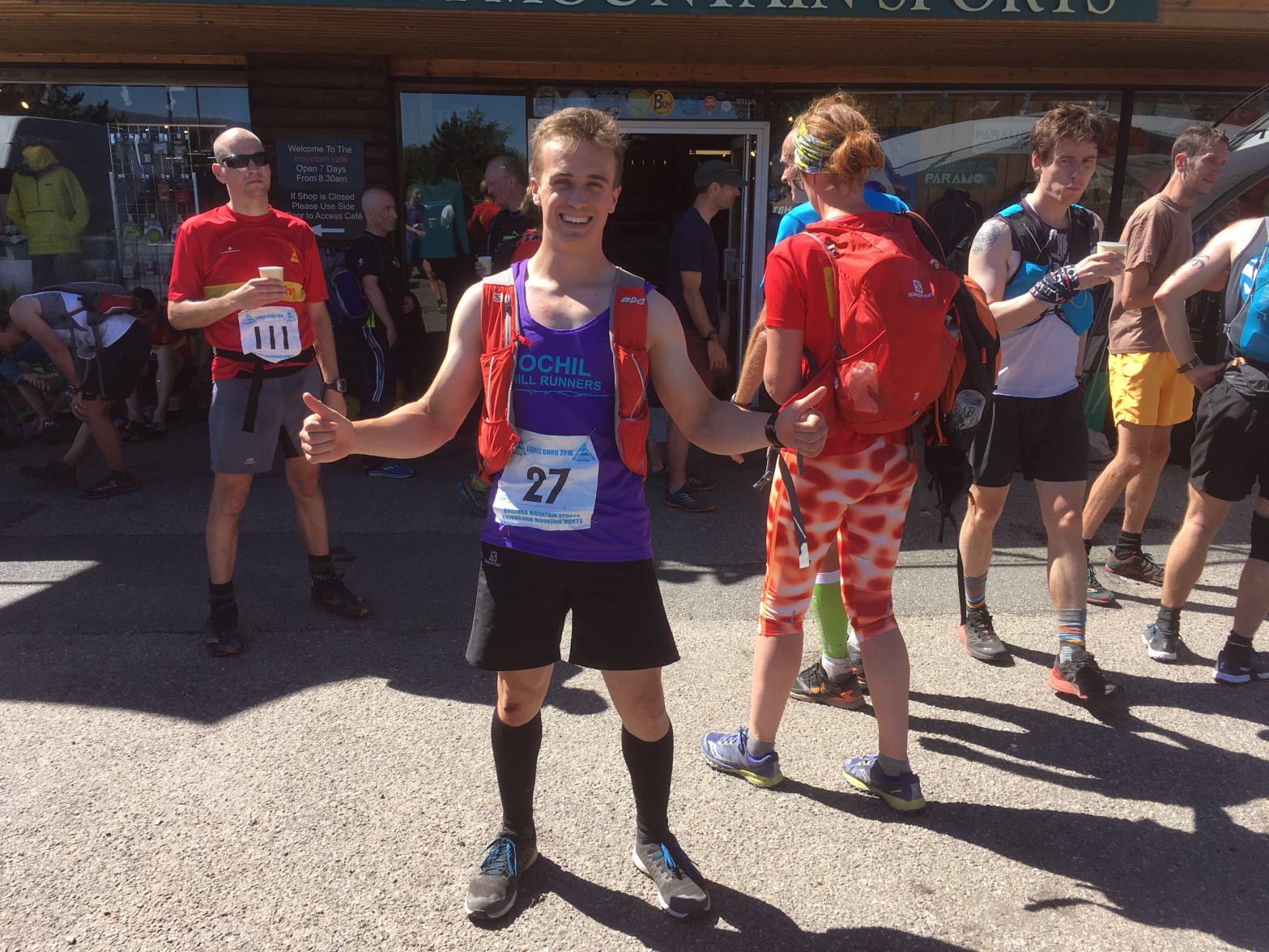
The Mountain Cafe was a perfect finish line

Aviemore and its inhabitants were basking in the heat of a June day, the start of another spell of warm weather to grace the country’s skies.

Ice-cream was becoming as popular as oxygen, with hoards surround the sweating teenager stuck behind the parlour.

“And do you want two scoops?”, they would ask the woman in front of them. “Uhm … aye why not? He probably will.” Taking the twin cone out of his hand, the woman would turn to her son to present the ice-cream.

However, as she stood up straight, she was met by an odd sight. Sprinting down the road towards her was what looked like a mad man who had just been to a rather funky disco.

Snarling, teeth bared like a wolf, clad in a purple vest and wearing a bright red pack, this chap charged towards her, making some rather uncomfortable noises as he sped past, a race number hanging loosely from his front and blood trickling from his knee.

Where had he come from? Who was he? Why was he running? And who is this man, in similar fashion, chasing after him?

In short, he had come from Braemar. To answer the second question, that guy was me- the one in front, being chased by another guy. I know, the colour co-ordination was not great, but rarely do you see a hill runner attempt to match their wardrobe too expertly. Then they might be called a road runner.

Rewind to four hours, 44 minutes and 15 seconds previously, 20.74 miles away as the crow flies, and over 200 similarly clad individuals are lining up for the start of the Lairig Ghru marathon.

The times to beat: 2:58.10, set by Murray Strain in 2017, and 3:32.38 by Lucy Colquhoun some dozen years previously.

“Number 26! Number 27!”, called the marshal. We all stood on the road opposite the town hall in Braemar. The sun was out, the skies were clear, and as our numbers were called we moved to the side of the town hall.

Camera crews from The Adventure Show filmed us as we crossed the road, I moving forward as number 27 was called. Soon, we were all stood next to the town hall, and were told to make our way to the start line.

Roll call

Think of a marathon, and you will probably imagine a big time board, timing chips, crowds, balloons, a starting horn and some semi-popular figure with a megaphone shouting, “Good luck!”, as all the competitors file out of the starting line. Not to mention the fact you have paid 40-odd quid to put yourself through this thing.

Lairig Ghru? Pay 12 bob, stand on an invisible line and get shouted at “Three, two, one – GO!”, and the local cafe owner says, “Woo!” as you hop by.

The Lairig is a famous mountain pass in Scotland, stretching from the Linn o’ Dee to Aviemore, taking in some of Scotland’s most dramatic landscapes through the Cairngorms.

It’s an extremely popular route for walkers and hikers, the latter using it as an access to the slopes of Carn Toul, Braeriach and Ben Macdui, while the former use it as a challenge in itself.

The Lairig Ghru itself is 19 miles long, so the organisers added on some seven miles to make it just over a marathon distance – 26.7 miles.

I had to joke when I was interviewed by The Advenutre Show the day before the race when they asked me: “So, it is just over a marathon, and a technical one at that, how are you feeling about it?”.

“Well”, I chortled, thinking of the guys who were starting their West Highland Way Ultra and across the pond the famous Western States 100, “being 26.7 milesmeans it is technically an ultra, so I am definitely stoked for it!”.

Later, I would catch a few finishers saying the Lairig Ghru did indeed have the feel of an ultra to it: a point-to-point race, dramatic scenery, a substantial climb, and the technicality of the Chalamain Gap.

This was my first marathon. Training had been solid, though not as rigid as the plan I had originally devised. My girlfriend and I had signed up together, but after she picked up a knee injury (for which she places the blame on my shoulders after a sprints session I had created) that plan was scuppered.

A lot of my training was just getting out and running in hills. I would, of course, look to build the distance every week, but a lot of training was just getting some vertical miles in and getting time on my feet.

The week prior to the race, I helped out at the Celtman Extreme Triathlon up in Wester Ross. Originally, Robin Downie had mentioned a fellow Celtman needed a support runner for the mountain section.

Initially I raised doubts. ‘That’s my tapering period’, I squirmed.

“I reckon it’ll just be the eight or so miles for the mountain section”, he said cheerily. Perfect. Lovely taper.

I text Mark later that week to introduce myself. A message from Mark on May 2 at 9.02am reads: “Just the run and possibly doing the full 42 k though if that’s ok.”

I did not respond until May 13.

Truth be told, I said: “Sh*t. He wants me to do the full thing.”

“Get to cross the line of Cetlman, though”, I was reminded.

I was in.

The Celtman experience is one that deserves a blog post all to itself, but safe to say I caught the bug. And a bug. Getting soaked to the skin for nearly six hours left me stuffed full, from head to toe, in a hideous cold that had be chocking and sniffing all week. Everything had gone well on the day, Mark and I crossed the line together, Mark finishing 11th of the white t-shirt winners.

No good story finishes with the words: “It was pretty sane”

Now, I had to shift a cold and get ready for the next challenge. Even on the day of the race, I was blowing into handkerchiefs and coughing like a 40-a-day smoker. It was going to be a long day.

Carbed-up and hydrated as much as possible, we hit the tarmac for the seven or so miles from Braemar to the Linn o’ Dee. Immediately, I started trying to find pace-makers – recognisable figures in the crowd I would keep in my sights as much as possible.

I wanted around four hours, preferable quicker than my uncle’s self-proclaimed ‘rather modest’ time of 4:18. Starting out on an eight minute mile, I got to Derry Lodge well ahead of the cut-off time of 90 minutes, leaving the old shooting lodge 66 minutes in.

Two miles later, and things were looking difference. I often get a blister on the arch of my right foot, but had not had it for months. Eschewing logic, I had not packed blister pads or taped my feet. Rookie error.

My feet felt like lava. Though the Inov-8 Roclite 290s are a darling pair of shoes, they can get hot. Boy were they hot.

10 miles in and I was putting my feet into any and all water I could find, slipping back in places thanks to my awkward shuffle. Meanwhile, the running vest/Salomon vest combo was giving some serious chaffing, so when I touched the skin I got no sensation from it.

Still 16 miles to go.

As you round the corner after the second notable climb of the day the stunning vista of Devil’s Point and Carn Toul emerges, with Corrour Bothy at their feet.

A Carnethy runner past me, and soon we were pacing with one another, trotting along for a solid 20 minutes without a break in pace. Soon, though, I remembered I had not drank for any of that time. Reaching down to swig a soft flask was the seconds required to take a good kick at a recumbent rock and go head first into the dirt.

Scuffing my hands and taking the skin off my knee, I waved away assistance. “Nah, it is ok!”, I said.

I had to laugh. My last race had seen me in minor injuries with five stitches after slicing my knee open on Stuc a’Chroin. When I looked down and saw no white tissue was on show, I knew we were safe today and trodded on. Now, though, it was getting hot.

As we climbed into the Chalamain Gap, everything was hot to touch, and somehow I required that right foot more than ever just as my blister squealed at me.

The Chalamain Gap is an impressive boulder field, but more impressive is its location between the sides of Braeriach and Ben Macdui. At its summit, you get a straight shot view to Aviemore – our destination.

Around the summit were several walkers with tents and sleeping bags on their rucksacks, many sat beside what I would describe as idyllic oases; beautiful pools of water that all I wanted to do was jump in, right there, right then.

But we continued.

Cresting the Gap, we had about 10 miles left. “Good man”, I said to myself, “into single figures now.”

We picked up pace as we descended, popping out in the Rothiemurchus Forest, some six miles from the finish. At this point, things were starting to hurt. It was not anything specific (apart from my foot and chaffing on my chest), just that weird feeling of your body going, “Mate, no. Just hold it. It ain’t right.”

It is funny how, in these races, you do find your group. Several of us were playing cat and mouse with each other most of the day, and we always stayed within earshot of one another. It then became my mission to finish ahead of them.

Everyone says the forest is the hardest bit of the race. They do not lie. The four or so miles in there are the longest four miles you will ever do. It is just a relentless, never-ending plod to Coylumbridge.

At the end of it, I rasped to a woman who held out water: “Do you have Lucozade?”. I knew she did; I had spotted some the second I got there like a dog to a bone. Throwing some in a cup, she passed it to me. Seconds later, I was gone, having downed it and started up again.

It was like the kiss of life. ‘This is it’, I thought, ‘the road. Last bit. Last push.’

George Foster (Keswick AC) coming in hot to take the win. Photo: John MacEwan

Past the hotel, past the mountain rescue hut, ahead was a final water station and there, right there, were all those guys I wanted to beat, crowded around it.

Water with just a mile to go? No way! I scooted past – come on, I was hardly battling for contention but any victory counts, right?

Passing the Old Bridge Inn, I passed another, before heading below the railway bridge.

It is rather odd. Four-and-a-half hours before, I had left the streets of Braemar. Here I was, running hell for leather down the pavements of Aviemore, holiday-makers watching me bemusedly as I groaned past them, running as hard as I could to the Mountain Cafe.

I blew past the ice-cream parlour, a woman starting at me while her son licked a twin cone ice-cream. He is lucky I did not just pull it out his hand and stuff it in my mouth, but the prospect of being ‘nearly there’ was too great for delay.

There! A woman in a high-viz waved at me across the street. The end is nigh!

I like to think it was a sprint finish. Not really. My legs were not moving particularly fast, there was much more arm involvement – like throwing myself forwards.

Crossing the line, I thought of the guys doing the West Highland Way, Mark doing it the week after Celtman. And of the guys doing Western States 100. How did they do it? I would have to run back to Braemar, back to Aviemore, and then back to Braemar again to do what they were doing.

The year’s winning time was 20 minutes down on Strain’s, the heat taking its toll on a lot of competitors.

The first marathon is done. The next? Let us see. I finished 71st out of 214 athletes with a time of 4:44. 4:18 is still out there. Next year? For sure.

Stay tuned for news on that and other hill race reports.

Special thanks to John MacEwan (fellow OHR runner) who sadly pulled out due to Achilles issues, but assisted with transport and some loose change for a well-earned chippy.