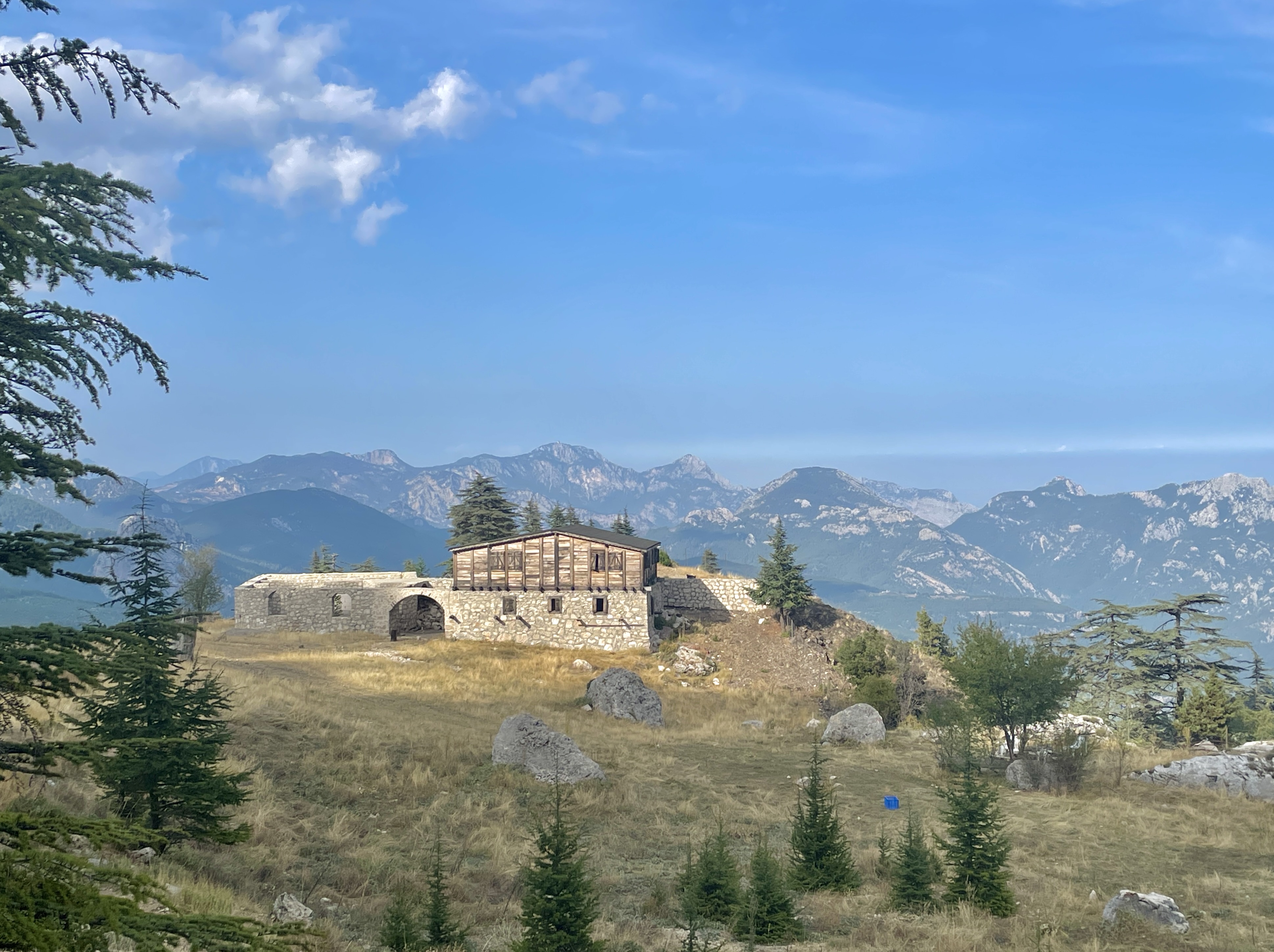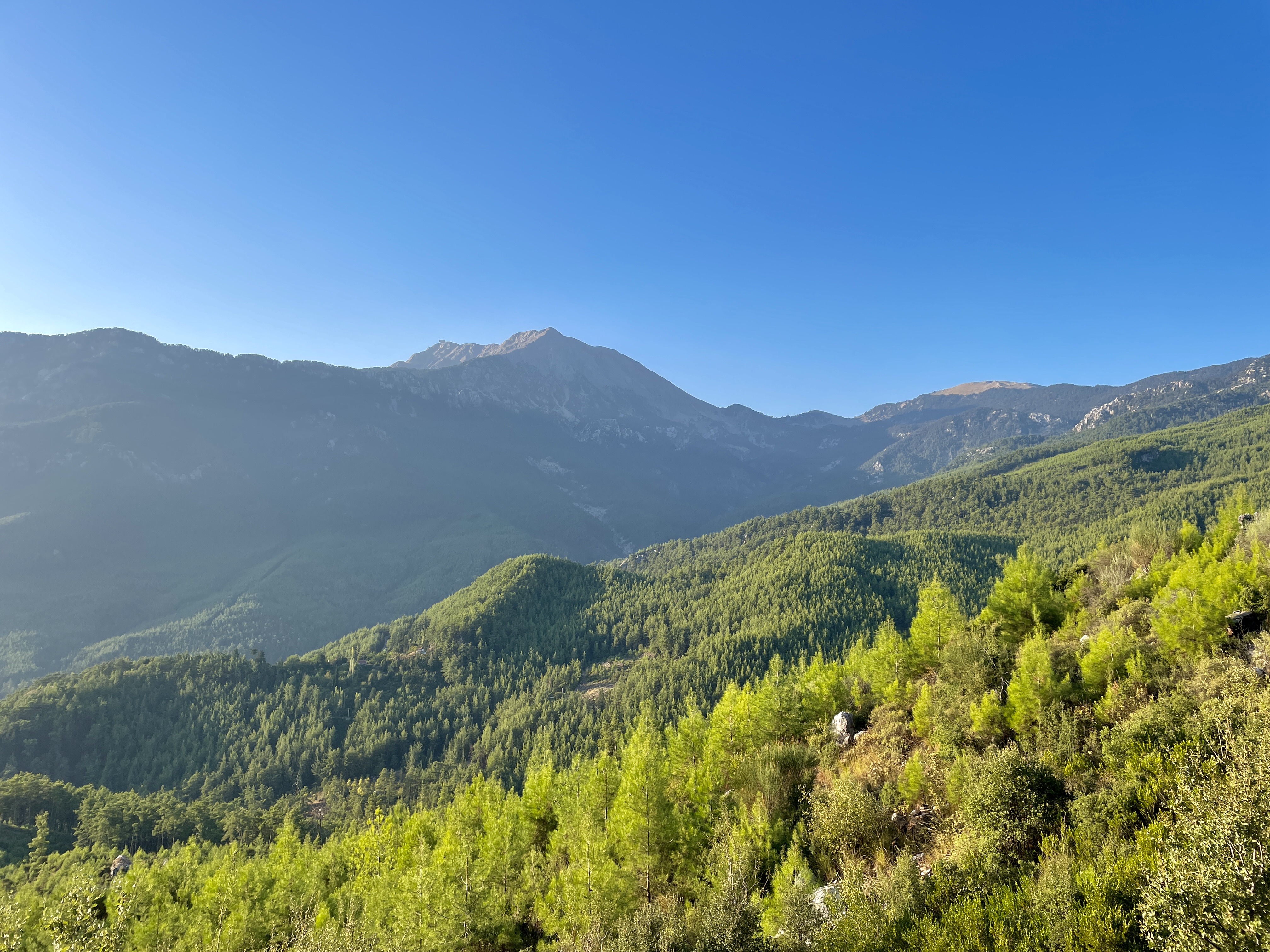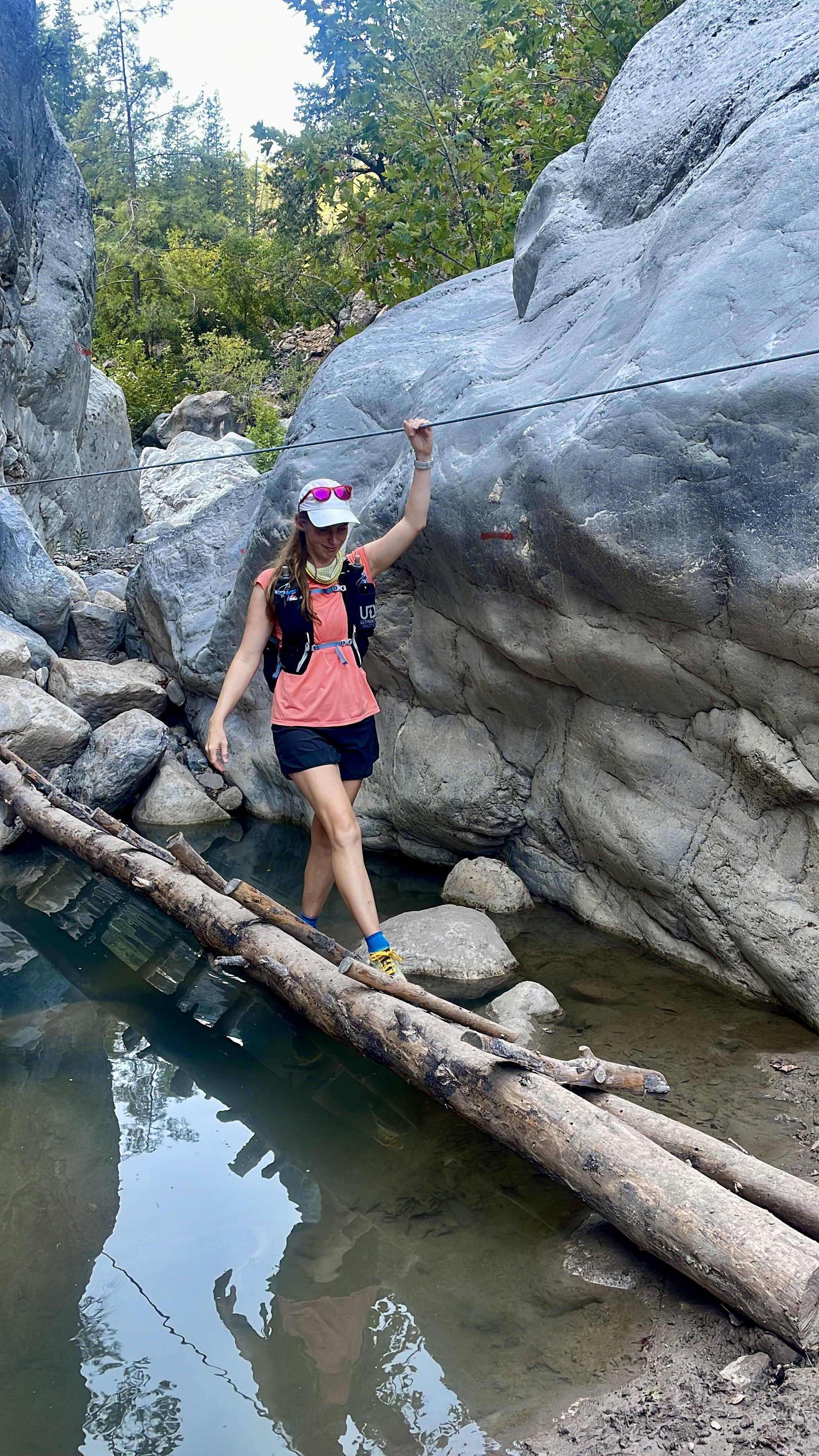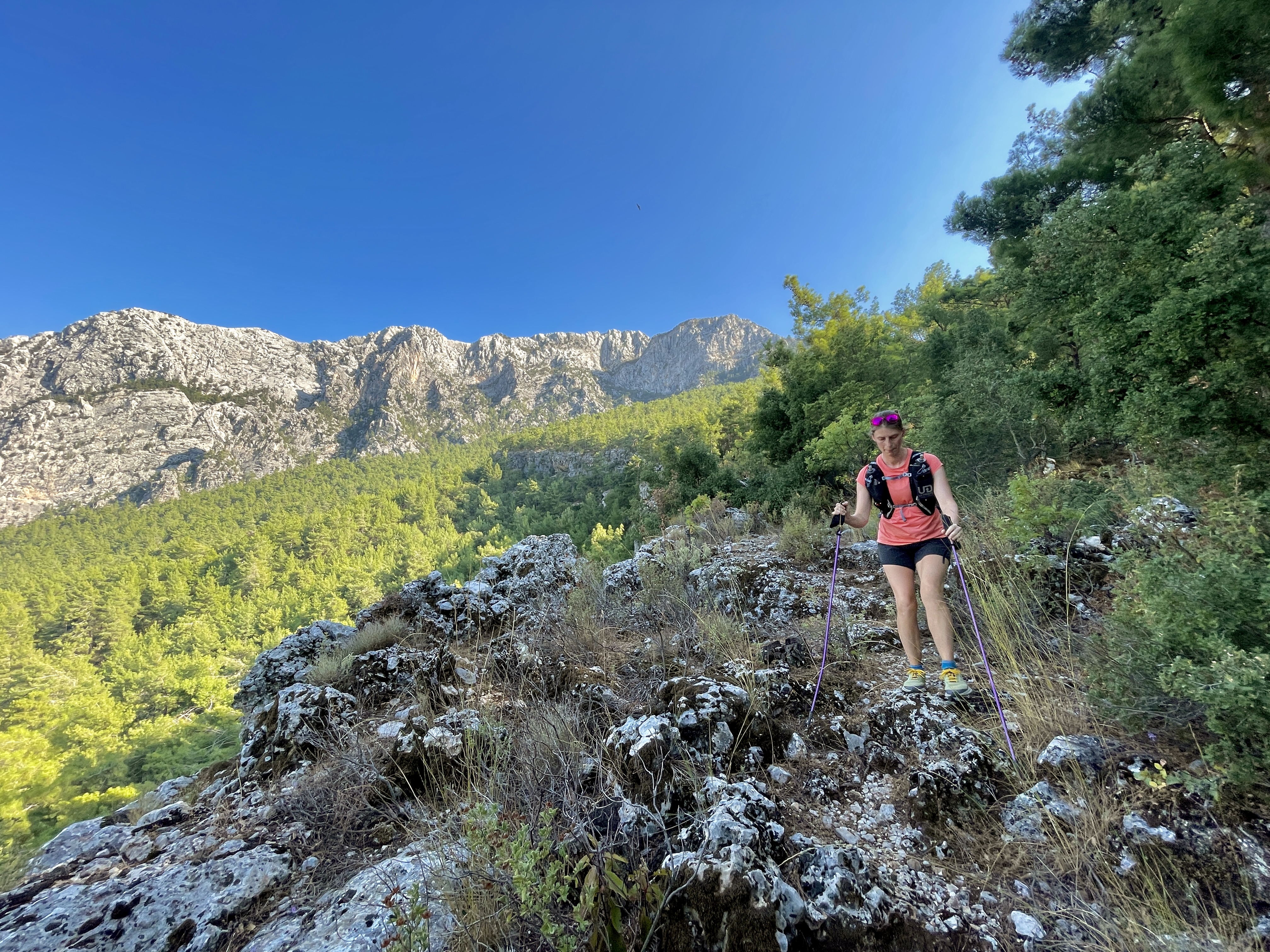
Importing your campervan to Switzerland – our experience

As you might know from my previous posts on here, we spent much of 2024 living in our van before a rather unexpected move to Switzerland right at the end.

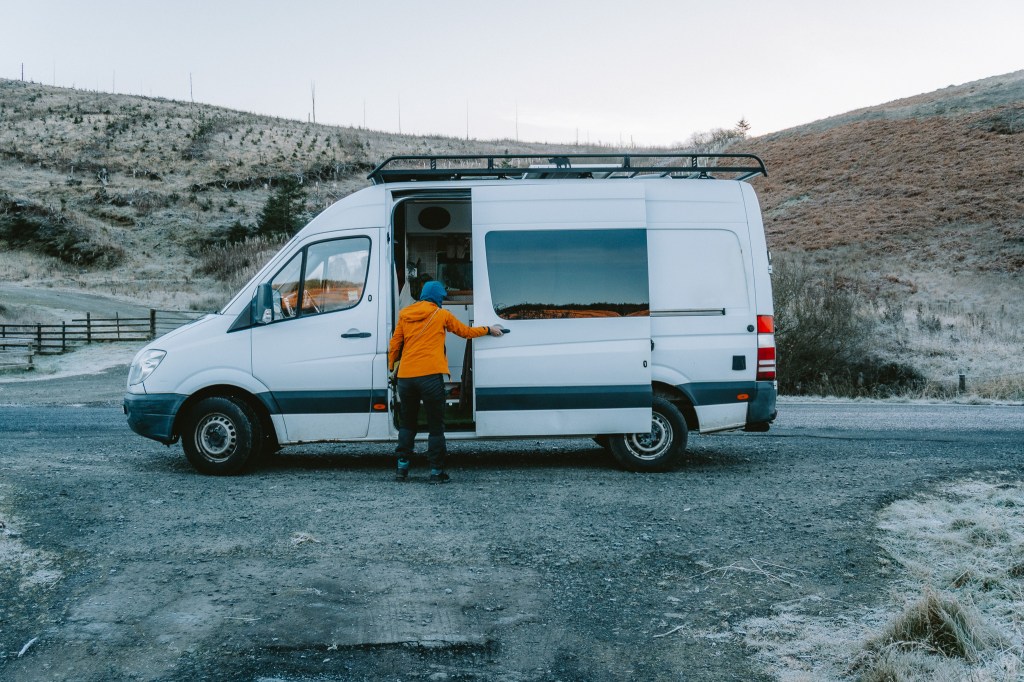
For a while, we weren’t sure whether we would keep Ziggy – our trusty home on wheels – long-term in Switzerland. After all, he’s 2.7m tall meaning it’s impossible to fit into underground car parks, and manoeuvring a large van around a city and over mountain passes isn’t exactly convenient.
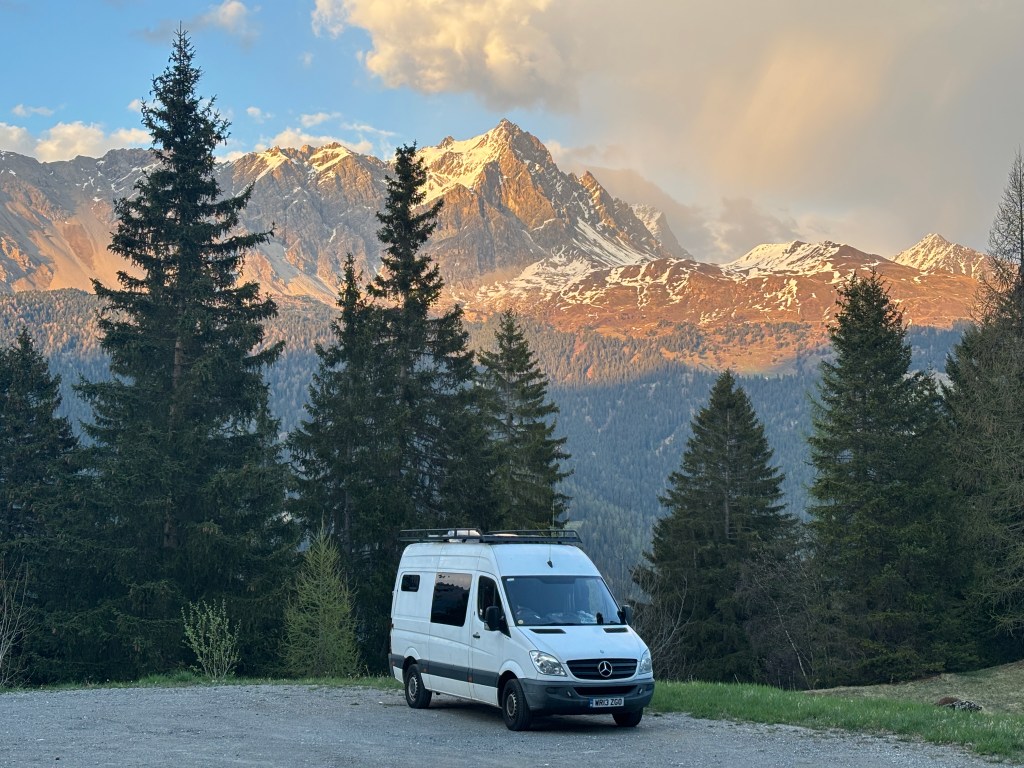
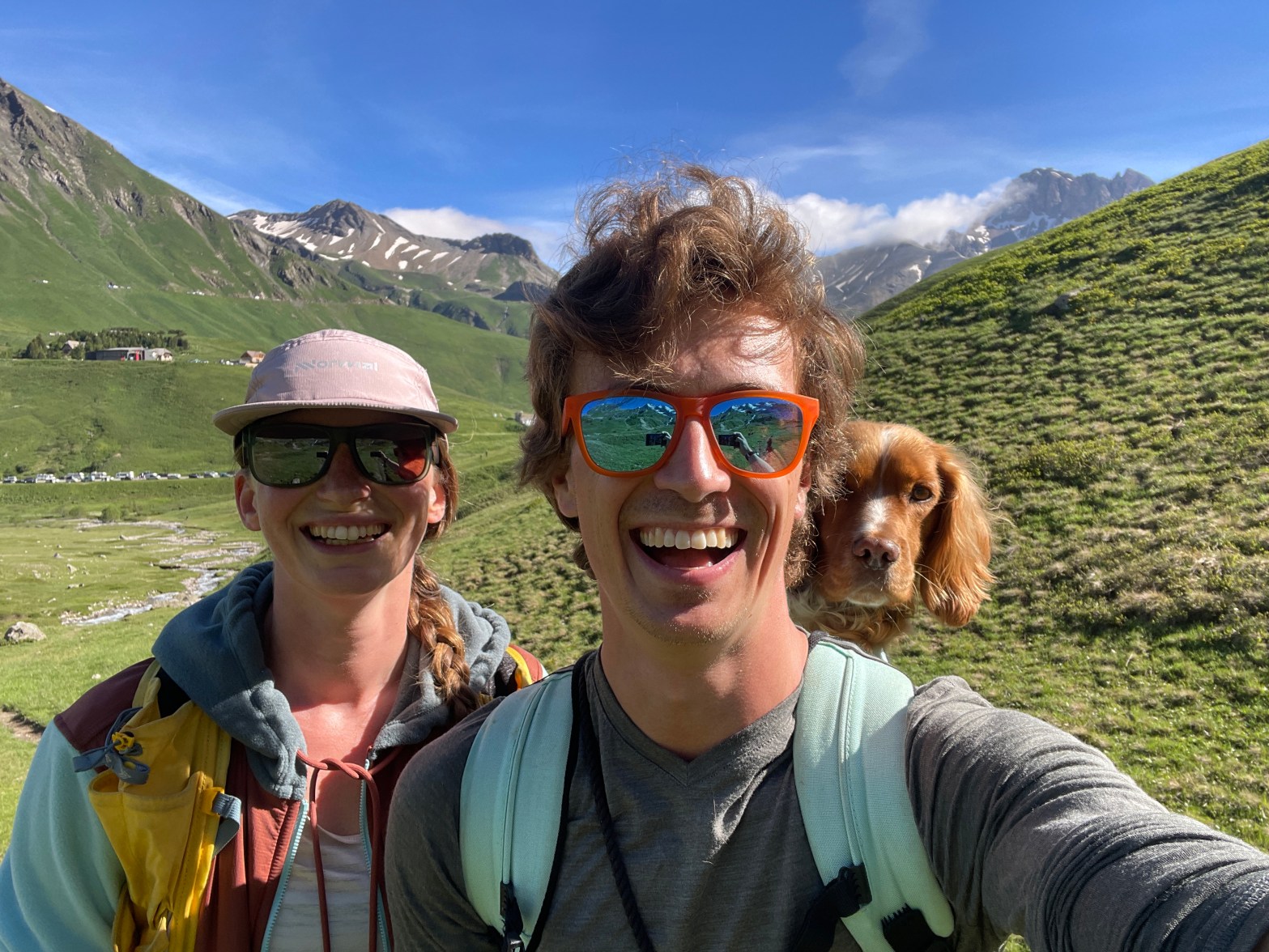
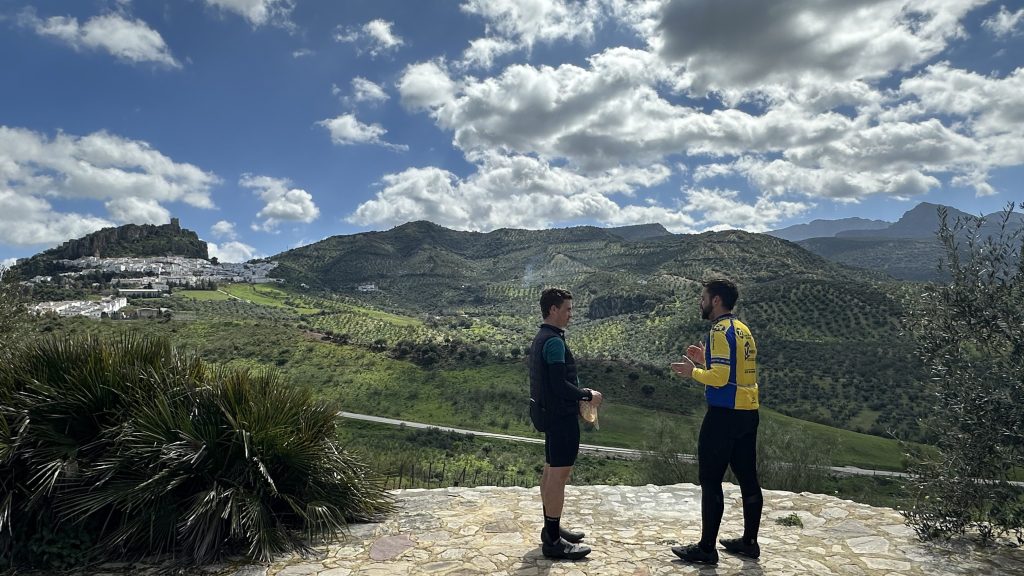
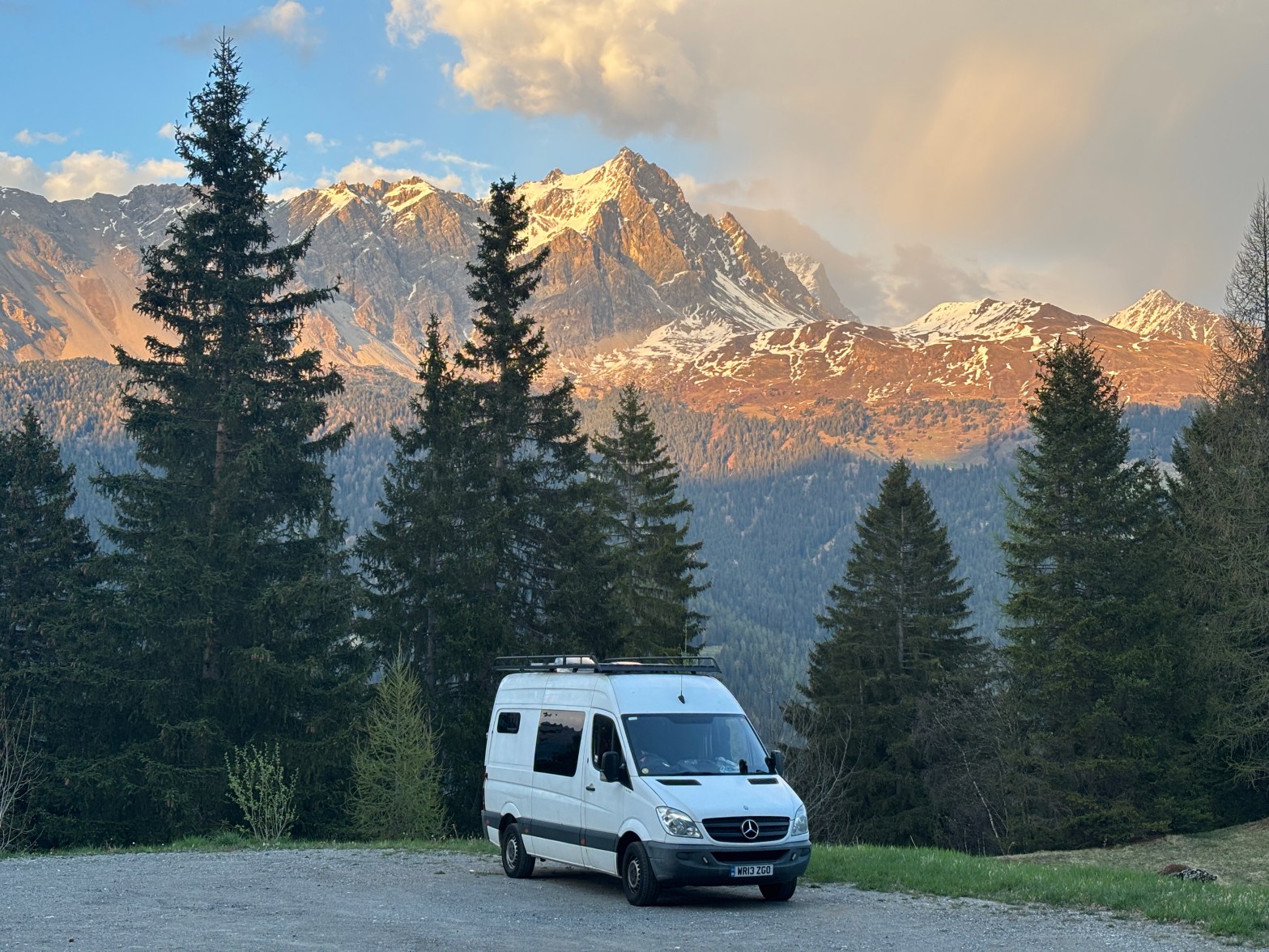
Ziggy near Lenzerheide

We looked into buying a new van in Switzerland, but found that for about double the price of Ziggy we could buy a van that was about half as good. In the end it was that, plus a heavy amount of sentimentalism, that resulted in us deciding to import Ziggy to Switzerland.

We received our Swiss license plates just last week after what felt like a mission to the moon and back, so I felt that now was a great time to write a blog on how you could import your van to Switzerland, too!

Disclaimer and first steps

Before I get started, I want to just clarify the scope of this blog:

  1. Every canton in Switzerland has slightly different rules and the MFK (similar to an MOT in the UK, a periodic inspection of your vehicle for road worthiness) varies in requirements between cantons. We live in Zurich, so I can tell you how that works.
  2. This blog is probably most helpful for those trying to import their van from the UK. I can’t say exactly what the rules are for other countries. For UK vans, you must have your headlamps switched for driving on the right-hand side of the road. This cost us almost 800 francs (CHF).
  3. We own a Mercedes-Benz Sprinter MWB van, registered in 2013. We don’t have an underslung LPG gas system. We have two acid leisure batteries, solar panel, AC and DC electrics, fridge, and so on. If you have an underslung LPG gas system, I would strongly recommend getting paperwork that confirms it was installed professionally.
  4. Before you even start down the road of importing your van, make sure you have a Certificate of Conformity (COC). In the UK, we rarely ever get these with our vehicles. A COC from EU/EEA is absolutely essential if you want to import your vehicle. If you wait to order one when you are already in Switzerland, you’ll pay at least 400 CHF for the pleasure.
  5. Generally, make sure you have all the paperwork (including the COC) available. That includes your V5C (“proof” of ownership), plus ideally a proof of purchase. The Swiss love their paperwork, so consider it a gift.

The process in a nutshell

  1. Own your vehicle for at least 6 months before importing it to Switzerland. If you buy a van and attempt to import it before this time, you’ll be taxed on it. If you’ve owned it for longer than 6 months, you’re all good!
  2. Go to the border and officially import your van within a year of moving to Switzerland. You will need various documents to prove you are moving to Switzerland, plus a completed 18.44 form. In return, you’ll receive form 13.20A at a cost of 20 CHF from the border control.
  3. Apply for insurance. This is usually done by contacting an insurance company like Zurich Insurance or Allianz. This is essentially the insurance company confirming they’d insure you, which they then pass on to the Road Traffic Office. You don’t actually take out insurance yet. It’s a good idea to get insurance as a “light motorhome” (as we are), which is cheaper than “van”.
  4. Apply for an inspection at your local Road Traffic Office immediately after confirming your insurance. Get every bit of paperwork you feel is necessary, especially: COC, proof of ownership, paperwork for any modifications (wheels, tow bar, LPG systems). You’re usually given a date a month or two away, but you can phone the traffic office between 7am and 7.15am to get a same-day appointment.
  5. Buy license plate holders. These can be as cheap as 15 CHF at a Jumbo, or as expensive as 90 CHF if you’re so inclined.
  6. Pass your test, get your plates! Or don’t pass your test, get the necessary repairs (addressing any “mängels”) and retake the test. The first test is 160 CHF in Zurich, and any 30-minute follow-up tests are 80 CHF. Once you pass, you get a month of insurance from the city.
  7. Purchase insurance and pay road tax. Insurance is around 600 CHF and tax is dependent on the vehicle size.

Sounds simple, right? Well, it is and it isn’t.

Budget

If you are importing your van from the UK, here’s what you should expect to pay:

  • Switching of headlamps: Around 900 CHF
  • Labour for switching headlamps: 200 CHF minimum
  • Administration costs: 20 CHF
  • Inspection costs: Starting at 160 CHF
  • License plate holders: Starting at 20 CHF
  • Insurance: Around 500 CHF depending on your situation
  • Road tax: At least 1000 CHF
  • Additional repairs to meet Swiss inspection standards: Potentially infinite.

Total estimate: 2800-3000 CHF

Our experience

As I said, we really dithered on importing our van. We made our mind up in April 2025 that we were going to import it and it wasn’t until September 2025 that we actually received our plates.

One of the big things that stymied our initial plan to import the van was a lot of scare stories online about how problematic it can be to import a campervan. We’d heard of people needing to get specific certifications for gas and electric, that they were blocked because of having a bed or a fridge, and any number of other excuses you could imagine the Swiss authorities giving.

In the end, we needn’t have worried because that never became a problem. But we did have a few other hiccups along the way.

Part One: Importing

As I said, we weren’t sure whether we were going to import our van when we initially moved, so we didn’t include it in our first 18.44 form when we moved to Switzerland. Technically you are supposed to declare the vehicle “when the vehicle first crosses the border”. Unless you get a very pedantic customs official, this doesn’t really matter, but you shouldn’t leave it too long.

In April 2025, we filled in our 18.44 form and drove to Koblenz on the German border to get our official stamps. Note: Only main border crossings have these customs offices, and you need to go there when they are open. The customs official is unlikely to need to see inside your van.

They will want to see:

  • Proof of ownership (V5C logbook, purchase receipt, etc.)
  • Proof of residence in Switzerland (if you’re importing at the same time as you are moving, then a tenancy agreement or work contract will suffice, but otherwise a resident’s permit works)
  • Completed form 18.44
  • Identification documents

They will scan everything and generate a stammnummer. This number is very important, as it connects your case and your vehicle to you. You’ll have to quote it in every subsequent conversation about your van.

They’ll hand you form 13.20 at a cost of 20 CHF. You have to keep a hold of this document and should have it to hand in case the police pull you over for whatever reason.

Congrats! You’ve made it through step one.

Part Two: The inspection process

We did dilly-dally at this point. Ziggy had taken us 10,000 miles around Europe, and his previous owners had done even more than that. This meant he was carrying some war wounds: Cracked reflectors, broken indicator housing on the wing mirrors, large rust patches. Wear and tear.

The key thing to know is that the Swiss are very scrupulous when it comes to vehicle condition – way more so than in the UK. If you are planning to import your van, I strongly recommend getting everything done in the UK beforehand. Labour costs in Switzerland are astronomical, sometimes 200 CHF per hour.

For that reason, we procrastinated for a while until we realised we absolutely had to sort out our inspection. There isn’t really a time expectation from when you import, but you really shouldn’t wait too long.

Once we had a proof of insurance, I went to the Zurich Road Traffic Office site to apply for an MFK – a vehicle inspection. For that, you will need:

  • Your COC document
  • Proof of ownership
  • Proof of residence
  • Paperwork detailing any substantial modifications (e.g. wheels, tow bar, LPG)
  • Stammnummer
  • Any other relevant documents

It’s a faffy process. Because we didn’t have paperwork for our tow bar, we had it removed. The RTO will post you an invitation to attend an inspection. This is usually quite far into the future and is probably done to give you time to prepare the vehicle. As I said before, you can call them between 7am and 7.15am and get a same-day appointment.

We had a lot to fix on our van, so we went to the UK for the repairs. We just asked a UK garage to carry out a service and an MOT and fix any and all advisories.

We also asked them to clean the engine area. The crazy thing about the MFK is that you need to get the vehicle into pristine condition: Inside, outside, and underneath. If it’s not, you will be sent home.

Once we’d repaired all the rust, replaced all our tyres, removed the tow bar, and fixed every other little thing necessary, we felt fairly confident about our inspection.

The inspection is a stressful process. They check absolutely everything. There are three outcomes possible from the MFK inspection:

  1. No issues – straight pass
  2. Minor fail – you’re handed a list of required repairs, you go to a garage, your mechanic tells the RTO the repairs have been addressed, you pass without an additional MFK
  3. Fail – you’re given a list of repairs, you go to your garage to have them fixed, you come back for another short test

We failed with several mängels that required a re-test, the biggest one being our headlamps. Foolishly, we thought it would be as simple as tweaking the bulbs. Oh, how wrong we were. You will have to change the entire front light system to be fit for the right-hand side of the road. These are expensive! If you have a nice garage, they’ll work hard to find a cheaper set, but generally expect to pay up to 450 CHF for each one.

One thing they didn’t ask for was certifications on electrics, windows, fans, swivel chair, or anything inside the campervan. However, I have heard some cantons do request specific paperwork for these things, Aargau being one of them.

We went back a week later and passed! Hurrah!

Phase Three: Becoming Swiss

Once you pass your MFK (big congratulations, by the way), you’ll be sent to another part of the RTO to receive your new plates.

If you are so inclined and feel you haven’t spent enough money already, you can splash out on a snazzy number plate. Don’t get too excited, though. In the UK, you can personalise your registration plate to your heart’s content, whilst in Switzerland you just get to choose a bunch of numbers. For 299’000 CHF, a guy bought “ZH 24” in 2024. You can be the judge of whether that was worth it.

Either way, you’ll be handed your shiny new metal plates and asked to hand in your old plastic UK plates. The RTO will also tell the DVLA that you’ve permanently imported your vehicle.

You’ll go to your car, unscrew your old plates, hand them in, and then realise you have no way of putting your new plates on because they don’t have screw holes.

Then you’ll learn you have another side quest to complete because the Swiss use specific click-in holders. Hopefully, you’ve read the list above chronologically and bought them already. We didn’t. You can put your plates in the window initially, but go to Jumbo and buy yourself some license plate holders.

Click your plates in – and hit the road!

After passing your test, you’ll have a month of free insurance from the city, but you should finalise your insurance as soon as possible. You’ll also be sent your road tax bill, which in Zurich is based on your engine size and the weight of the vehicle. You can find out how much you’ll pay here.

And, once you’ve done all that, it’s probably time to hand in your UK driver’s license. You need to do this within a year. It’s straightforward enough, just:

  • Fill in the form on this website
  • Get an eye test – this is very easy to do at McOptic
  • Get a passport photo taken – did I mention that Swiss passport photos have specific dimensions?
  • Hand your completed form in to the Stadthaus or the RTO

Your UK license will be sent back to the UK and you’ll receive a temporary paper version while you await for the arrival of your shiny Swiss license.

Ready to go?

Hopefully this blog has been helpful if you’re considering importing your van from the UK into Switzerland. You might not get everything quite right, but hopefully this blog will save you from making any expensive mistakes.

Putting those license plates on will feel like an enormous achievement, and you’ll draw fresh bewilderment from fellow drivers who see you driving on the right-hand side of the vehicle while sporting snazzy Swiss license plates.

If you have questions, feel free to reach out – but otherwise, good luck!
What’s happening to brand storytelling?

I am now on Substack! For the time being, I will be posting both here and on Substack, but willl like be posting a little more over there so feel free to subscribe!
Marketing is no longer about the products you sell, but the stories you tell

– Seth Godin

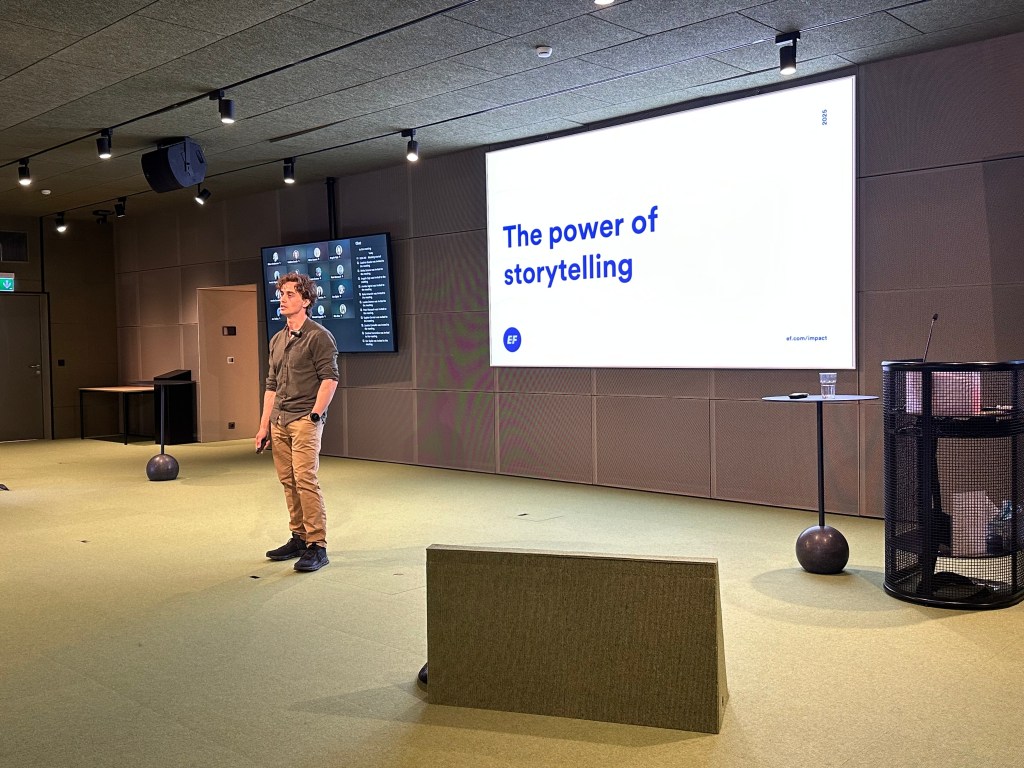
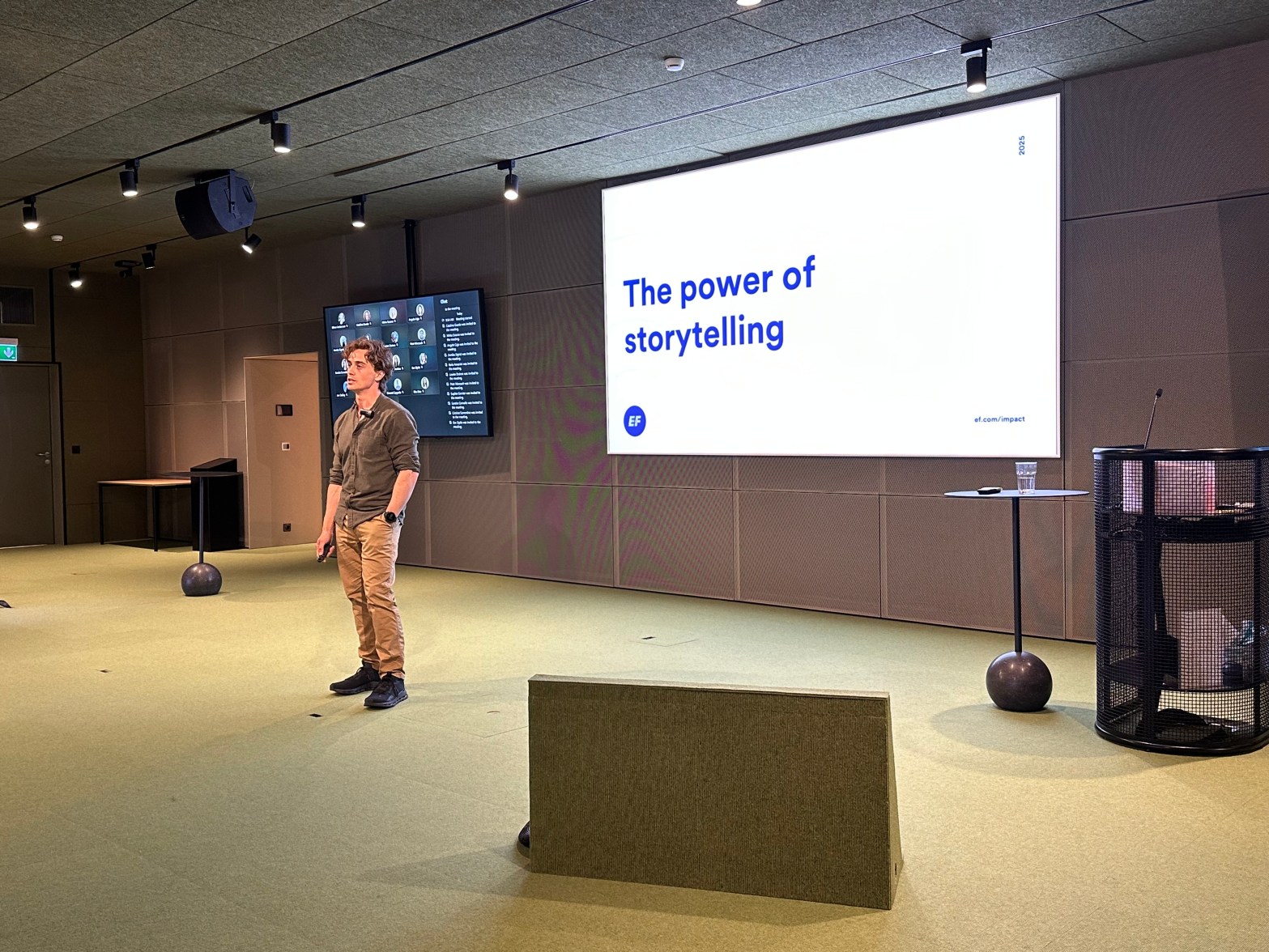
I used this quote yesterday in a talk I gave at work. For context, I work as a content writer and editor for EF Education First, managing their impact website.

My talk was centred on the idea that storytelling is more important now than ever – in fact, I’d go as far as to say it always has been important, we just keep forgetting that it is.

I am extremely privileged in my job that it is my responsibility to find, research, and tell incredibly moving stories about the work of EF. Yes, EF is a profit-driven company, but – as I said to my audience – I believe what it is doing is extremely powerful and pertinent in today’s world: That the world is a better place when we seek to understand each other.

It’s a powerful, impactful belief, one that transcends bottom lines to become a global message of intent; a railing against the current trend of entrenchment and protectionism we are seeing the world over.

As I took my audience with me towards my thesis that stories are crucial in spreading this message of EF’s impact, I saw many of them nodding along at my points on diversity, creativity, and storytelling.

Speaking to a few of them afterwards, I learned many of them don’t work in marketing, communications, or brand. Many of them came along simply because the title – “the power of storytelling” – resonated with them due of their love of stories.

Stories are in our DNA

One of the big messages in my talk was that stories are utterly intrinsic to us as a species. Stories are some of the oldest and most memorable forms of communication available to us. We can all recite the old stories we learned as kids (The Boy Who Cried Wold, Little Red Riding Hood, etc.), and that’s because they lodge themselves in our memory.

They’re part of who we are. All the way from campfire stories to TikTok videos which – albeit they are a facsimile for genuine storytelling – are often human-centred stories, and take a heck of a lot of work to do right.

As I prepared for my talk, I voraciously consumed presentations, videos, and articles on the rising trend of brand storytelling.

Everywhere I looked I was repeatedly told that people want to connect with brands at a deep level. While, yes, what a brand does and how it’s products stack up to its competitors is still a big decider in what we purchase (more on that later), we actually look for brands that say something about who we are – about what we believe.

According to the World Economic Forum, 70% of people buy from brands that align to their values. This isn’t news to many, but it’s what turns us from simply a laptop user into a Mac user; what turns us from a Nike person into an Adidas person; what turns us from fast fashion into a Patagonia wearer.

Patagonia, in particular, has planted its flag firmly in this territory, to the extent they are reducing the visibility of their logo on some of their products in what I believe is an attempt to prevent people buying purely for the status. Instead, in their products, in their marketing, in their positioning, they are sticking true to their brand.

And by goodness are they good at telling stories that reflect that.

The force-fed consumer

This all sounds wonderful to me. I’m a storyteller, and you’re telling me that more and more people are looking for brands that are values-based, and that more brands are putting money into storytelling? Hurra!
Then I think about AI…and I get confused.

Last week, Mark Zuckerberg (sorry) stated that Meta could start producing AI-driven advertising content for businesses. Some of this isn’t news: Meta’s algorithm has been customising ad content for years by determining which combination of copy and imagery yields greatest results.

But the actual outsourcing of the creative process to AI is a slippery slope. I don’t think many large businesses will want to lose control of their brand in such a way, but I can’t help feel like the foundations are already compromised.

I read a blog that the reason many brands are doing this is to “keep up with the demand for content”. When I hear that statement, several big questions come to mind:

  1. What measurement are you using to determine this?
  2. If it’s true, what kind of content are people actually looking for?
  3. Is this less about consumer desire, and more about business desire for profit?

For me, hearing people like Mark suggest that we are all dying for more content makes my stomach curdle. I hate to use this analogy, but it puts me in mind of animals being force-fed before being sent to slaughter.

Except, on this occasion, it’s us being force-fed a bunch of low-nutrient, fast-food content before we’re packaged up and sent to the checkout to buy the next item we don’t need.

Perhaps the writing has been on the wall since the dawn of capitalism – and the consumer. And, sadly, capitalism itself has turned many of us into output-oriented consumers as opposed to process-oriented humans; where they creation of what we consume matters very little to us.

What next?

This leaves us with a bit of a head-scratching situation. On the one hand, data shows we want brands that walk the walk and don’t just talk the talk, and that we can see human-centred stories are something we crave. On the other, we are seeing more executives saying to “keep up with content demands” they are outsourcing creativity to robots.

I am not a complete anti-AI individual. I believe it has some advantages. However, I do not believe we are all on the hunt for the cheapest, lowest-nutrient content out their to fill our insatiable desires.

Attention spans may be small, but we still see films over two hours long topping the billboards. We still see story-centred brands like Patagonia soaring. We still see brands like Adidas, and On pouring millions into genuine storytelling.

I don’t see a world where a brand outsourcing its stories to a machine can say anything about who we are, or what it means to be human. It’s the antithesis of that.

That just leaves me to say that I want this story to end with the hero – human-centred stories – the victor. And I believe we should be celebrating brands sticking to that belief. Yes, AI might have a hand in their creation – perhaps in ideation, automating some repetitive tasks – but that, in the end, they are stories that only humans could create.

And if I am wrong, I don’t believe human-centred brand storytelling will go anywhere. Perhaps, just as with the hospitality industry, we may see a separation of fast-food AI content, and beautiful Michelin star storytelling.

What you need to remember

If there’s anything I want you to take away from this, it is this:

You are in the wonderfully privileged position to choose what you consume. Mournfully, a cow in a battery farm does not have that choice. It’s life is already determined.

Yours is not. You can decide to eat AI slop, or you can seek out green fields of genuine storytelling. Where you find content that is AI-generated drivel, turn your back; when you see stories that light up your imagination, praise them.

We are still consumers. Right now, the capitalist machine wants our money either way – an issue I feel is almost far too complex to try to unpack here. However, Big Tech believes we want more content, but I’d encourage you to remember you are in the driving seat here.

So, go out and tell a story.

Hefted

Hefted isn’t a phrase you’ll find many places outside of the Lake District in Northern England. The meaning speaks to a culture endemic to that little corner of the world, and a tradition passed down through generations of farmers.

Hefted is used to describe a system of farming where sheep are left to roam freely across the fells (hills) without physical barriers. While it is a practice, however, it is also a description: To say the flock is hefted to the land is to convey how they are rooted in this land, they know their way around its ghylls and dales without the need to be shepherded, and they pass that knowledge to their lambs.

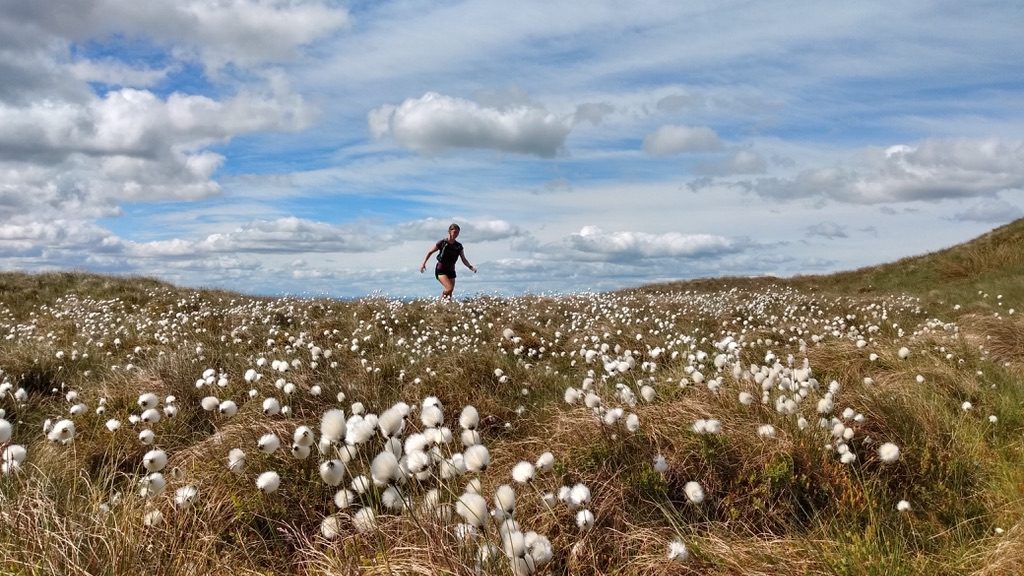
Summer in the Ochils when the bog cotton replaces the sheep as the fluffiest things on the hills

It’s similar to the way a swallow will return to the same rafter year after year, despite spending its winters in the warm climes of southern Spain or Africa. When they are released from their pens, Lakeland sheep are drawn back to their corner of the fells where they will graze unbridled until needed.

***

Friendships of the hills

This word played in my head on a run back in my home hills in February. Not since before Bo and I set off on our van trip have I returned to run in the Ochil Hills in Scotland. One brief visit between van life and Swiss life did not afford the opportunity for me to don my shoes and run through the tussocks of these grassy bumps – but this time I went back with intention.

Tom on the initial climb from the valley floor

I was back on this occasion for a surprise visit for my grandfather’s 90th birthday (yes, you read that right). I made plans with long-time friend, Tom, to scale our favourite hills again on one of our beloved routes.

My friendship with Tom is born from a love of the hills. We met working together at Run4It, a retail chain in Scotland, and spent hours together talking about running: him, usually extolling the virtues of barefoot running; me, nodding along patiently while fitting a pair of high-stacked shoes to another customer wanting to ‘correct’ their ‘over’-pronation.

Since then we have been on many a bothy trip and run together, dozens in the Ochil Hills. He now lives 100m from the start of one of our favourite routes (about 100m closer than my parents do), and so we set off up the first unrelenting gradients towards the humpbacked summit of King’s Seat.

***

Looking down from Andrew Gannel several years ago

First forays

Growing up at the foot of the Ochils was a blessing. They were formative hills for me, and featured in almost every weekend growing up. When the snow was too thick to be climbing Munros in the winter, my parents would take my brother and me up into the Ochils, climbing hills with names like The Law, Andrew Gannel, King’s Seat, Innerdownie, Ben Cleuch, White Whisp, and countless others.

Their soft, grassy edges bely their challenging gradients, especially those that plunge vertiginously to the Forth Valley. From the front door of my parents to the summit of Kirk Craigs – a distance of just 2km – you can expect to climb almost 400m. As a youngster, this climb chewed me up, and was the trial to reap the rewards of finding yourself alone among the hills that rise up in all directions. As an adult, it still chews me up, I just get up a little quicker.

***

Friends and hills – a key feature of the Ochils for me

A gale and a piece

Tom and I choose the more gradual ascent up Kirk Craigs, a steady climb from his house, past the Big Boulder (that marks the turnaround point for the annual Kirk Craigs Christmas Cracker race that my uncle organises) and towards King’s Seat. We wind our way up through the gorse – bereft of its coconut perfume this early in the year – and the brown bracken stalks. In summer, the bracken creates a microclimate I can only imagine equates to that of the Amazon rainforest: Humid, hot, sweaty. Today, however, we only have a wintry breeze to contend with – and a steep climb.

As we crest the top of the steepest part of the climb, the Ochil Hills rise around us and the wind whips across the tussocks and rushes. Normally, skylarks would explode in a siren of chirruping, rising above you until you become dizzy watching them. Today they’re grounded. Still too early in the season, or they have half an ounce of sense.

My being here, as I said, is a secret, and Tom is my abettor, providing sanctuary in his house before I turn up to my parents. Ironically, however, up here in the middle of nowhere with not a soul to be seen, the only people I am likely to bump into are members of my family. These hills are not just my playground but also my parents’, aunts’ and uncles’, and were my grandparents’ until only recently.

The higher we climb, the stiffer the wind becomes before snow eventually appears beneath our feet as we break the 500m barrier. To my right is the summit of Kirk Craigs, where our first family dog Flora’s ashes are buried. Close to that is the stone, curved just enough to provide a comfortable seat, that my grandparents would always stop at for a “piece” (sandwich) and that my grandfather has asked for his ashes to be scattered.

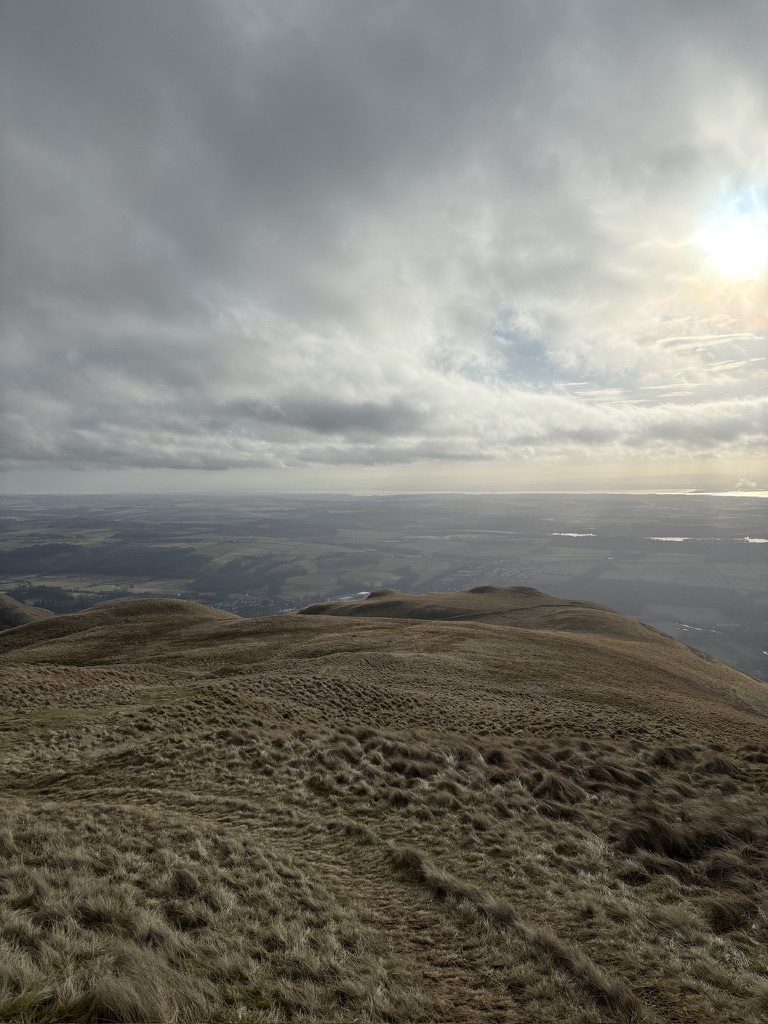
King’s Seat would normally loom above us, but today its head is lost in the clouds, so we make our way up blindly as the fog and snow begin to merge. Vaulting the fence at its base, I remember the days I first discovered what running in the hills was like. At the time I was still wearing a rucksack and boots, but the thrill of throwing myself down a hillside was no less exhilarating. Sometimes I would just be running down myself, other times racing my brother. If only I knew that those first bounding steps would result in a love for hill running!

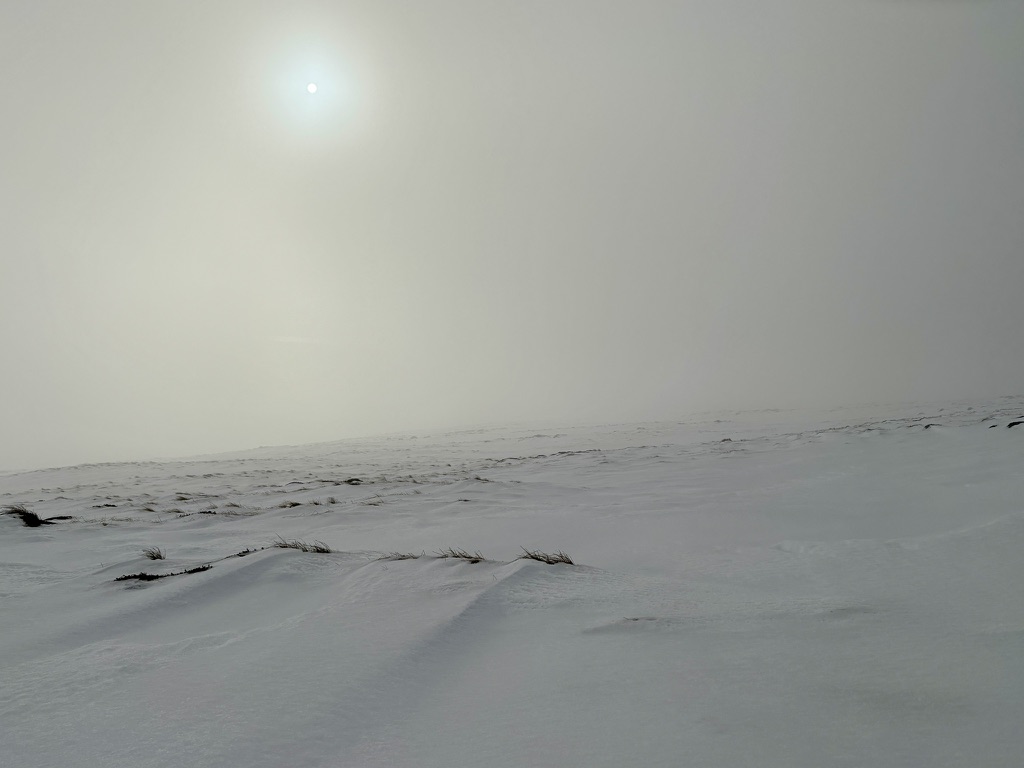
Above: Same day, very different conditions!

Like a pair of ships in the wind, we stagger to the summit of King’s Seat. Tom is wearing shorts – as is his way – and I can see his legs have gone from a bright red to almost grey as his bloods flees the biting gale. We tap the summit and plunge into the nothingness. Until now, we’ve been following the wider trails, but this is where we put our faith in our internal compasses and follow trods (faint paths) known only to those whose feet are familiar with this terrain. Even so, I often have to take a moment to catch my bearings with the snow covering most of the usual clues: “There’s that hollow behind the big tussock, pass that on the right and then bend to the left”.

With a bit of luck – and a little more than half-remembered navigational cues – we are at the Maddy Moss, the namesake of the Maddy Moss Hill Race. Jumping the wobbly wire fence, the conversation turns to our hill running club, Ochil Hill Runners. For the last few years, Tom has organised the Maddy Moss hill race, a race (I am ashamed to admit) I have never run.

***

Forever an Ochil Hill Runner

Though I may live 1,300 km away, I still consider OHR to be my club, helped in large part by the fact my family and friends are still heavily involved in it. It’s been a great couple of years for the club, with some fresh, fast blood taking it to the top of the Scottish Senior Championships – the first time in 31 years that one of the two biggest clubs, Shettleston and Carnethy, hasn’t won.

I have raced plenty of other races in the Ochils, including the infamous Ochil 2000s. In 2019, the race started very well for me, sitting in the top 10%. But if the Ochils don’t beat you at the start, they will break you down by the end. Ultimately, it was the descent off Blairdennon that broke me: A leg-sucking bog that turns into a precipitous 500m descent back to the foothills, promptly followed by a spirit-breaking climb to the 418m-high Dumyat. This is the catalyst for many a runner’s demise, and it takes a strong runner to push through it.

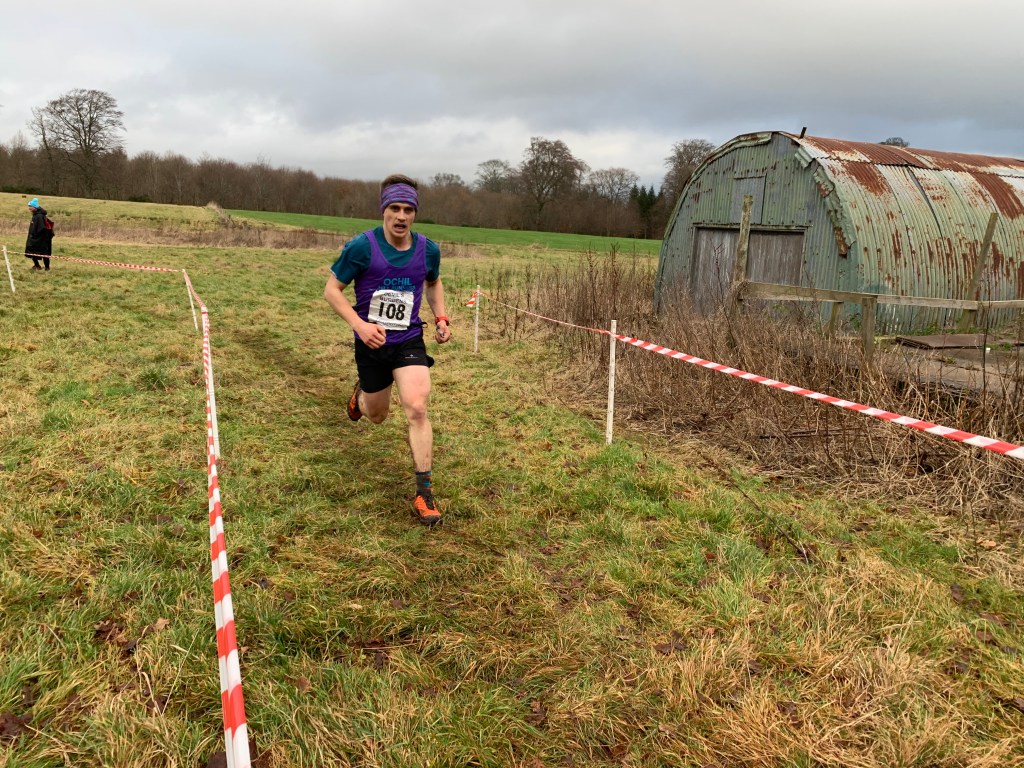
Racing in the purple vest of OHR

***

Endless opportunity

The steep gradients of King’s Seat have given way to the broad side of Andrew Gannel Hill, a top that is the chagrin of any marshal on the Ochil 2000s race thanks to the fact that Ordnance Survey and Harvey Maps place the summit in two different locations.

For us, however, it’s the end of the thick fog as the sun finally feels strong enough to send its rays to Mother Earth. Our route undulates over uneven ground as we climb towards Ben Cleuch, the highest point of the Ochil Hills at 721m. Its bald top often gives sweeping views to surprising reaches of the Highlands, with panoramic views of Ben Lomond and the Arrochar Alps in the west. Directly ahead the conical summit of Ben Vorlich and its crooked partner Stuc a’Chroin are prominent, and on a clear day you could even see Glen Coe. As you turn right, you can spy the Breadalbane hills, Ben Lawes range, and north-eastwards to the Grampians.

Today, only a hint at those views is possible as we shelter behind the summit cairn to clad ourselves in windproof layers. Wrapped against the gale, we traverse the summit plateau, diving down to the cleft between Ben Cleuch and Ben Ever – our final top of the day.

There are many things I love about the Ochil Hills, but one of them is how easy it is to add to and cut away parts of your route. From this crease, it is possible to take in Ben Buck, traverse around Ben Cleuch, tap The Law, and descend to Mill Glen. Or bypass Ben Buck and head west to the head of the ATV track before climbing to Craighorn and over The Nebbit. The possibilities are endless.

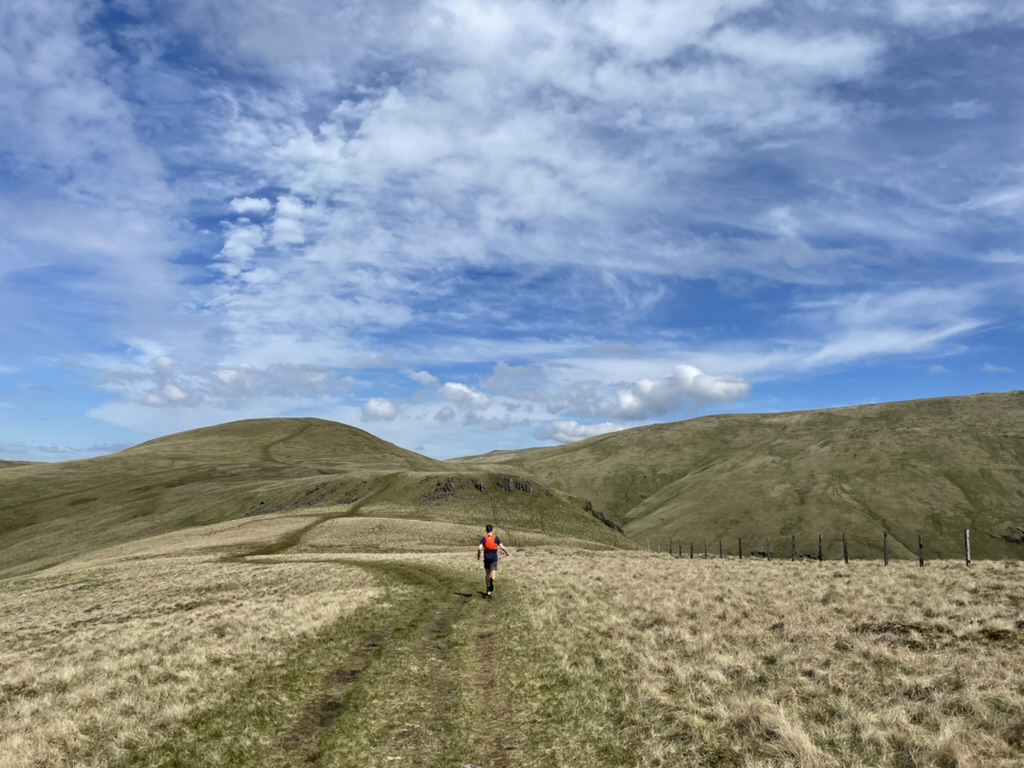
Broad views on a sunny day in the Ochils

Many faces

As we begin our final stretch towards home, I think more on that point, and that word hefted comes back to me. I could navigate these hills blindfolded, my feet knowing every trod, tussock, and stile on them. For the entire run, I had felt this boundless energy, a feeling I attribute to that sense of familiarity, of my feet being in their natural habitat. These hills make sense to me in a way that is hard to describe.

Despite my lack of affection towards them for turning the Ochils (and many hills in Scotland) to ecological deserts, I thank the sheep for bringing the word hefted into my lexicon. It’s the only word I feel can capture that feeling of familiarity I have for these hills. Not only that: This level of understanding allows for so much play. In knowing every twist, turn, and mood, I know how I can immerse myself in the landscape and play.

These are hills of many faces. Like a crème brûlée, you have to pierce through the tough exterior that is their valley cliffs to find the soft, rolling tops they are defending. And though they may not be the highest peaks, you can easily rack up over 1000m of climbing in a little over 10km.

Though their barren tops have been domesticated by farming and grazing and the towns of Tillicoultry, Alva, and Menstrie are only a short distance away, there are few places I have felt more exposed and that have tested my mountain craft than the Ochil Hills.

Descending into Mill Glen, I look to our left and see the usually soft curves of the hills have turned into striated muscles, every fibre and sinew brought into stark relief by the streaks of windswept snow.

To know a place

My feet are cartwheeling beneath me, thundering down the hillside and keeping me upright against gravity’s pull. The idea of running downhill at such speed sounds sickening to anyone who has never experienced it: “What about your knees? What if you fall? What if you roll your ankle?” To them I would say you have never known joy until you have left the brakes of rationalism behind and hurtled down a hill.

After bottoming out in Mill Glen and nursing our beaten legs up the final short rise to our descent home, our conversation turns to projects and plans for summer. Tom’s plans nowadays include a lot of climbing and mountaineering, something that has captured his imagination just like running did when we met.

Trotting into the field, I take another glance back up to these hills of home. I have so many memories of mornings before university, evenings after work, sunrises, sunsets, days above the clouds and days in the clouds, runs of joy and others of anguish, walks with family and runs with friends up there.

My personality is interwoven in the Ochil Hills, in their tops, their curves, and their creases. Whilst I might have traded them for the lofty heights of the Swiss Alps, they are the hills that shaped me as a person, and where I will always go back to – like the swallow in summer, or the sheep let loose from the pen. They are the nexus point for who I was, who I am, and who I will be.

This is what it means to know a place, to have it reflect you and reflect in you.

And, of course, the sky is clear, and the Ochil Hills are bathed in winter sun.

From guilt to pragmatism: A new environmental approach

I have worked in the environmental sector for six years, and over that time I have experienced an evolution in my perspective and position as an ‘environmentalist’. As a child, nature and the outdoors were the pillars of my upbringing, and so choosing to work in the sector seemed only natural (if you pardon the pun). 

Starting out as an intern with Keep Scotland Beautiful, I was using my limited knowledge of climate and litter to craft social media content. As I moved on to the John Muir Trust, I brought what I learned at KSB and combined it with my love for the outdoors and wildlife.

I would say those years at the John Muir Trust were utterly profound in shaping my opinions on climate and the environment. Foremost, I never looked at a landscape the same again. It was as though I was looking at a landscape through a camera and suddenly the aperture had been adjusted and I saw things that were previously hidden to me. For the first time, I could see how Scotland’s (and the world’s) ecosystems were completely out of balance.

New perspective: The day I learned how the vast spaces I loved were actually ecological deserts. Credit: David Lintern.

I began to understand how humans had shaped the world around us in seemingly imperceptible yet dramatic ways, and how those impacts cascaded through food chains, influencing the very soil beneath our feet. I will never look at a landscape the same again.

Recently, I worked as a freelancer for The Green Runners, a grassroots group of environmental activists. The Green Runners are full of fire and urgency, but I also discovered something in them I had not heard from many other groups: Pragmatism.

Every job I have had in the sector, every book and document I have read over the years, every loud debate and every quiet confession I have had with activists and experts has led me towards something I never expected.

That – in equally frustrating and liberating ways – is nuance.

I bring all this up because I have had a couple of friends half-jokingly making comments on my current lifestyle. I have never publicly stated what my environmental commitments are, because I never really felt the need to. Furthermore, I have never found myself to be in a position that required such transparency, nor have I ever been vegan, painted buildings orange, or blocked a highway. 

However, I am aware I have described myself as an environmentalist, and have a (if very small) public persona. That puts me in a position where I should be at least somewhat transparent, which is why I feel it’s good to talk about it, not least because I hope what I have to say might resonate with others who crave a little bit of honesty. 

I am going to do a few things: First, I want to look back on where I’ve been; next, I want to look at reasons for optimism; and, finally, I will lay out my approach today, plus some tips for you.

Environmental paralysis

At the start of my environmental journey, I fell into a tribalism and absolutism that some might recognise in environmental discourse: “Never do this”, “never do that”, “don’t drive”, “don’t eat meat”, “fossil-fuels are the worst”, “plastic is killing our oceans”. 

This coincided with when I started living alone, and I became overwhelmed with a crowd of noises and incessant guilt that came simply from existing. It absolutely sucked. Everything in my life came under a microscope and I became paralysed by indecision. 

I am not alone in this. Many will be aware of the rise of eco-anxiety, especially in young people. According to the journal Nature, 72% of people aged 18–34 said that negative environmental news stories affected their emotional well-being. These results are reflected in several other studies. What’s good is that this anxiety is resulting in pro-environmental behaviour, but what’s the good in that when we feel depressed about it?

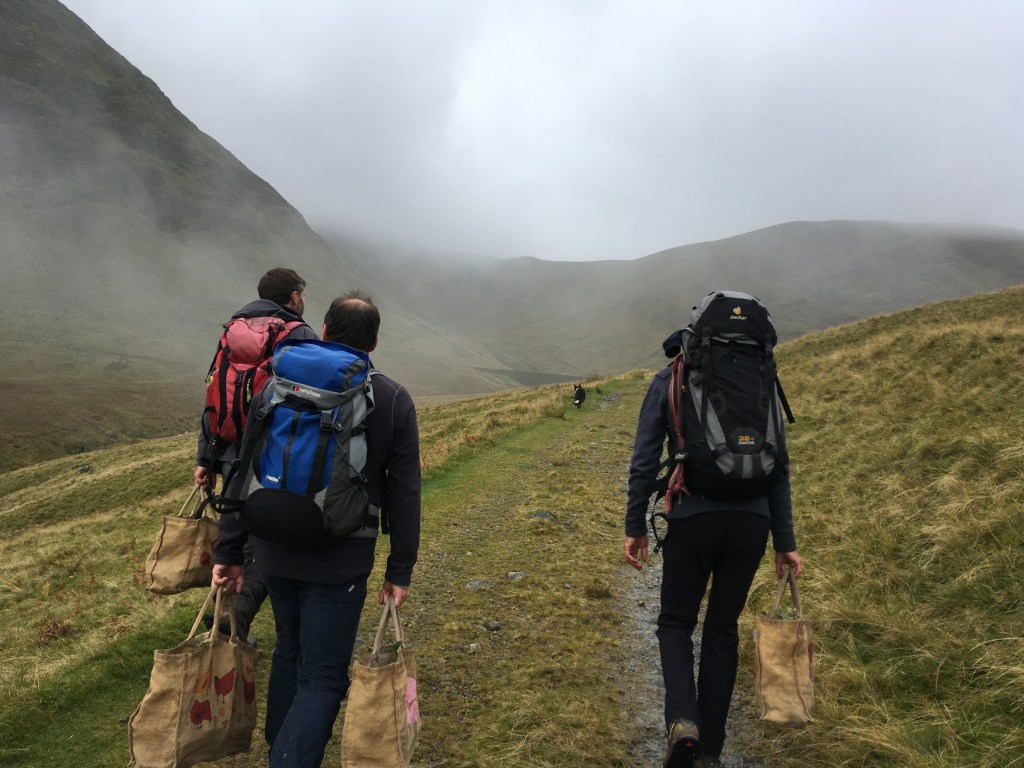
Green shoots: A day spent planting willows on Helvellyn

Things are getting better

Lately, I have found a lot of solace in Hannah Ritchie’s book Not the End of the World. In it, she describes a childhood and adolescence astonishingly similar to my own when it comes to climate anxiety. She writes how, for years, she assumed things were simply getting worse. She references another incredible book I read recently – Factfulness by Hans Rosling – in helping her realise that we are, in fact, going the right way on many data points relating to the environment.

Here are a few excellent points Hannah makes in the introduction to her book:

“To get this out of the way, let me make one thing absolutely clear: I’m no climate change denialist or minimiser. I spend my life – inside and outside work – researching, writing and trying to understand our environmental problems and how to solve them.”

And…

“…our impending doom leaves us feeling paralysed. If we’re already screwed, then what’s the point in trying?…I can assure you that after reframing how I saw the world, I have had a much, much bigger impact on changing things. When it comes down to it, doomsday attitudes are often no better than denial.”

At the end of her introduction, she makes a call for “urgent optimism”, and that “if we want to get serious about tackling the world’s environmental problems, we need to be more optimistic”.

This is so refreshing for me, because reading it felt so relatable and lifted a weight from my shoulders, knowing that I do have a role but that there are certain things I should focus on and that things are actually getting better, not worse.

According to Ritchie, the average person in the 50s and 60s emitted around 11 tonnes of CO2 per year. Today that figure is less than 5 tonnes. In 2009, solar cells cost around $360 per unit of electricity; that’s now down to below $40 per unit – solar electricity now costs 89% less than it did in 2009.

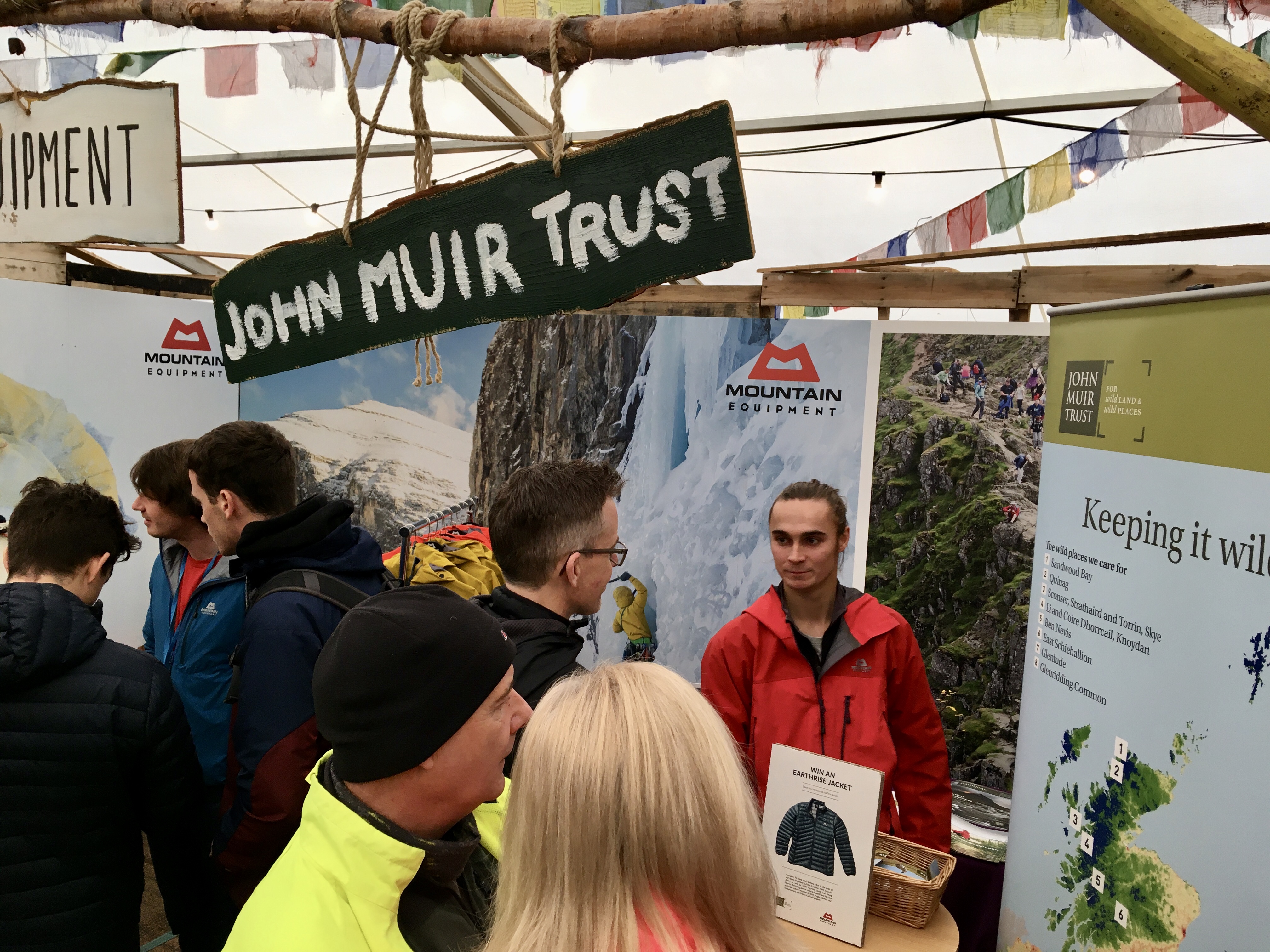
Above: Hosting various talks and events over the years with the John Muir Trust

For those yearning to travel but still consternating over the environmental cost, remember where we were in the early 1800s with rail: Trains were coal powered, horribly polluting, and desperately inefficient. In 200 years (a long time, yes), we’ve moved from zero passenger rail journeys powered by electricity to over 57% in the EU, and that is with an expanding network. Given our reliance on aviation today, I can only expect it will become an increasingly efficient form of travel.

Nevertheless, appetite for aviation is continuing to grow, with a 4.1% growth in passenger air traffic expected in the next 20 years. However, the usual western markets are not the source: The majority is from emerging countries like Vietnam, India, and Saudi Arabia where income levels are growing. This is great news in a way, because as countries develop they also tend to move away from fossil-fuels. Just look at most European nations today versus in the 1950s.

All of this goes to saying that things are improving, and there’s still progress to be made.

The travel conundrum

I no longer work in the environment sector. In fact, I might even work in its polar opposite: Travel. I work for EF Education First, which provides education-based travel experiences to people of all ages. You probably know of EF from the cycling team, but the company goes well beyond the vivid pinks and funky designs you see in the Tour de France.

To facilitate the travel of all their travellers, flying is an integral part of how the company operates. Yes, flying, the pinnacle of environmental sin.

But I see it differently. I applied for the role at EF for a whole range of issues, but above all it is their belief that “the world is a better place when we try to understand each other”. I believe that statement is perhaps more important today than ever.

In his book Let My People Go Surfing, Yvon Choinard, founder of Patagonia no less, mentions how his trips to the Himalayas, Andes, Alps, and so on opened his eyes to the impact climate change was having on his beloved landscapes and the people that live in them.

Above: Experiencing the colour and culture of Türkiye

I have spoken to many friends about the conundrum of wanting to go on adventures and write about incredible places, while also balancing that with my environmental beliefs. I know flying is inordinately worse for the environment than overland travel (depending, of course, on the type, capacity, and how it is powered), but I also know that reading about these places is an inferior alternative to experiencing it first-hand.

In Europe, we are incredibly blessed with having exceptional rail networks (in most places) that are also powered by electricity created with renewables. However, if you live in the U.S., it is almost impossible to experience other cultures without hopping on a plane. In fact, it’s sometimes impossible to see your relatives within the same country without doing so.

For that reason, I no longer want to vilify people for flying (to a degree), nor feel horrendous when I choose to do so. I genuinely believe that seeing other parts of the world and engaging with different cultures is essential, both in tackling the rising tide of xenophobia as well as ignorance over climate breakdown. Climate change is having observable impacts on communities right across the world, but without engaging with those cultures it’s hard for people to comprehend it.

I read countless testimonials from EF customers of how their experiences shape them and their perceptions, which is exactly the kind of travel we should be encouraging. 

Travel is just one example where I have started to understand the complexity and fallacy of seeing environmental issues in such binary ways. Instead, my once black-and-white opinions have mellowed the more I have read and discussed problems with people. 

It leads me back to what I think is at the heart of all of this: Intent.

My new philosophy

“The unexamined life is not worth living” – Socrates

Every decision I make I weigh up with the planet in mind. I always ask myself whether this action is necessary or whether a more sustainable alternative is available. To use The Green Runners’ four pillars, it affects how I fuel, how I travel, how I kit up, and how I speak out.

What I cannot abide are the people who go about their daily lives without a care in the world for the environmental consequences of their actions. Whilst others may wish to decry the actions I take as not being the most sustainable, what they fail to recognise is the energy I – and many others – expend anguishing over various decisions.

Travel is perhaps the biggest issue I get pulled up on – even though I have only started travelling fairly recently. Since 2020, I have taken eight return flights and one one-way flight. Three of those return flights were for work, as was the one-way flight*, taking me to five personal return flights over four years**. 

In the preceding 25 years, I rarely travelled outside of the UK, taking just three or four overseas and two domestic (as a child, something I’d never do today) return flights. You could wag a finger and note that in just four years I have doubled my lifetime of flight-based emissions, but that completely misses out several key personal changes, such as marrying into a family that lives in another country, and moving to another country myself.

However, despite all that, I would say that today I (and by extension, my wife) probably live more sustainably than I ever have. Firstly, I eat about 50% less meat than I did pre-2020, and thanks to the fact I now live in a city I only drive once per week at the absolute most compared to every day when I lived in the UK.

While I had no influence over the building of it, the fact our apartment is built to some of the highest environmental standards in Switzerland was a big factor in our choosing it. We’ve not used our heating since we moved in thanks to incredible insulation, and everything is powered from 100% renewable energy, primarily hydro and wind.

Wearing my beloved Salomon Adv 12 pack that I have repaired several times over the last eight years

It’s also rare you will find me buying new clothes nowadays and, if we want to talk about running, I am rarely purchasing new kit. I am also in the very fortunate position to have a wife that works in the running industry, meaning I usually get samples or test items that don’t require additional production.

This leads me to where I sit on the environmental debate. I try not to see things as so dualistic anymore, nor get myself paralysed by potentially environmentally-harmful behaviours. Every day I make adjustments to what I do to try to live more sustainably, as many others do. I also recognise what I do today is not what I will do tomorrow, or maybe in 10 years. Lives change, and we need to be a little more pragmatic with the parts of our lives we can make solid environmental choices in. 

We need to see systemic change

We also need to support one another in these changes, because many of us are living in a system incongruent with environmentally-friendly choices. It’s like being given a rubber hammer and told to build a house.

Many of us are limited in our choices due to geography, time, money, and more. What I want to see is those factors minimised as much as possible, due to expansion of infrastructure, technological advancements, reduced cost of more sustainable options, and employers providing flexible working options and support for sustainable travel. At the John Muir Trust, staff are lucky enough to receive two additional days of leave called Sustainable Travel Days for exactly this purpose.

Secondly, while individual choice matters immensely, robust systemic change is absolutely vital. During the Covid-19 pandemic, when many of us were locked indoors and entire economies ground to a halt, global CO2e emissions fell by just 5.4%. This isn’t nothing, but it’s not much given how our lives stopped.

Another great example was reported today, with BP now dropping all its green investment plans to appease its shareholders. It’s unsurprising. BP is looking at its competition and wants to avoid losing out. Without legislation to level the playing field, capitalisms endless pursuit of profit will trump sustainability every time. Who foots the bill for the greed of the already mega-rich? It’s you and me.

No Fly: Travelling overland back from TCRNo9. I have huge admiration for Lost Dot’s commitment to their staff not flying to and from their events. Others should follow suit.

This is not an attempt to eschew responsibility, because I believe systemic and individual change go hand in hand. We can bring it about in how we vote and what we buy. Politicians and businesses adapt depending on the will of voters and customers, so what we do does matter and we should be fighting for that.

Just as fossil-fuel companies sought to sidestep responsibility by co-opting personal ‘carbon footprints’, so now we are taking the responsibility to sort things out ourselves. This follows the narrative for the injustice of climate change as a whole, where it is those contributing the least to climate change who are being affected the most. As we’ve seen, individual behaviours are changing, but we need system-wide changes to help us.

Some parting thoughts

You might disagree with everything I have written above. Perhaps I am being too woolly, complacent, or eschewing personal responsibility. That’s not what I am here to do.

I still believe we all need to change our behaviour every day, and that requires a personal responsibility to remain educated on the issue. Every step we take towards living more sustainably is a step in the right direction. But that should not paralyse us from living life. 

We need to have the resources to make sustainable choices. To get them, we need people to push for them. This, I believe, is where our greatest power lies: In our votes, in our voices, and in our wallets.

We also need to be better stewards of our planet. I have long been passionate about enhancing biodiversity, and I believe when nature thrives, so do we. In my job, I have spoken to amazing people running community projects built on this philosophy, and it gives me hope for a different future for us all.

Furthermore, I want to see the debate on the environment reflect the complexity of the issues we face. Unfortunately, social media is currently not a space for nuance, and while I’d love to post and share things about sustainability on Instagram, I am all too aware of how that works out. It’s for this reason most sustainability accounts are fairly purist, because without total devotion there’s a risk of being seen as hypocritical. Damian Hall, co-founder of The Green Runners, is an excellent example of how to challenge that dynamic.

Still, that doesn’t mean we have to stick our heads in the sand or vacate a space and leave it for denialists. Share what you do – even if it’s small – and speak in the positive, because it’s far better to tell people what they can do instead of what not to do. 

Finally, I want to leave you with this: No one is perfect. And I mean, no one. Because what does ‘perfect’ mean for the environment? Well, to not exist. We cannot be measured against something indefinable; that’s impossible. Nor can we all be expected to comprehend, interpret, and action upon things that people spend entire lives researching. We can only do that which is in our power and that we can fit into our lives. Again, placing enormous responsibility on this without the time, money, or knowledge to do so will simply paralyse us.

I hope you find solace in this. In some ways, the enormity and complexity of the issue is both anxiety-inducing and comforting. Each of us can do our part, but those with the levers of power have the greatest influence. Thankfully, we do have some power over them, as we can now get into.

What should I do?

The final final thing I want to leave you with are a few key things I feel are of vital importance when it comes to environmental stewardship. My philosophy of environmental pragmatism and keeping the planet at the top of your mind in your decisions obviously comes first, but here are some key things to remember:

Speak out and get involved

Whether it’s pushing for your employer to offer flexible working to accommodate overland travel, emailing local representatives to share your views, or participating and organising events locally, speaking out and getting involved is one of the best things you can do for the planet. These actions don’t have to be public; it can simply be reading manifestos to ensure you vote for pro-environmental parties.

While individual action is excellent, we can multiply that tenfold if we get businesses, governments, and communities to unite. I still need to find this outlet in Switzerland, but writing this blog has motivated me to find it.

Education, education, education

Read books, blogs, articles. Speak to people, share ideas, share worries, discuss and debate. Crucially, support others to learn too. There are a plethora of books, including the ones I have mentioned, that can help you on this journey. Here are a few which, while being largely UK-focused, I found helpful:

  • Not the End of the World, Hannah Ritchie
  • Factfulness, Hans Rosling
  • Let My People Go Surfing, Yvon Choinard
  • The Future of the Responsible Company, Vincent Stanley
  • We Can’t Run Away From This, Damian Hall
  • There is No Planet B, Mike Berners-Lee
  • English Pastorial, James Rebands
  • Silent Spring, Rachel Carson
  • Feral, George Monbiot

If you’re a runner like me, check out The Green Runners – their philosophy and guidance is excellent.

We also have to do anything we can to support women and girls to learn, especially in low income countries. If you can do this, help.

Fix more, buy less

Producing stuff requires a huge amount of resources, and emits vast amounts of carbon. That’s why we have to reduce how much we buy. I see far too many frivolous and thoughtless purchases, which are costly for the environment and, well, you. 

Do you need something or want something? This is the question I ask myself every time I go to buy new kit or clothes – or anything, really. Do I have something that already does a similar job? If it’s because something broke, can you fix it? If not, can someone else?

If you want something, can you buy it second-hand? If you can’t, which brands have the best sustainability credentials? 

You can see here how there are half a dozen questions you can work through before you buy something new from a planet-unfriendly brand.

Eat more vegetarian and vegan foods

Take just one look at this blog from Our World in Data and you will see why I am saying this. I am constantly trying to balance my nutritional needs and preferences with the needs of the planet. Any opportunity you have to choose vegetarian or vegan, go for it.

Something I hadn’t considered a lot is dog food. Our spaniel is still on a diet of around 40% meat (mostly fish with some lamb), so there is a consideration to be made there, too.

Opt for overland travel more

I have talked about it a lot now, but wherever and whenever you can, fly less. If you do fly, find a way to make it count, either by attaching it to other plans or extending the trip. Later this year, my wife and I will go to Japan, attaching a holiday to her work commitments. If you’re thinking of flying, see if you can change your plans to avoid it. I recently changed a holiday in Spain to one in Italy so I could take the train. 

I recommend checking out Rome2Rio, which can be a helpful way of finding how to get places via alternative transport.

With these changes, you are already making huge progress in reducing your carbon emissions. I hope you found what I had to say useful, and that there are lessons and comforts you can take from it.


Thank you to everyone I have debated and discussed these ideas with over the years, especially my wife, Bo. Also a big thank you to Alex Roddie for reviewing the initial draft of this piece.

*I want to differentiate between personal emissions and company emissions. For a start, the company’s with whom I flew measure that carbon as their own, but also because how much influence I can have over such situations is minimal. Though, I do seek to push for change wherever possible.

**It’s worth remembering emissions from aviation are far more problematic for the environment due to the altitude at which the emissions are produced. 

Reflections on 2024: A year of adventure and being brave

My foot sank straight down to the knee, the grasp of the snow forming around my calf. I clutched my poles halfway down the shaft in some kind of makeshift anchors, forcing my trailing leg up the slope to provide the next contact point.

Drive knee, plant foot, sink, pole, pole, repeat. Robotically I made my way back up the slope to where my friends and wife watched my ridiculous toil. In fairness to me, I’d told them to go the other way when I realised just how deep this section of snow was. Breathless from the effort, I cast my gaze across the landscape that surrounded us.

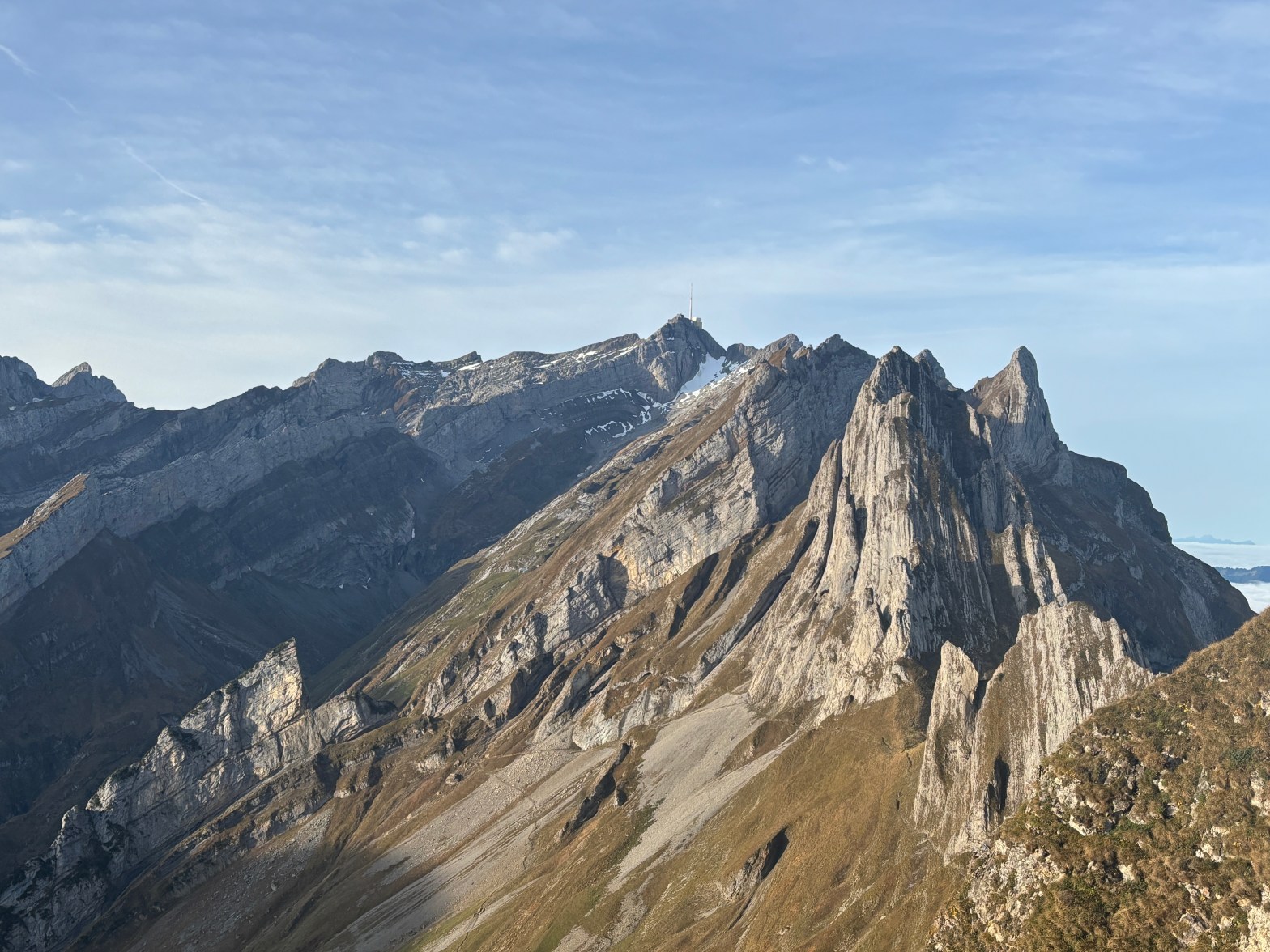
The Alpstein massif was encrusted in its winter coast. I love the shapes of this mountain range, ever since my first visit here a few months before. Great protrusions of rock stretch upwards, gigantic hands, fists and fingers pointing towards the sky. It looked less like the snow had fallen upon these shapes and more like the mountains had burst from the ground, bringing the snow up with them.

Walking in the Alpstein

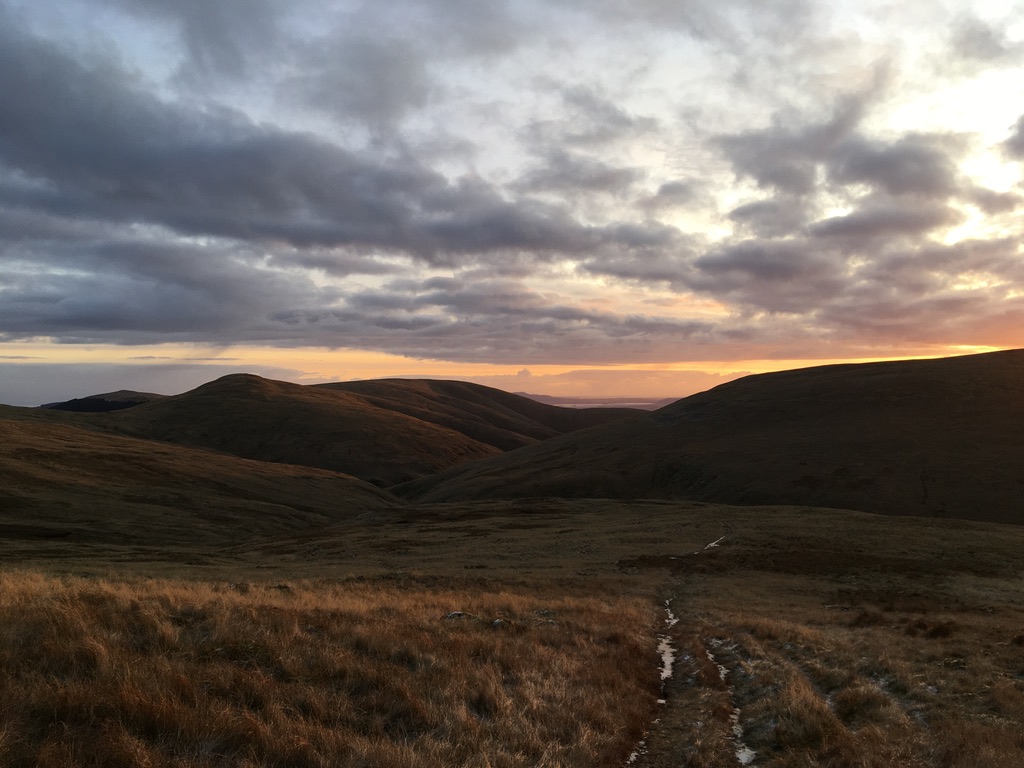
As soon as I got my breath back I chased after the others: we had a mission. Half an hour ago we’d realised we would soon lose the final sun of the year as it dropped behind the mountains. We changed in a hurry and shouldered running packs on the hunt for the last sunset of 2024.

Now, as we tramped our way towards the Schäfler mountain hut, perched precariously on a crest of the ridge, we could see it being lit from behind by the sun making its final bows. As we approached the hut, golden light spilled across our faces and the wind threw diamonds of snow into the air. We could barely make out the magnificent view of the Altenalptürm as we squinted against the blazing sun.

The landscape around us was putting on a show, as if it knew this was the end of a year. While years feel somewhat arbitrary, they do bring with them a sense of endings and beginnings. As the sun crept closer to the farthest mountain we could feel its warmth leaving us.

I turned to Bo, my wife, and smiled at her. “We’ve had quite the year, haven’t we?”

“We really have”, she smiled back at me. We kissed and turned to watch the shadows grow around us before finally turning our backs on 2024 in the west and towards 2025 in the east.


We are now over a week into 2025 and I have yet to write my ‘review’ of 2024. Truth be told, I always struggle with these types of blogs. I make a point of avoiding writing them before the year is actually finished – who knows what adventures await before 23.59 on 31 December?

As it turned out, 2024 packed adventure in right until the end. We spent New Year’s Eve in a mountain hut with two friends, playing board games with some local skiers and enjoying quality Appenzeller beer. So, in that sense, I was right to wait!

Walking back from an outdoor BBQ in the snow near home

When I think back on 2024, I am genuinely astonished and incredibly proud of what Bo and I have done. On 1 January we were driving back to Kendal from Fort William in our recently purchased van, right in the middle of preparing for our van trip. We were nervous, no doubt about it: we had a house to rent out; we were leaving our jobs and going freelance; we had to pack our life into a Mercedes Sprinter and chart a course across Europe.

I am not one for quoting books or thinkers in my blogs, but one comes to mind I feel is most apt:

“It’s a dangerous business, Frodo, going out your door. You step onto the road, and if you don’t keep your feet, there’s no knowing where you might be swept off to.” – Bilbo Baggins, The Fellowship of the Ring

I can’t think of a better way of encapsulating the year we had. As we left Kendal, neither of us could have imagined where the road would lead us.

There’s another level of symmetry between the Hobbit’s journey and mine, personally. I have always been a home bird, enjoying the delights of familiarity and knowing a place intimately. I know Scotland like the back of my hand, and was at least four fingers into knowing the Lake District. The prospect of leaving it behind for the relative unknown was nerve-wracking. As I explained in my previous blog, Bo was very keen for such a trip whereas I required some convincing.

Above: A few pictures from the latter part of our van trip.

As the months in the van went by, though, I felt myself grow in confidence and better at dealing with the unfamiliar. And we had to deal with our fair share of adversity, especially Bo when she had a persistent knee-injury that at times looked liked it’d derail the entire trip after just a couple of months. It’s very easy to show all the highlights, but there were certainly low ones, too, where we were angry, scared, made mistakes, and more besides.

But we stuck through it, through everything. As a couple, I cannot think of anything better in both helping us realise how much we care for each other and how we can rely on one another. We had some of the best times and some of the hardest times; saw some of the most stunning places and slept in some of the strangest; cried with delight at stunning mountain views and laughed together as the rain drummed against the roof.

None of that would have happened without us being brave enough to try. No one ever tried to dissuade us, either. We were so well supported by friends and family, for which I will be eternally grateful.

If you had told me in 2023 that I would have spent eight months living in a van just a year later, I would have never believed you. And if you’d then tell me we would move to Switzerland, I’d laugh you out the room.

But we did.

Again, very little of moving to Switzerland was plain sailing, nor without tears. When we found out Bo had been offered a job in Zurich, we slowly made our way back to the UK, where we would then pack up our house of what we’d left in it and turn back towards Europe.

Despite all the challenges we faced on the van trip, I think the hardest moment for me all year was that trip to our home in Kendal. Removing our belongings from a place we held so dear in our hearts – with its views across the town, the garden, the access to the fells, the community – was a painful experience. We sat together for some time, both crying, wondering when we’d be back. Do I still miss it now? Absolutely, but sometimes you have to turn your back on the things you love for a time to grow.

Above: Recent adventures in Switzerland

Moving to Switzerland was by no means in our plan, but I am proud of us, both for saying yes to the prospect and in achieving what we have here. I am sure I am not alone in having those ideas – call them dreams, if you like – but immediately dismissing them because they seem so far-fetched. Switzerland was that dream. If you’d asked me a few years ago if I’d like to move here, I would say, “Of course! But like that’s going to happen.”

And yet here we are. It was a scary thing to do, and we’re still navigating our new lives here, but I am so glad we said yes to it, despite how hard it’s been at times.

As I reflect on the year, I am unsure how to completely unpack the lessons from it, because I genuinely feel like I and we have changed so much over the course of the year. What I can say is that being brave yields incredible results. Things will never be as bad as you fear and you can never imagine just how good they can be, nor what can come as a result of them.

I am certainly no fatalist, but I don’t think we’d have moved to Switzerland had we not been on the van trip. We learned to adapt, to face challenges, to work together and show up for each other and ourselves. Had we not had that experience, I am not sure what would have happened.

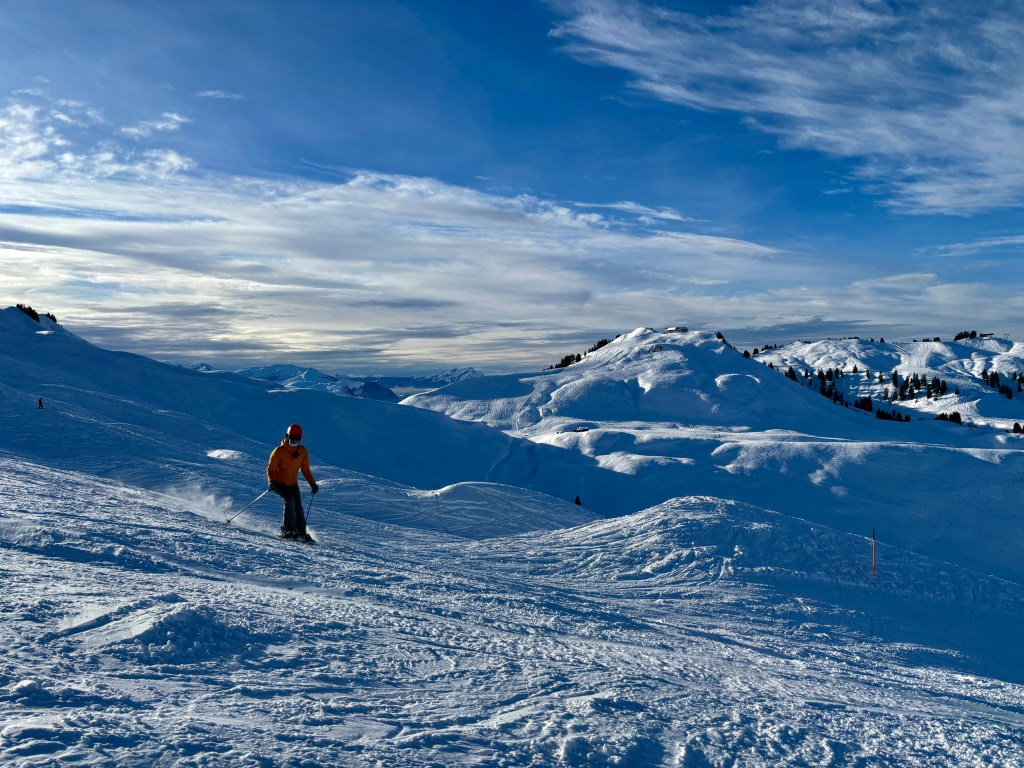
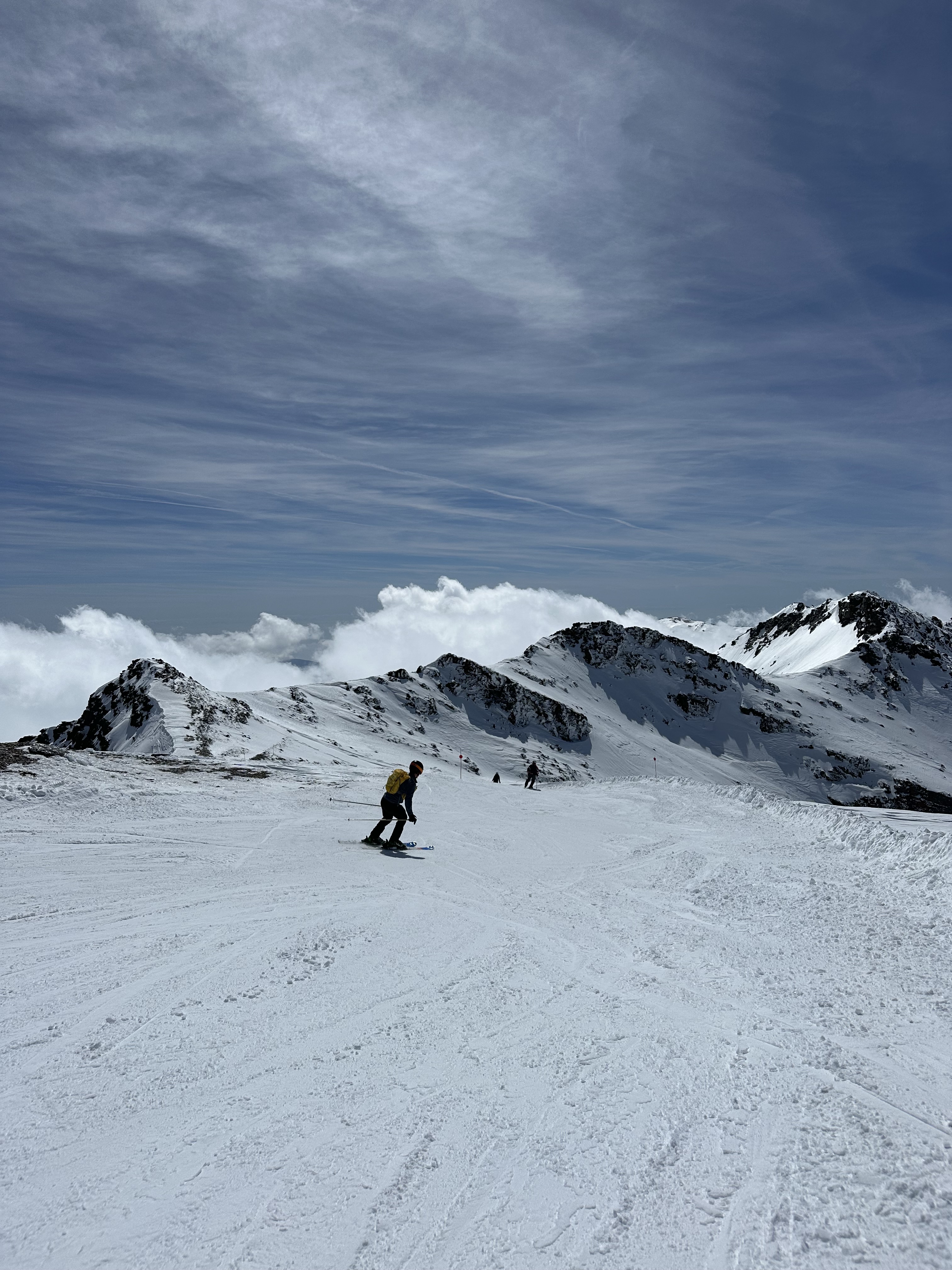
Learning the delights of skiing has been a true highlight of 2024

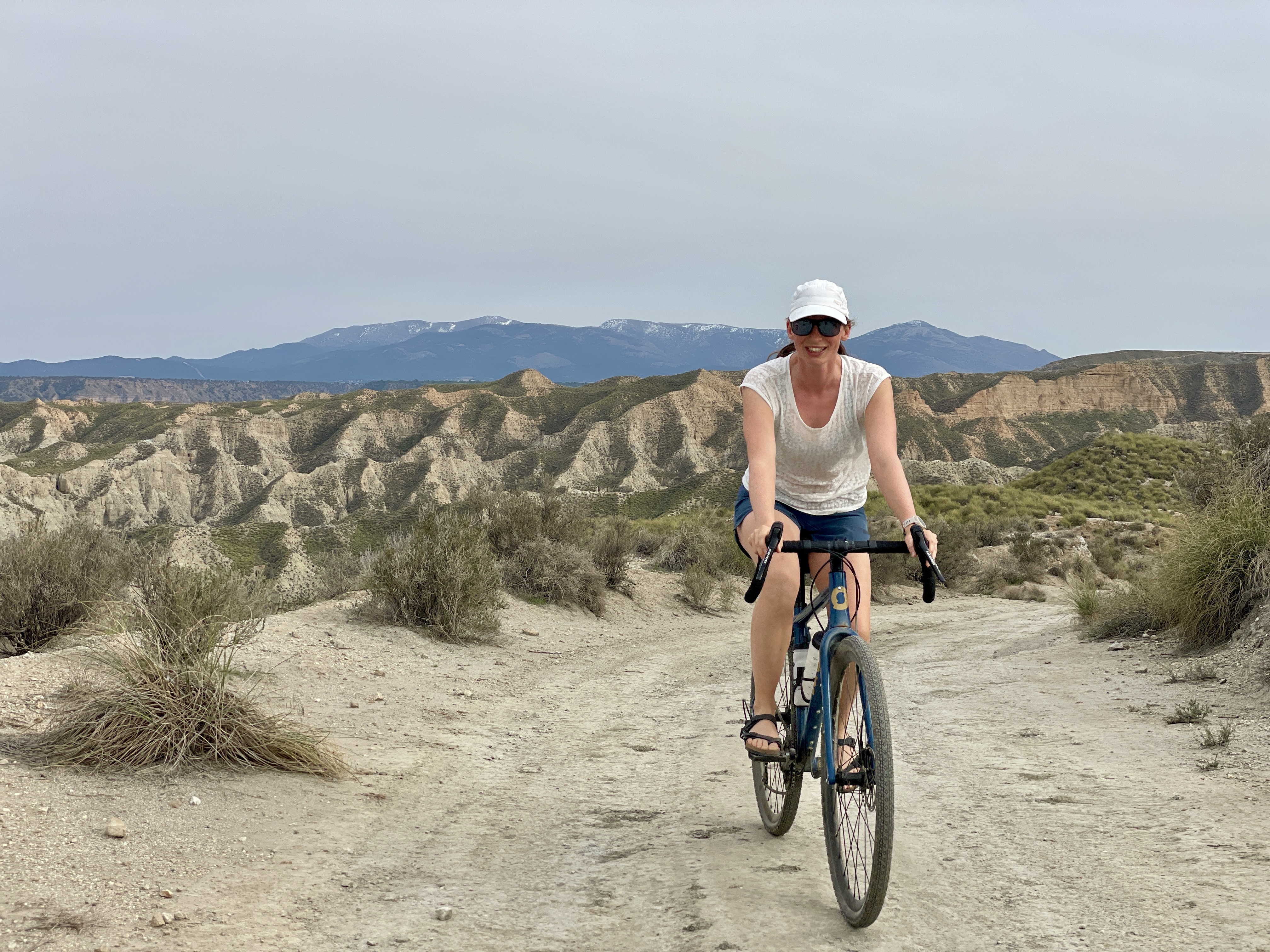
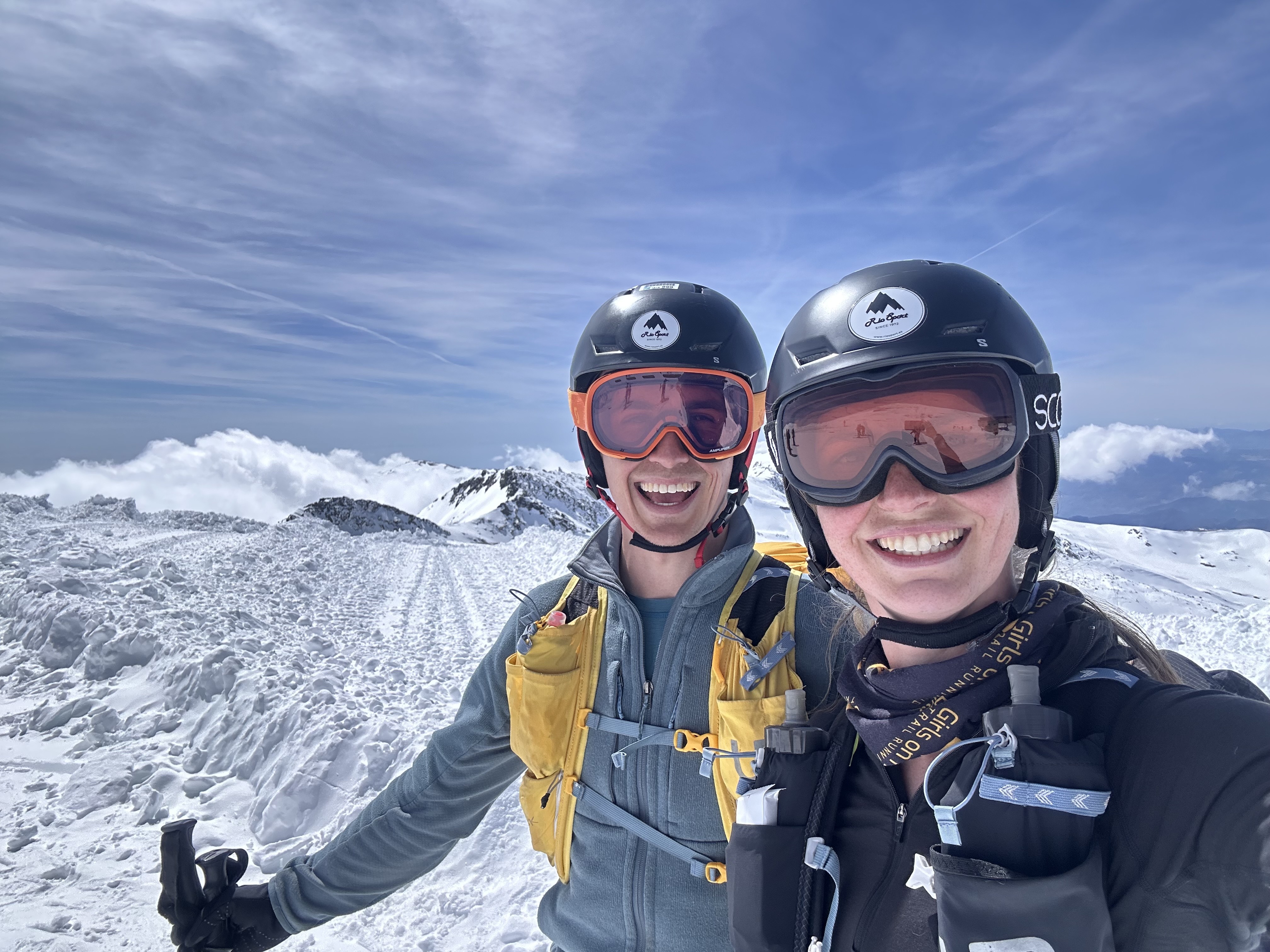
In 2024, I learned to ski, ran on a glacier for the first time, we made pasta in Italy, we both worked freelance, we cycled in a desert, I cycled up my first Alpine passes, I saw the Dolomites for the first time, we became an aunt and uncle, I wrote a feature for TGO magazine, we both got jobs in Switzerland* – and so many more.

But I also learned to be a little braver, to challenge my fears and expand my horizons a bit more. Trust in myself a little more, perhaps.

I look back on 2024 with genuine pride. Pride for the big, daunting leaps we made, the connections we forged, the chances we took, the mountains we climbed and the ones we didn’t, the hard decisions we made, and that we stuck together through it all.

I’ll take being proud of a year any day.

It felt absolutely right to enjoy that final day of 2024 on a mountain, with my wife, with my friends, surrounded by the stunning landscape we are now fortunate enough to live near. Fireworks burst in tiny plumes of colour in the valleys and plains around us at midnight, as we rang in 2025.

May it be another year of being brave.


*If it is of any interest, I am astonished to say I am now a full-time writer for EF Education First. I will be writing for their ef.com/impact website, so feel free to read the latest articles there.

The fear and wonder of the Alps

Light streams through the forest canopy, great beams of light pushing their way through the branches like light spilling through a half-opened door. Frost crunched beneath our feet as the jays chattered above.

We’ve been walking steeply uphill for half-an-hour, leaving the van behind to walk through a quiet village still stiff from the overnight frost. As we’d emerged from the van, mist was hanging low and heavy on the lake, concealing the peaks we knew stood just beyond it.

The mist was replaced with pines standing shoulder to shoulder, again blocking our view even as we left the lake behind.

Despite the near-zero temperatures, steam rose from inside our fleeces as we huffed against the gradient, the young sun still strong on that September morning. As we rounded another hairpin bend, we entered a lingering pocket of icy cold air. It slapped us in the face, forcing us to take a sharp intake of breath. A few steps later and it was gone, warm air rushing back up to us.

I came to know this phenomenon as we made our way through the Alps and Dolomites in our van. I call it Alpine breath, and they’re a sensation I have only ever come across in these high mountains. You step into a momentary blip in temperature that gets right down your jacket and behind your ears before it’s carried away.

Soon, we noticed the air around us continue to lighten as we broke through the densest part of the forest. The rigid grass defrosted and laid back in the sun. Walking up a steep grassy slope we turned to feel the unimpeded warmth. It blasted away any and all remaining frost on our skin and yet – our breath was still taken away.

The Alps.

The Alps pulled me, like gravity, towards them, as if I would fall into them. I felt fear and wonder almost simultaneously.

Like a sentence scrawled on the horizon, they rose and fell as letters scribbled on a page. Some were sharp, angled, others curved and domed, all joined by one long elegant line. Each could stand alone but together they tell the story of this landscape.

I haven’t forgotten that first weekend we spent hiking in our new playground here in Switzerland. Since then we’ve spent nearly every weekend in our van, continuing to explore more and more in the areas around Zurich.

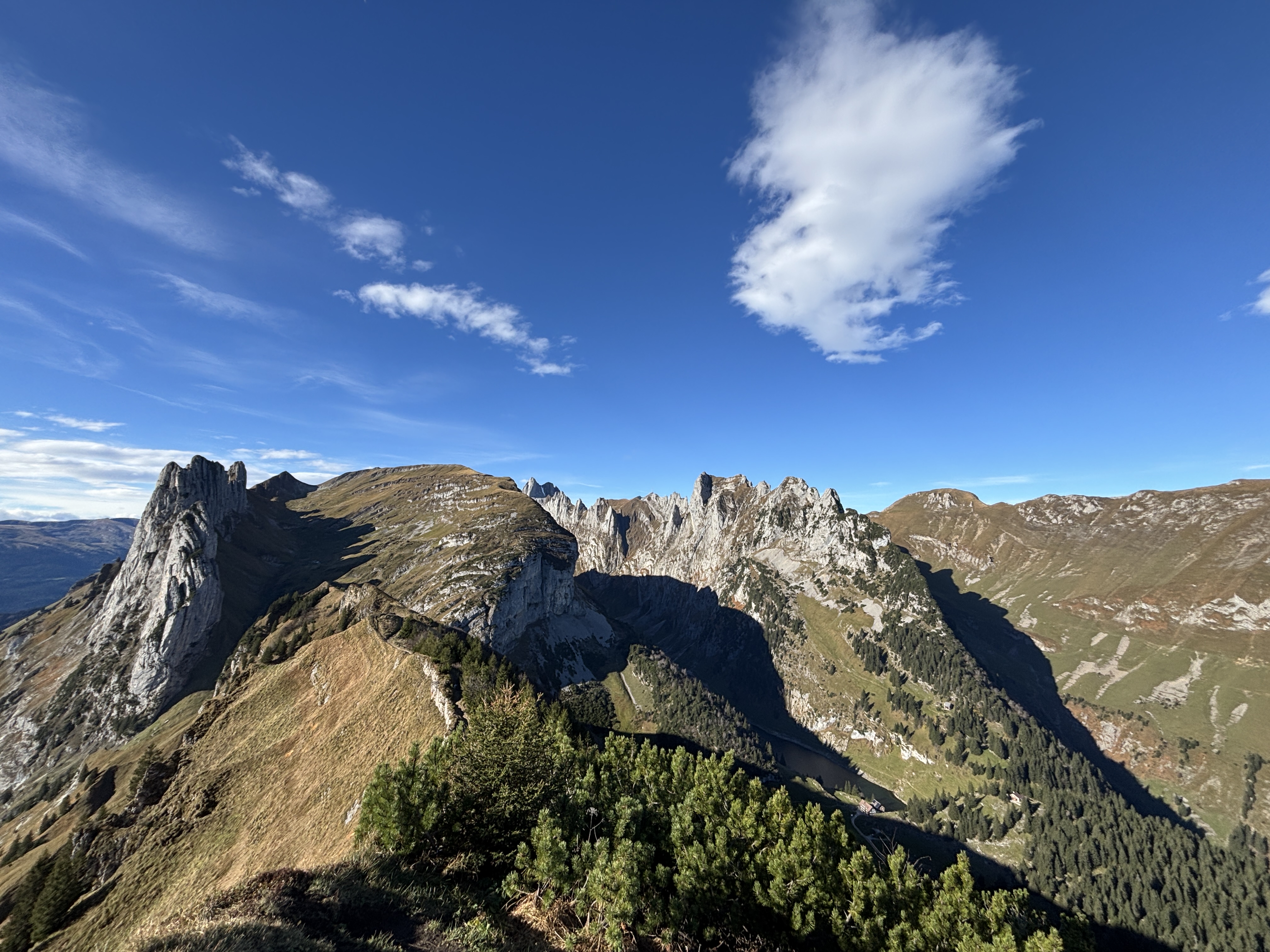
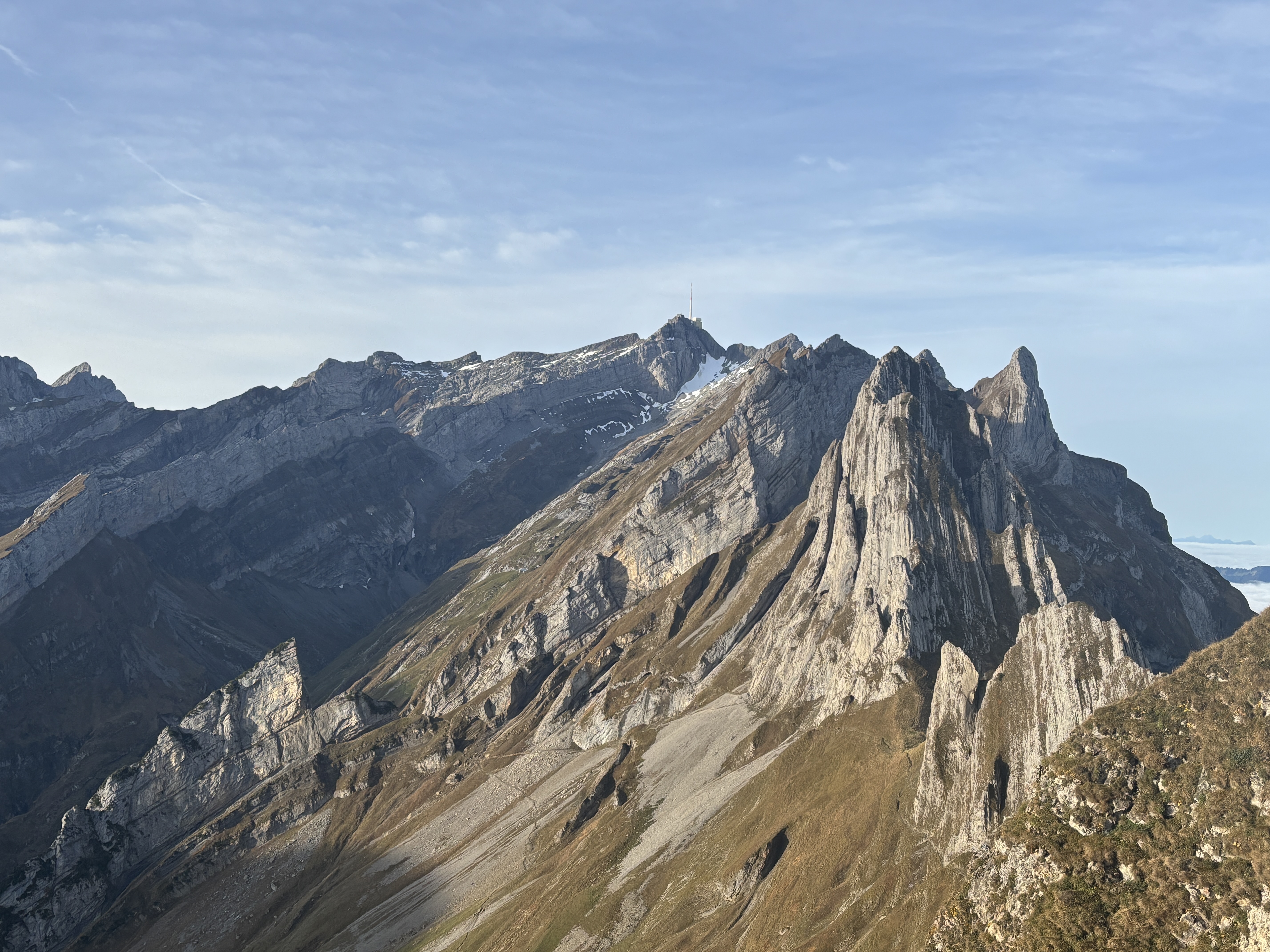
The mountains of Appenzell – the Alpstein – caught my imagination in particular. From the air, these three parallel ridges look like a huge cat has scored its claws through the earth. Säntis, the highest peak of the range, acts like a singularity, each ridge sucked towards it and drawing the eye.

Away from these grander adventures, even on a run from the front door, the presence of these huge guardians is palpable.

Cycling home on the darker nights, I can feel them hunkered in the dark at the end of the Zurichsee. Dormant, watching. In the mornings, when the fog is so deep, the Alps are hidden behind a shield of mystery. Sometimes I run through the forest under a clear sky in search of a view of them – only to find them obscured behind a wall of cloud.

Other days, when the sky lies blackened and bruised above, I look south to see the belly of the cloud engulfed in a white flame. On these days, I imagine the Alps burning the feet of the sky in an attempt to free themselves of its clutches.

Some days, they retreat back, looking diminutive, unassuming and distant. On others, they advance, towering above the Zurichsee like gods on Olympia, reminding us they have the power to unleash torment upon us.

We are here by their permission. They are everlasting; we are but visitors.

For now, their icy walls have gone up, and until the ski season truly gets underway they will remain locked. I look to them every day, wondering what their mood will be, waiting for the next chance to explore them.


We’re now two months into living in Switzerland and already I have discovered so much about this place, myself and ourselves. I want to document that more regularly.

I am toying with the idea of moving my content over to Substack. I’d like to share pieces like the above once a month, possibly alongside some additional information like our move to Switzerland, curious places we’ve found, and gear reviews.

I will see where those thoughts lead me but, for now, I hope you enjoyed this piece!

Fastpacking the Lycian Way: Running Turkiye’s Lycian coast

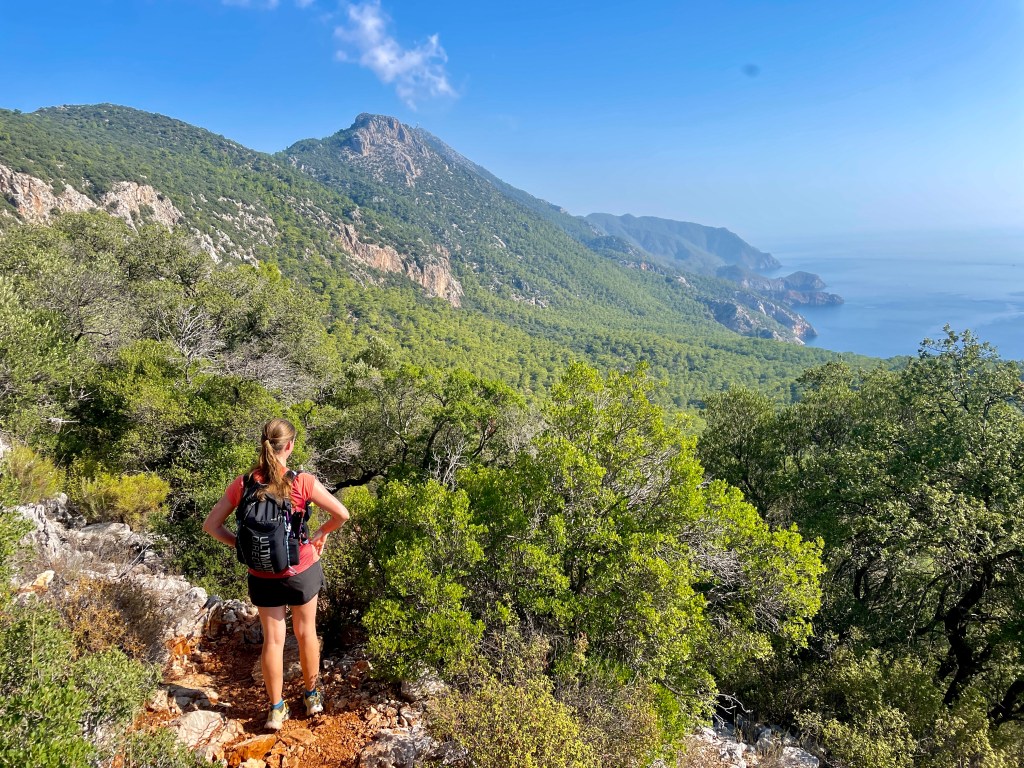
The waves washed over my dust-covered legs as the sun shone a spotlight on this little corner of the Mediterranean coast. This tiny pocket of paradise, hemmed in tightly on all sides by sweeping mountains and the seemingly never-ending sea, was the first stop on our Lycian journey.

As I slid into the water, I let the warm sea envelope me. As a Scotsman, the novelty of temperate open-water was not lost on me. The sun glinted on the rocks as the light danced across the turquoise water.

The taste, the smells, the sounds, the scenery – it all brought to mind images of, well, here. The definition of Mediterranean paradise.

Washed clean of my earthly coat, water running in rivers down my legs, I plonked down into a chair next to my wife. The dust was soon replaced by crystallised salt as my skin dried quickly in the afternoon sun. Tired, invigorated. The first day of our Turkish fastpacking adventure was complete.

The idea

It’s now a year since that magical day on the Lycian Way in Türkiye. I wrote about the preparation for the route in a previous blog, but since then the small matter of living in a van and exploring Europe took over my mind, and so returning to that trip has been a protracted endeavour.

As I mentioned before, my wife, Bodil, and I got married last April. The honeymoon had to be a grand adventure, so we spent several months poring over maps and guidebooks, reading blogs and burrowing into the clunky websites of half-forgotten long-distance trails in Europe.

We set out a few parameters: Novel and unique; adventurous but ideally not requiring camping kit; and something that would take 2-3 weeks to complete. The more we researched, the more the Lycian Way cropped up. And so, after reading Kate Clow’s guidebook, we set our sights on the ancient Lycian coast of Türkiye and the route that navigates its historic roads and trails.

Before we begin…

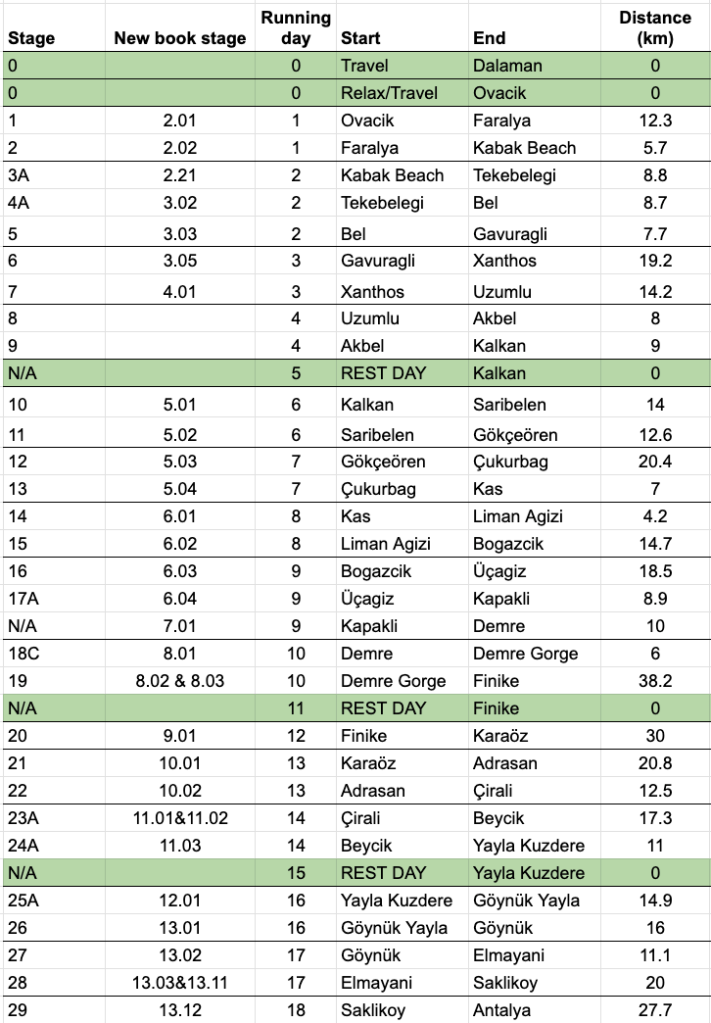
To avoid this blog being tens of thousands of words long, I am going to spare you the full 2-week account of our journey. Here and there I will dip into anecdotes from the trail, but largely this will be a practical guide to help you either hike or fastpack the Lycian Way.

In order to allay any notions of grandeur: If I make reference to ‘fastpacking’ or ‘running’ the route, remember the trail is over 400km-long through harsh and, sometimes, mountainous terrain. If I were to put a number on the amount of time spent running in those 450km, it would likely fall into the 20-25% range.

The key difference between what we were doing and those hiking the trail largely came down to how much we packed. In reality, I believe any proficient hiker could complete the trail in the time we did so long as they were disciplined enough to dispense with luxuries and slim their packing list down.

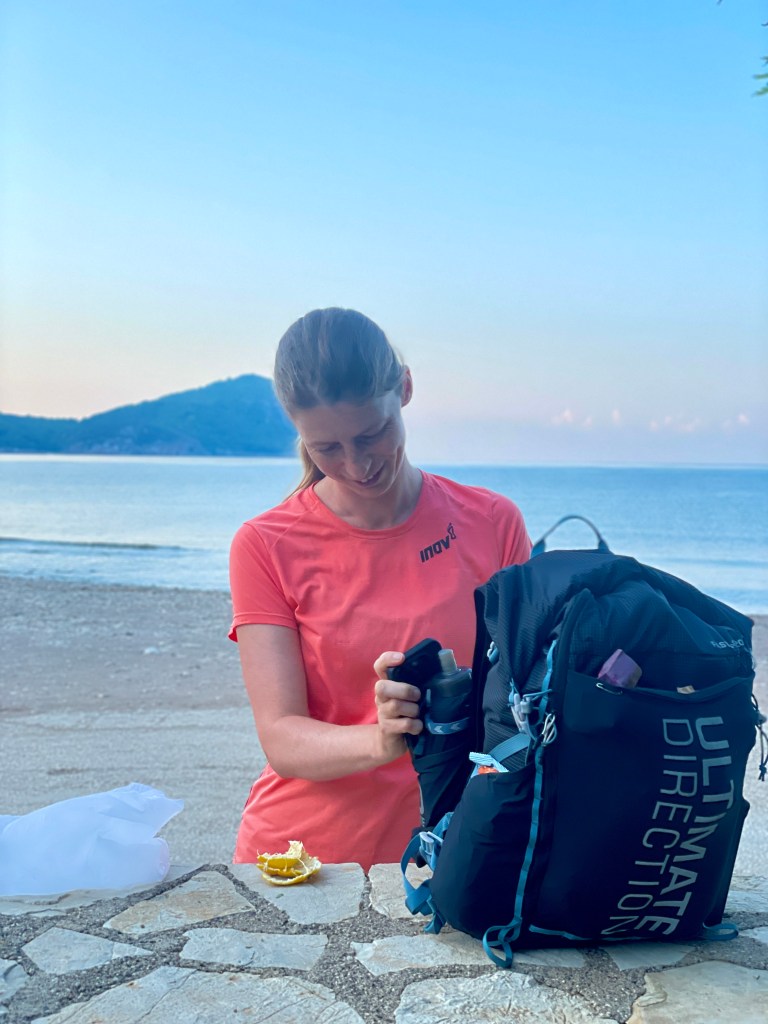
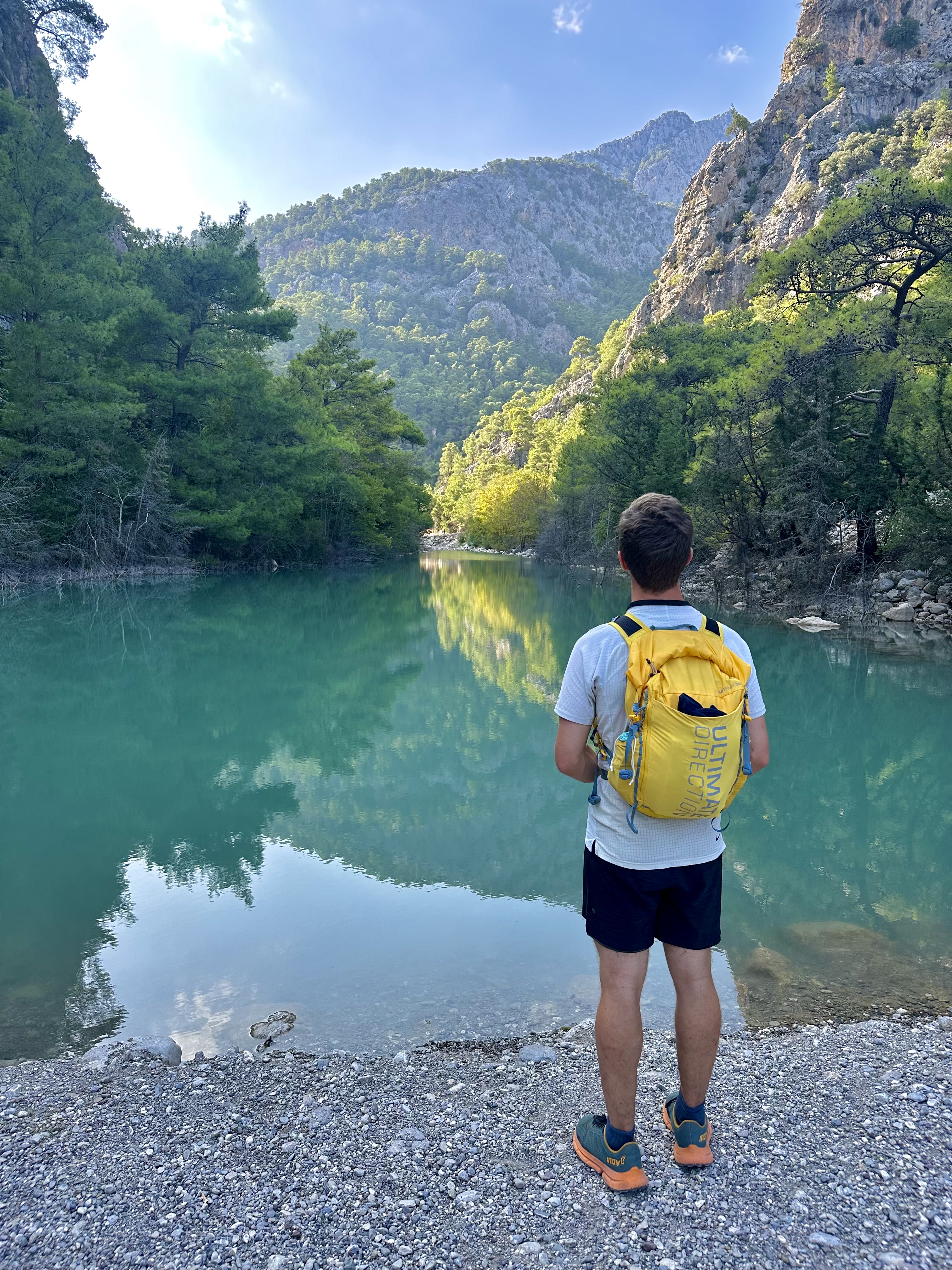
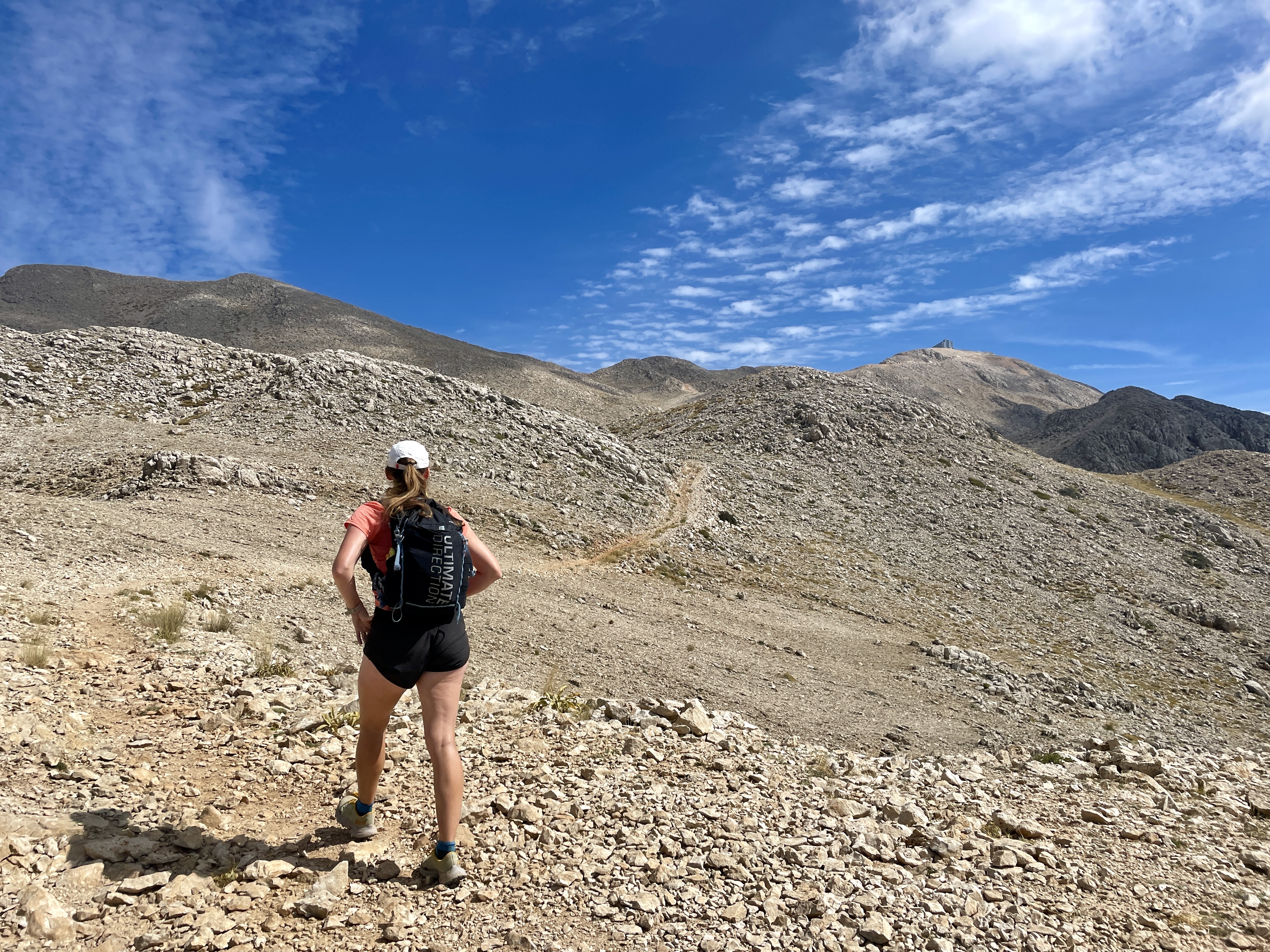
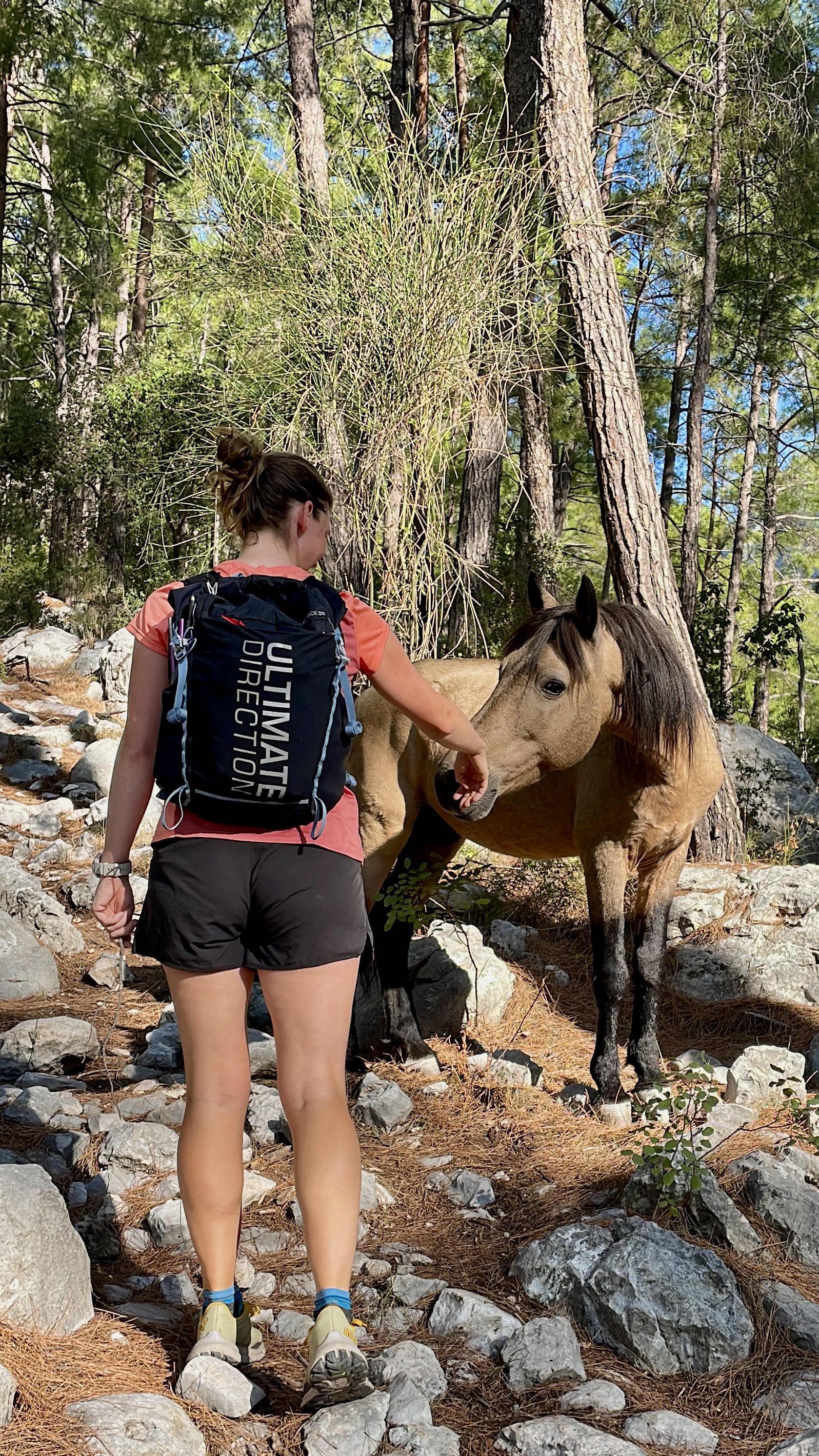
We ran with 20L backpacks (Ultimate Direction Fastpack 20s to be precise) and found them to be more than suitable. You can find the full packing list in the preparation blog I wrote previously.

The essential items

To get the most out of your Lycian Way journey (and save yourself headaches and confusion along the way), make sure you do your research.

That research includes reading any blogs available (like this one!), but also picking up a copy of Kate Clow’s guidebook.

The guidebook is dated in places but new versions have been released since the original. Kate is based on the trail, so what you are reading is her first-hand account of the route.

To supplement the guidebook, I strongly recommend downloading the TrekRight: Lycian Way app and making it available for offline use. You would be surprised the number of times we relied on this for finding the trail and supplies along the way.

Every evening we would sit reading the next day’s section, reviewing the GPX files we had on komoot, and cross-referencing those with the app. Discrepancies always creep in, so make sure you have reviewed everything at your disposal to give yourself the best chance of having a great time!

When to visit Lycia

Another way to ensure you enjoy yourself is by choosing the right time of year. This is southern Türkiye, meaning the mercury can easily pass 40ºC in summer, so avoid visiting at this time.

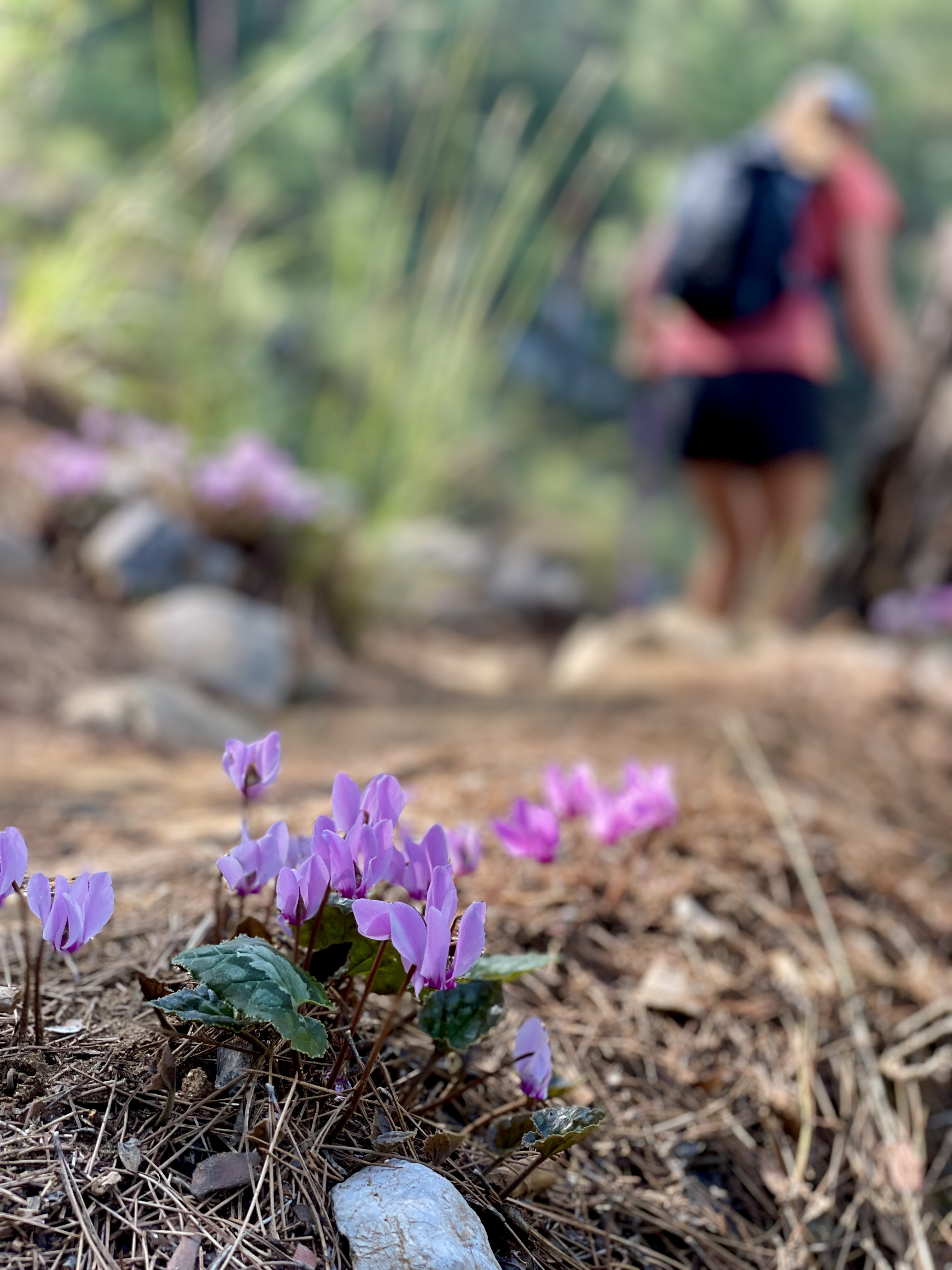
Thus, shoulder seasons are the best. Higher sections (particularly those above Çirali) still hold onto snow until early spring, so late April to early June is perfect, especially given the riot of spring colours and greater supply of water at this time.

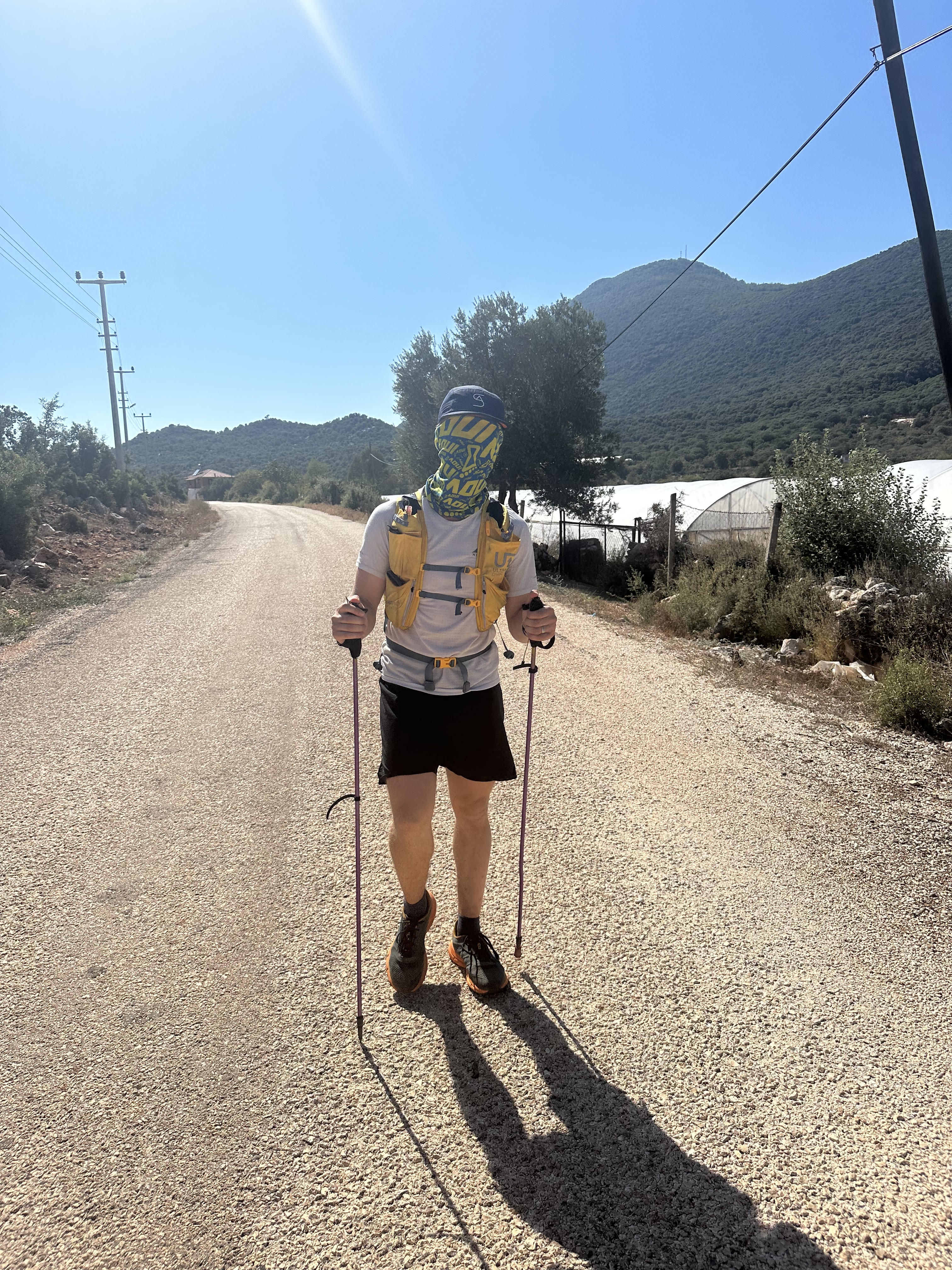
Full covering against the sun

We chose September and October to visit, mainly due to work and other commitments. The climate tends to be more agreeable but we still faced temperatures in the mid-30s, meaning we had to start most days before 7am.

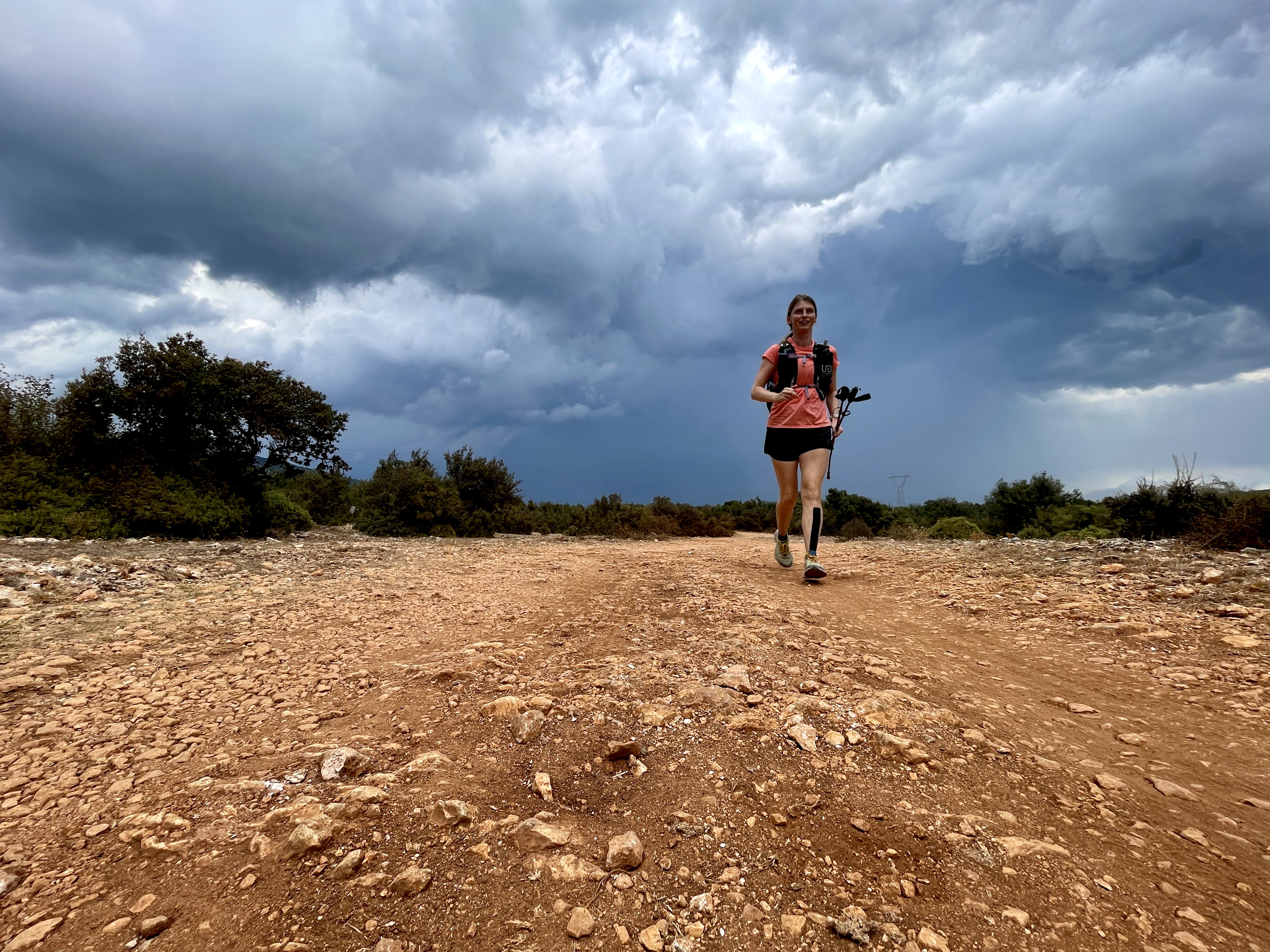
One day, the temperatures hit me particularly hard. I will go into the route in a moment, but on the day from Kaş to Sahil Barak my legs and head turned to jelly in the heat. This particular section was exposed and the trail taunted me, going this way and that before disappearing altogether. In the end, I wobbled to our accommodation with what was likely heatstroke feeling utterly drained.

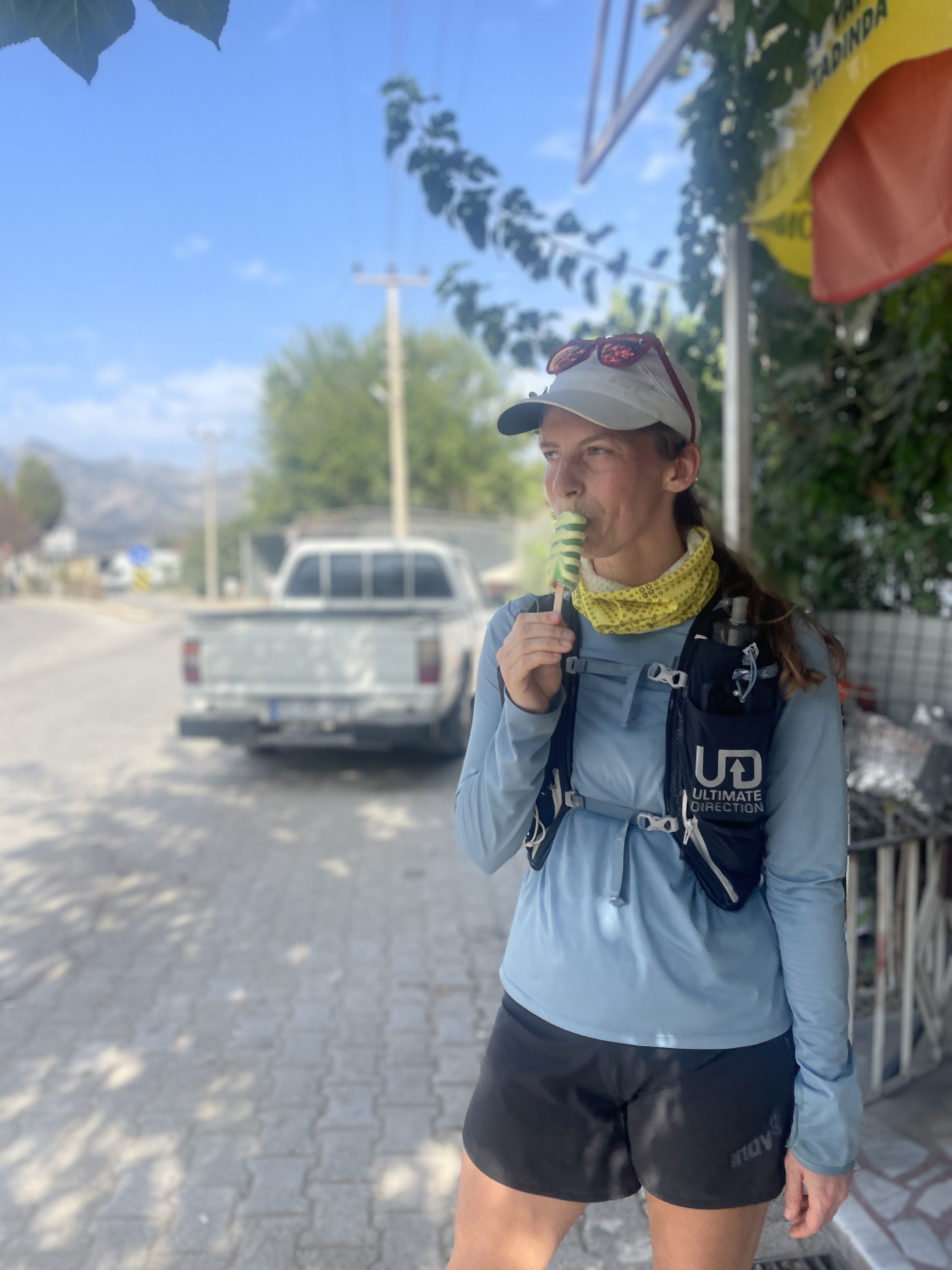
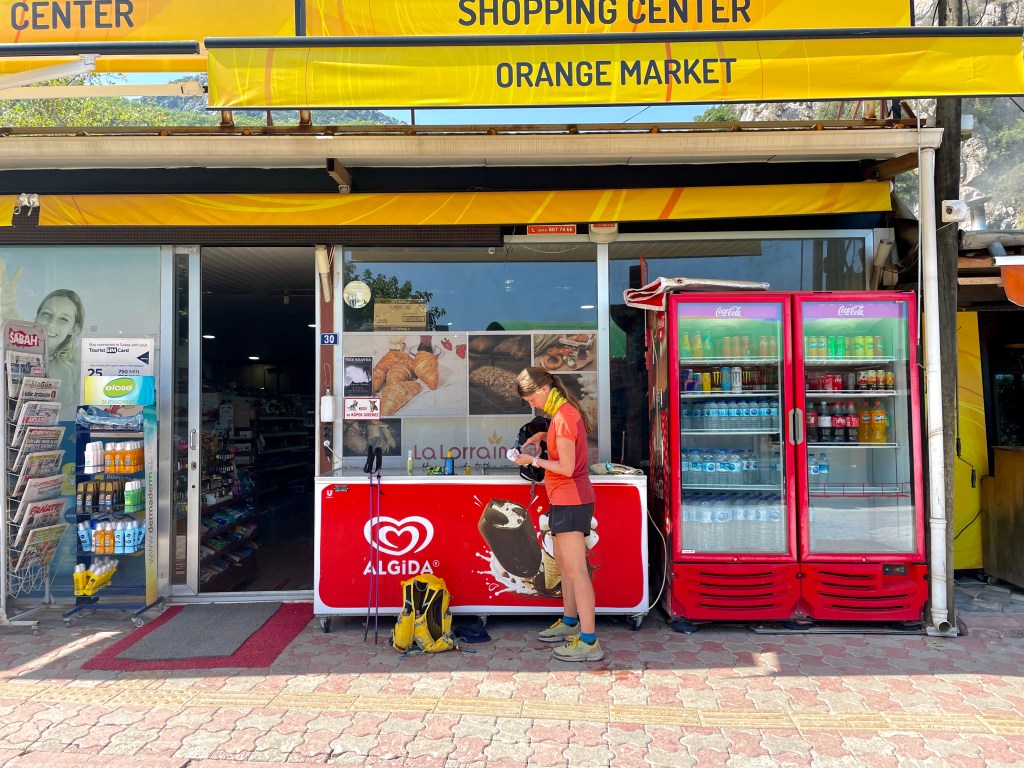
Above: Seeking shade and ice-creams along the route (left); me totally cooked (centre); infinite dips in the sea to cool down! (right)

It was that day that saw us cut our next day in two and completely skipping a remote 40km section to Finike to avoid a repeat of that situation.

All that leads me to say, be mindful of when you go and check where water refills are scarce.

The route

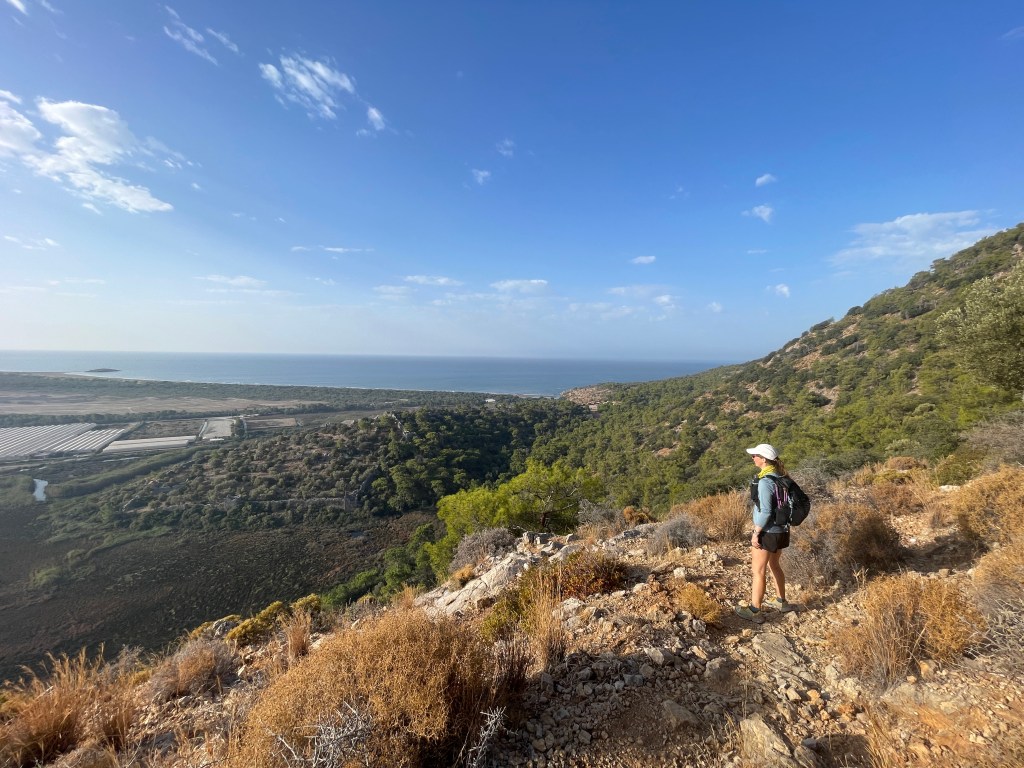
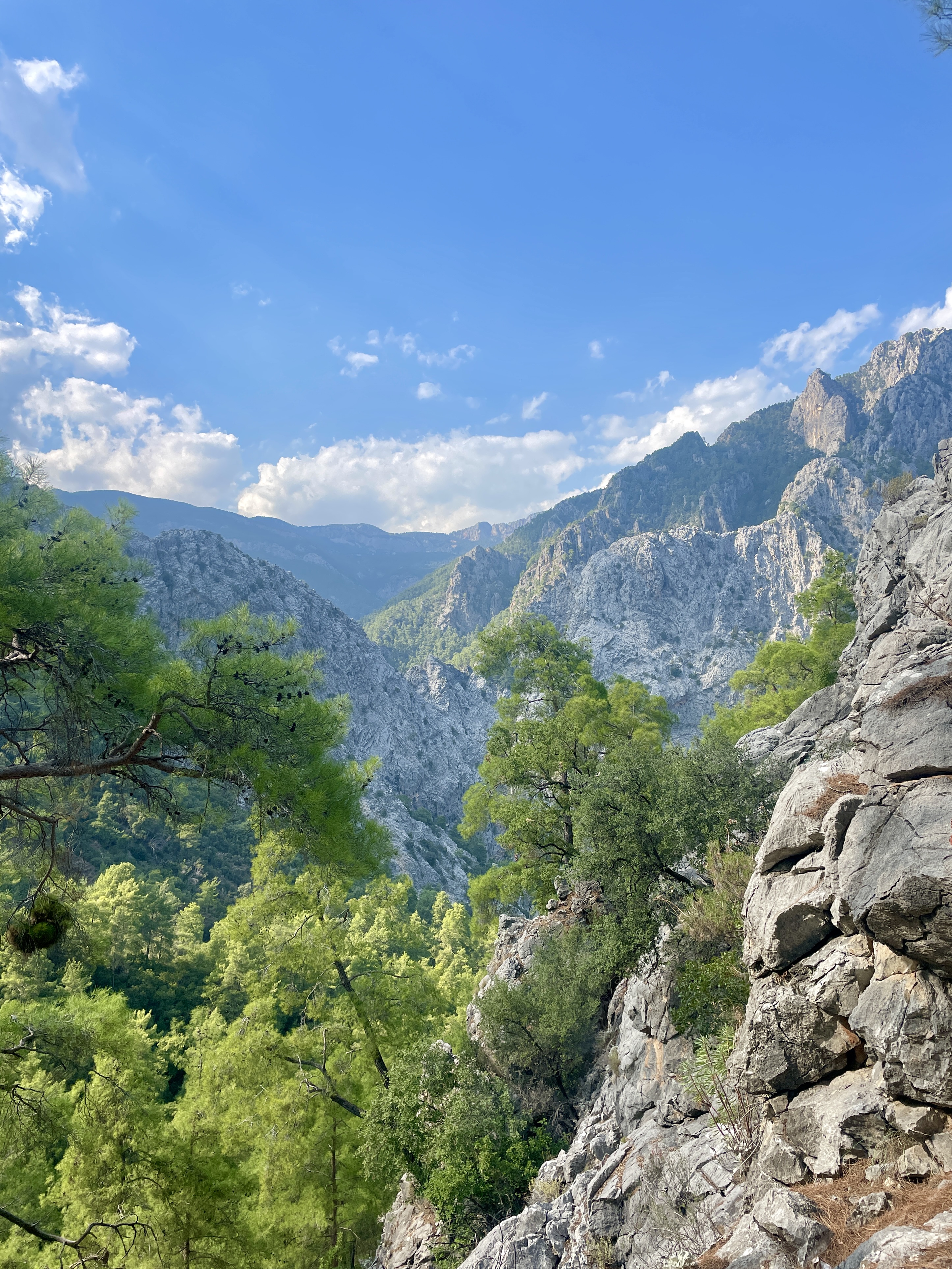
The Lycian Way is divided starkly into three sections: The expansive hillside and tough scrub from Öludeniz to Kaş; the rugged coastline from Kaş to Demre; and the forested mountains from Finike to Antalya.

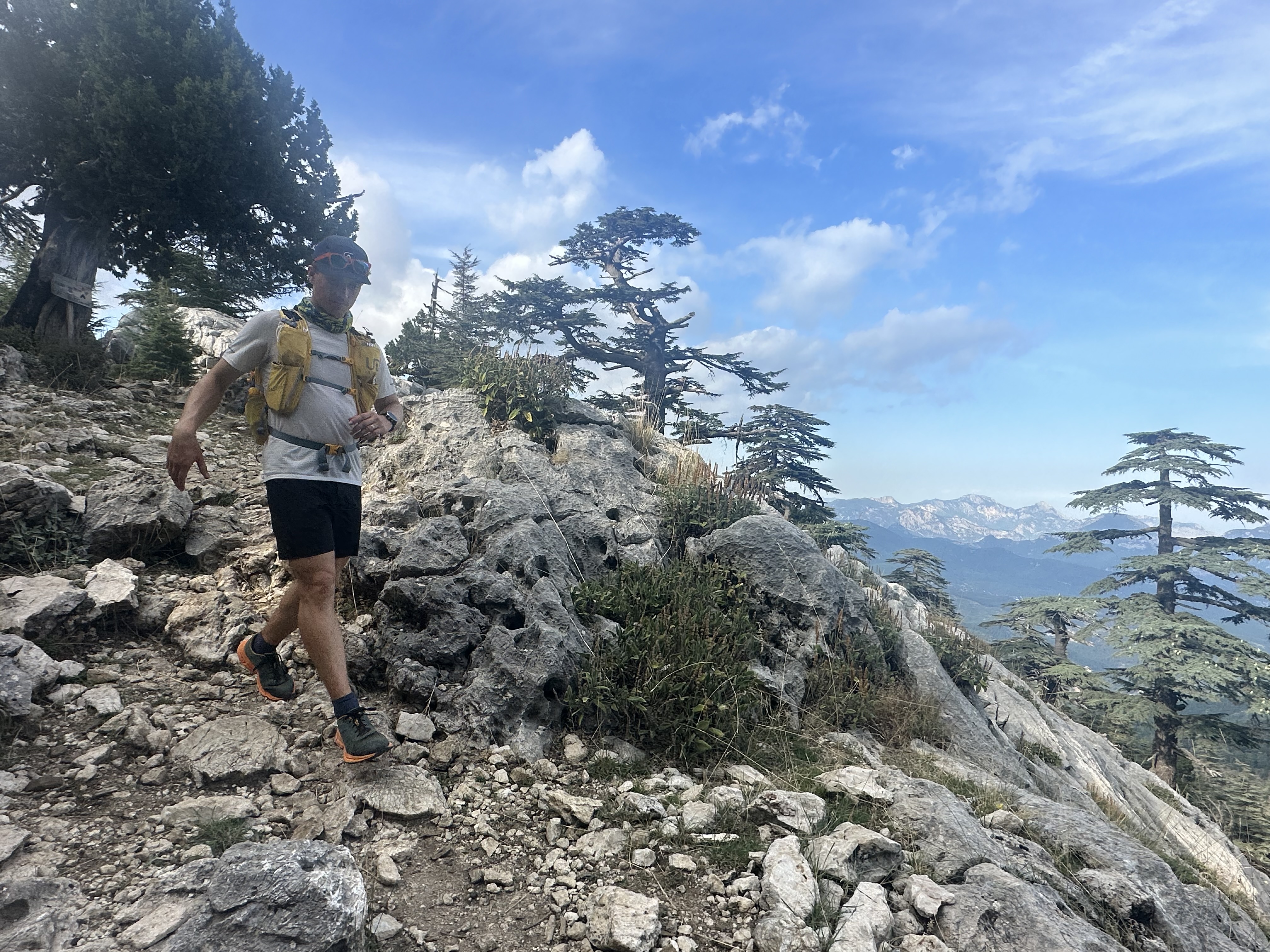
It is a sharp landscape: the spiny shrub snags at your clothing and the limestone eats away at the rubber on your shoes. It’s a wonder livestock find anything edible in this harsh environment, but they do!

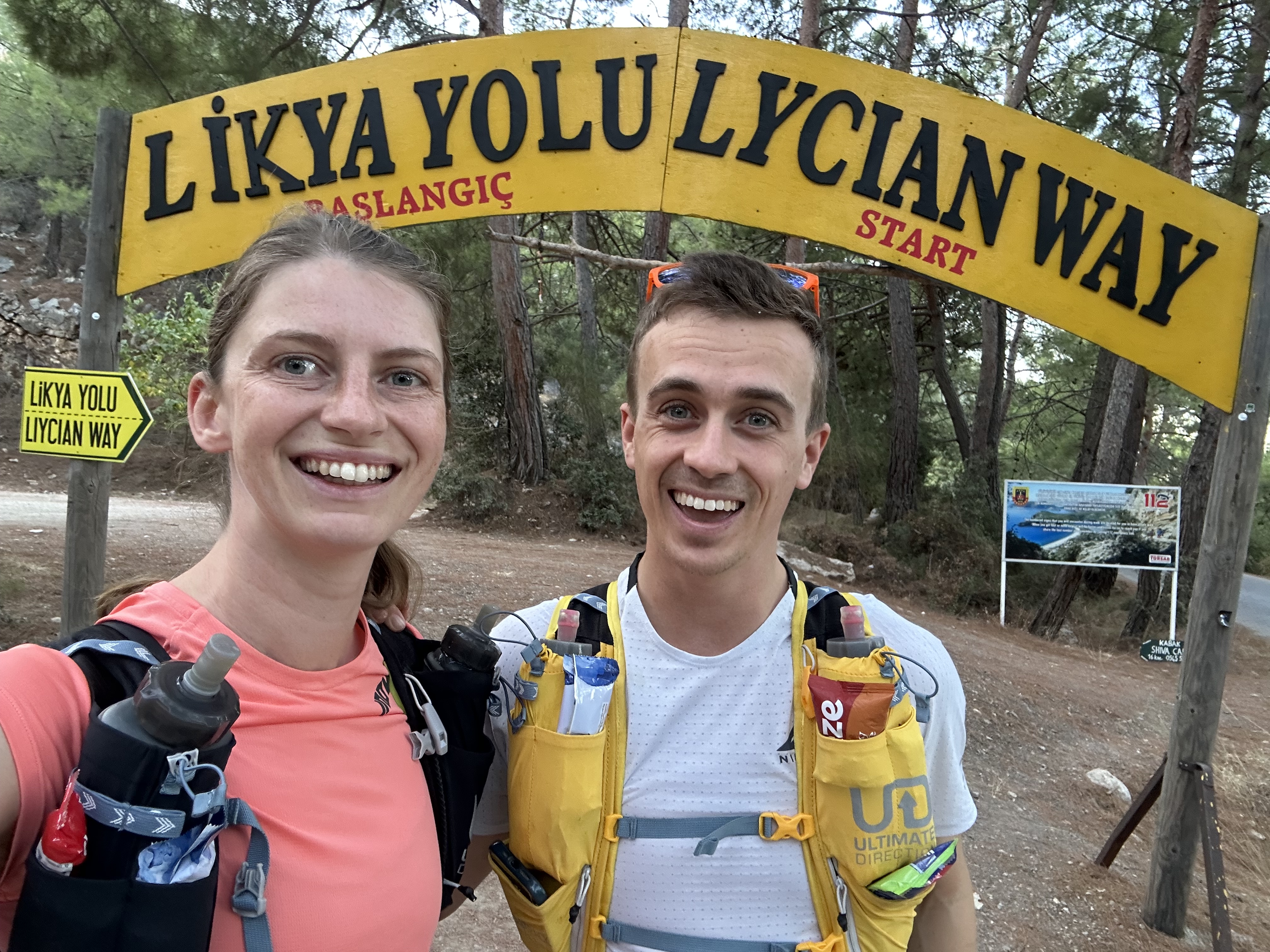
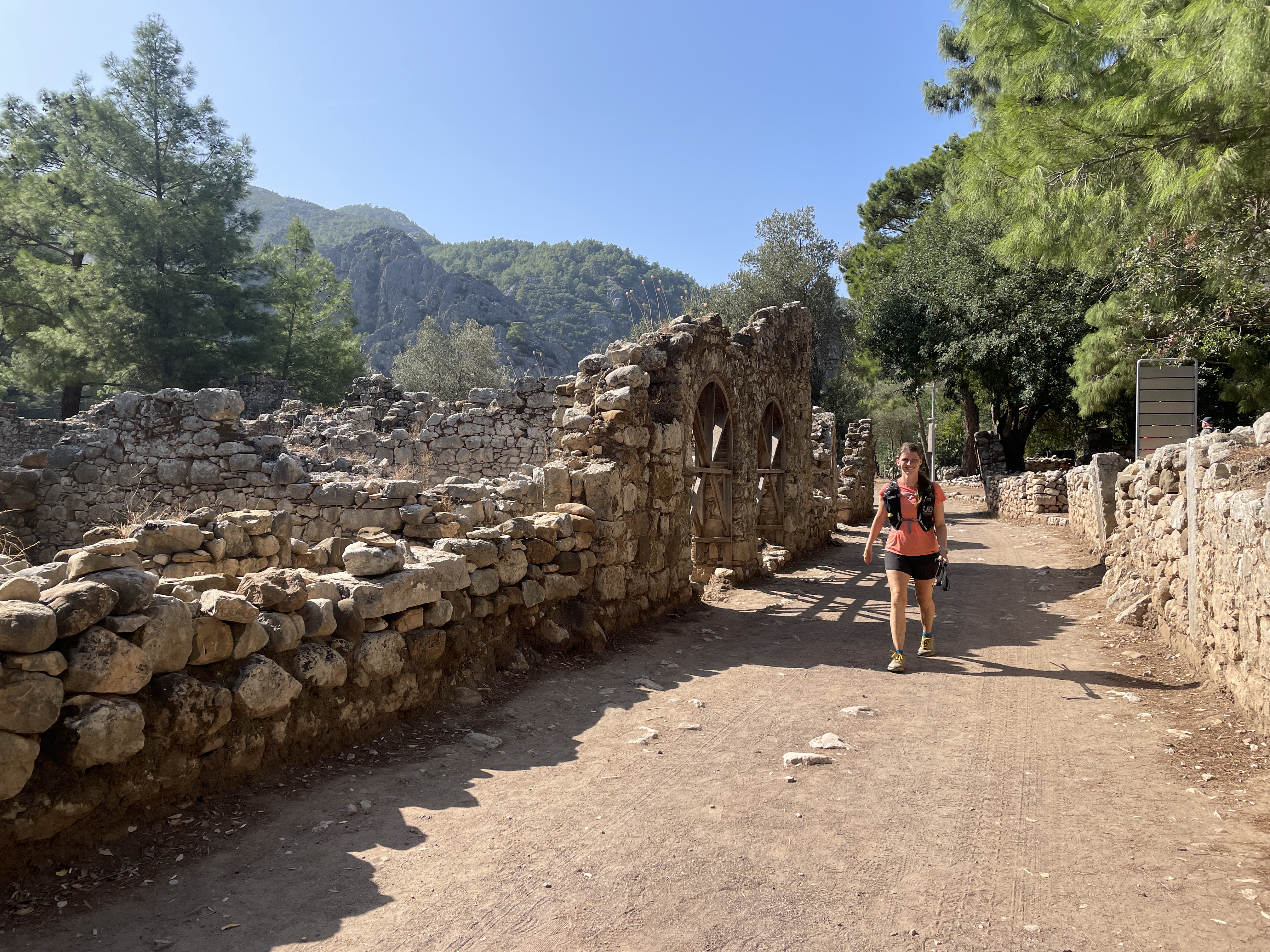
I will never forget the variety of that first day. Leaving the yellow archway marking the start of the trail in Öludeniz, we skirted the soaring Babadağ mountain with a gigantic Turkish flag perched at its summit. It’s sheer face was decorated with layers of rocky slabs cascading on top of each other like enormous grey feathers.

We passed through pine forests where beekeepers collected the sweet honey that would appear on our breakfast plates every morning thereafter, before dropping precipitously down to the secluded shores of Kabak.

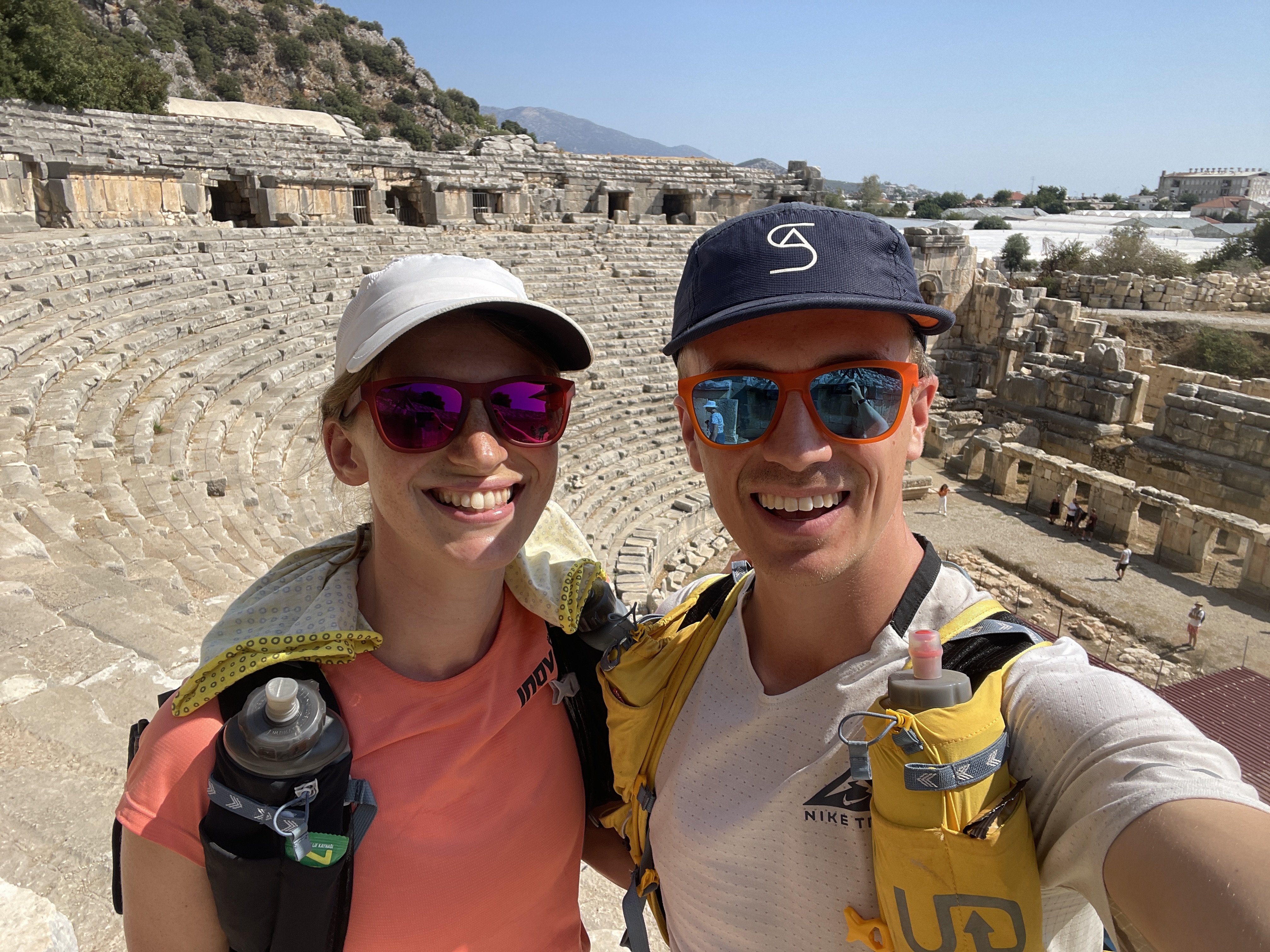
Over the coming days, we would find the trail to straddle various dichotomies: Mountains and sea, ancient history and modernity. In places, old waterways and roads are slowly being consumed by the prickly vegetation. In Europe, historical monuments are imprisoned behind paid entries and turnstiles, whilst here you are crawling through ancient Lycian ruins just to get from A to B. It just goes to show how intertwined the people are with the land around them.

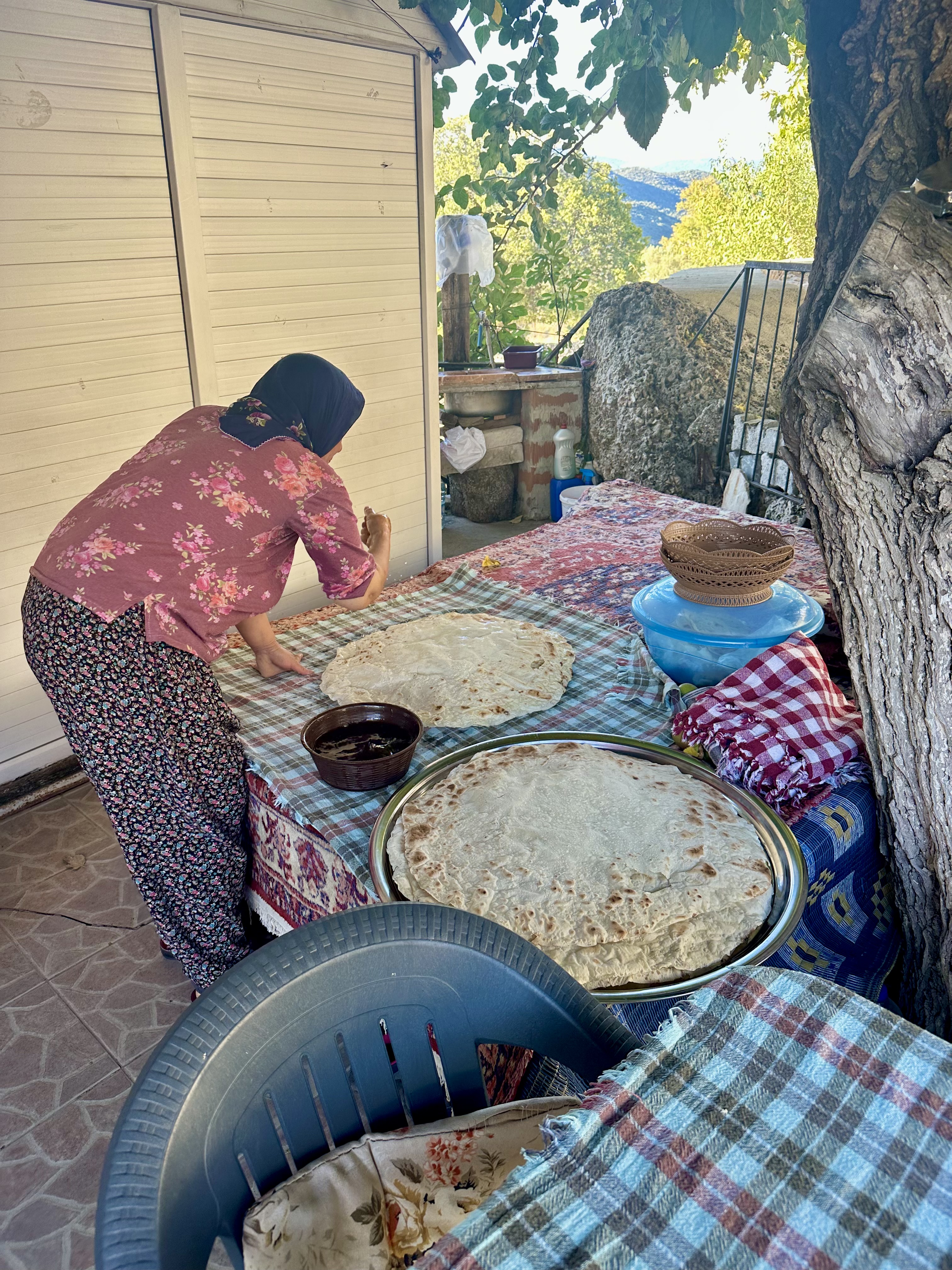
There is still a strong culture of transhumance and traditional farming in this region. We passed through numerous yaylas – high settlements where farmers bring their livestock to summer pastures before returning to the sea over winter. With each yayla we passed, bronzed hands reached out to offer çay (tea) thick with sugar, and warm smiles beckoned stories told through hand gestures and staccato sentences.

This blend of the people and landscape was really a characteristic of the first section, with the people we met just as hardy as the world around them.

The end of the first section came abruptly with the eruption of an enormous thunderstorm over Kaş, turning the dusty trail to cake mixture that made our shoes three times heavier. Following the heatstroke I mentioned earlier, we caught a bus to Finike and also skipped the next section along the shore to Karaöz – a pan flat, mostly tarmac section with little to no shade was not what we came for. Whist finishing the whole trail on foot was our aim, we were still here to enjoy ourselves.

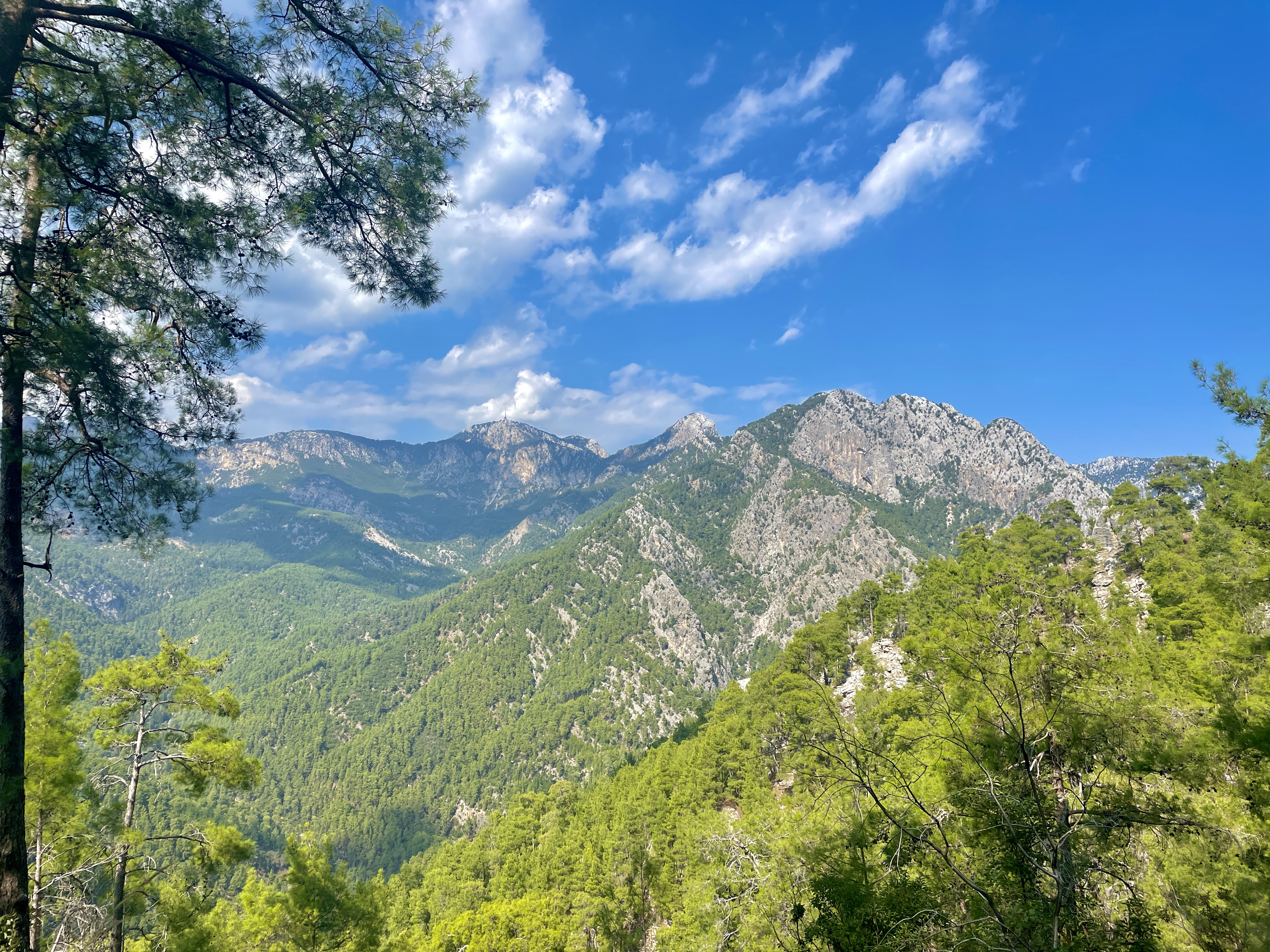
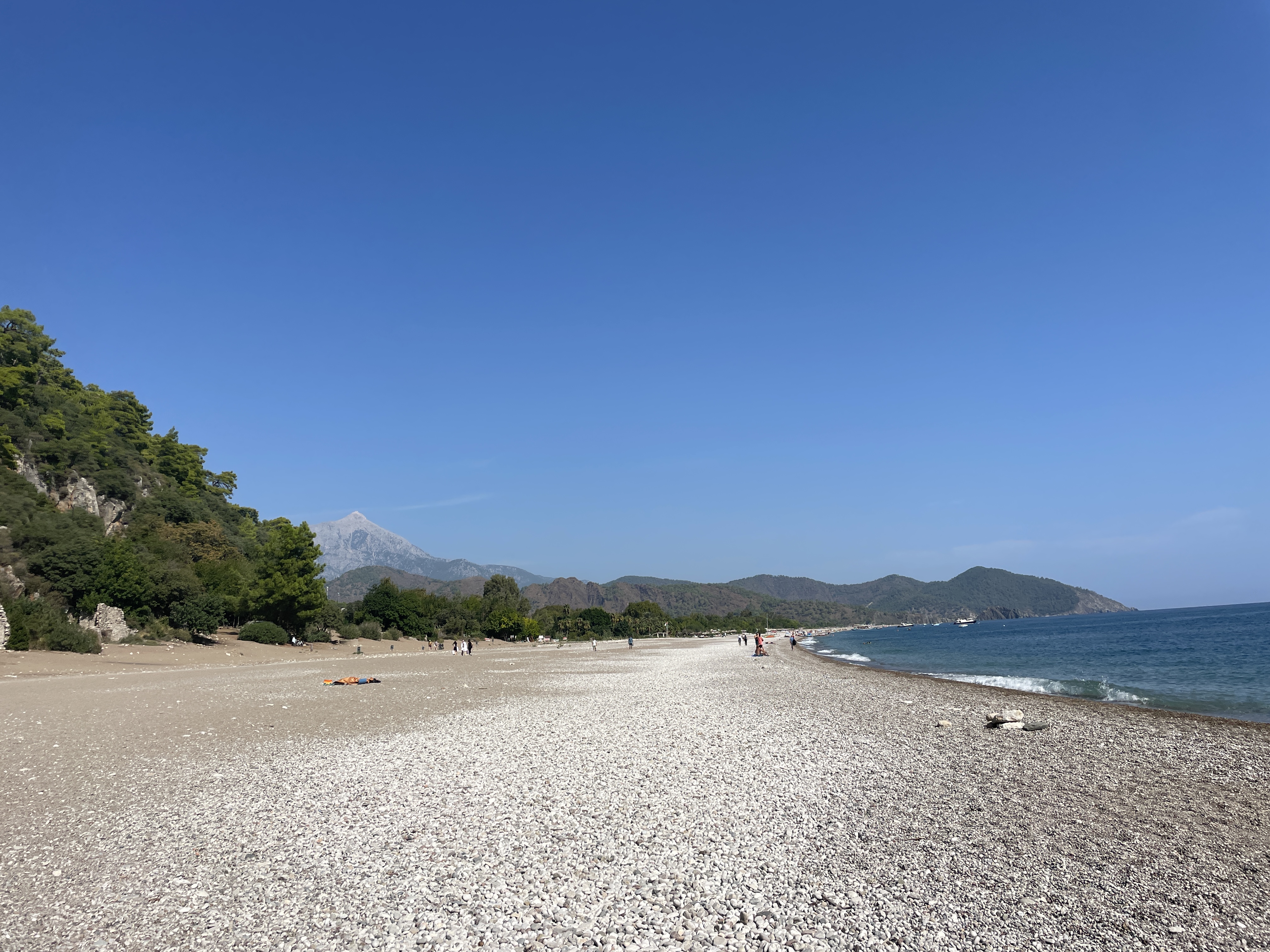
The section from Karaöz to Antalya was my favourite of the entire route. The eastern coast of Lycia was practically verdant compared with what came before; it was like we’d entered a completely different climate, as though the trail had evolved in the time we had been away from it.

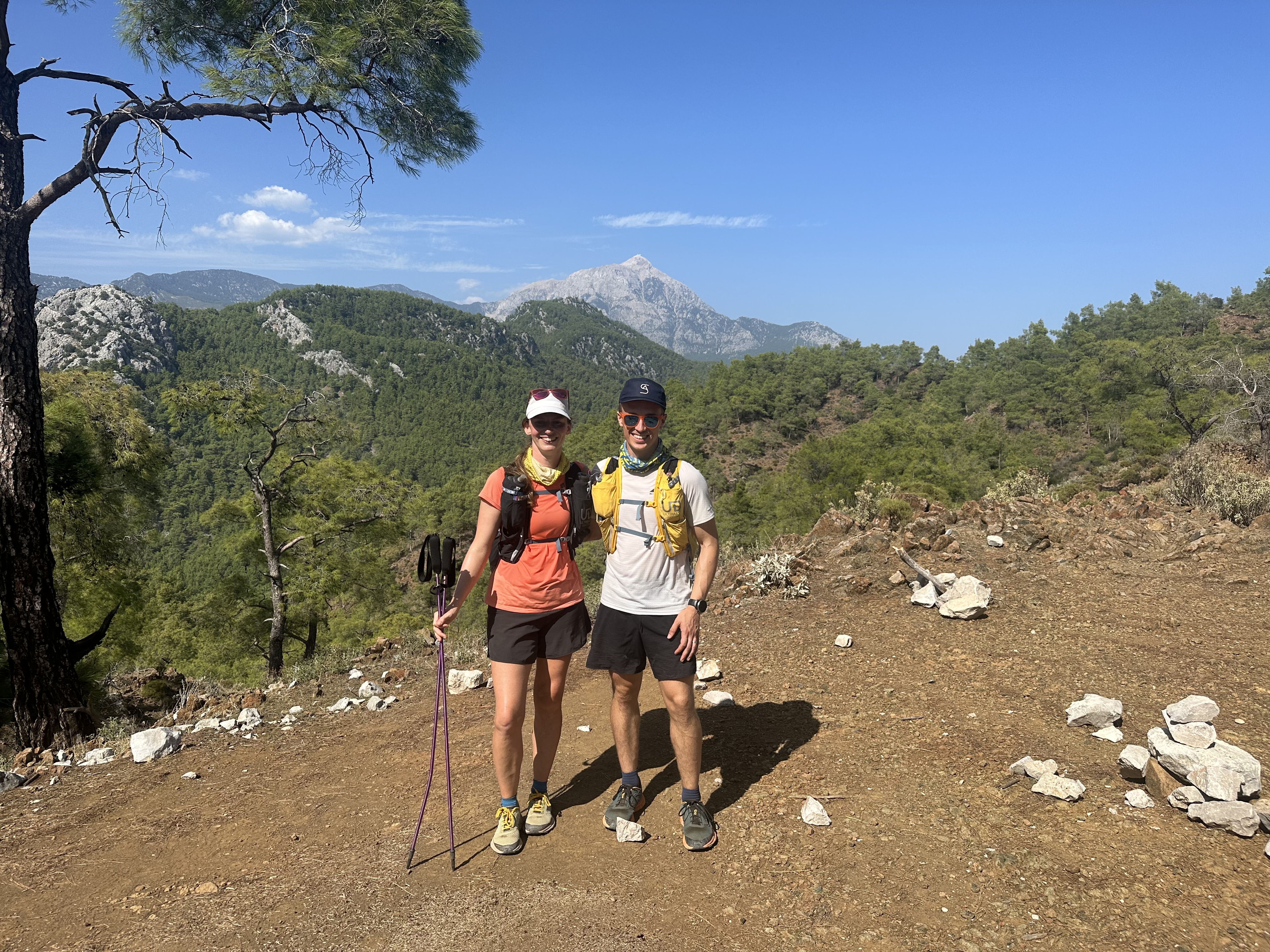
This section is perhaps more touristed, but this was low season so we had whole beaches, cafes and restaurants to ourselves. We passed through jungle-like wilderness, where twisted trees like muscular forearms arched across the trail, stretching towards the crack of light in the canopy.

As we emerged from one such forest, we stumbled into the ruins of Olympos near Çirali, a place steeped in the religious history of this varied coastline. From the nearby beach, we spied the Lycian Mount Olympus – Tahtalı Daği – a towering 2,366m peak gazing out across its dominion. The next day we would be on its lunar summit, our dust-covered faces and grubby clothes clashing with the cleanliness of the tourists who had arrived by cable car to the summit.

Before then, however, we had a long prologue to enjoy that passed through the legendary Chimaera flames and pomegranate trees bowing with the weight of their sweet fruit. We swam in a pool looking up to Tahtalı Daği, ate breakfast in a treehouse, stayed in a ramshackle pansiyon and ran through huge expanses of forest thick with the smell of cedar.

It was a stunning part of the route, delivering us to our finish in Antalya after 15 days of running and 18 days on the trail. The end was the one big thing I’d change about the route. The ‘main’ finish is a remote, challenging slog north before finishing in a nondescript place; our finish was similarly anti-climactic, but at least ended at the sea that had been our constant companion on the trail.

Below I have summarised the full route for you to take inspiration from.

Our itinerary

Here is a screenshot of how we divided the route into the days.

The first ‘Stage’ column refers to an old edition of the book.

Accommodation

We stayed in such a wonderful array of accommodation along the route, including Airbnbs, hotels, pansiyons, yaylas, lodges, and more. You often here this about places people visit, but the people were genuinely incredibly hospitable and willing to help you.

A big thing to remember is Booking.com and Airbnb are not actually available in Türkiye. This might seem strange given the large number of places listed on there. The way around this is to not search for accommodation on local Wi-Fi. ESIMs seem to work just fine (I use Airalo).

Aside from that, the biggest culture shock for anyone coming from Europe or other western countries is the haggling culture. In this part of the world, bartering is a social activity and breeds goodwill between you and your prospective host. Fail to engage and you will probably just offend them, which will be rewarded with a high price for your bed.

You really don’t need to be a commodity trader to participate in bartering, nor a board room negotiator. Everyone knows you will meet somewhere in the middle, so give it a go. Inflation in Türkiye is still a runaway train, so prices will have ballooned even more since we visited. Back then, a room for 500TL seemed very reasonable; now that might be closer to 800TL.

To put that into perspective, 500TL is now worth £11.15 (13,31€ or $14.57).

The view from Yayla Kuzdere (one yayla that was on Airbnb and books up fast)

Our tactic for accommodation was to run half our distance for the day and book our accommodation over lunch. This worked every time. With pansiyons and yaylas, there is often no way to book in advance, so you show up and hope for a room, which I doubt you will every be refused.

We did book a handful of places in advance but we slightly regretted this because it meant the flexibility offered by our main tactic was nullified by the set bookings.

The variety of accommodation is extraordinary. We stayed in a few pleasant hotels and B&Bs, but we stayed in several…unique establishments. The most peculiar of these was Ali’s Pension. We found pansiyons to often be named after the man of the house but managed by the wife.

Sadly, I have forgotten the name of the woman who cared for us, so I will call her Asli. Upon our arrival, it was clear our presence was not hotly anticipated, but she went about showing us around the homely pansiyon, with cast iron pans covering surfaces and threadbare carpets adorning the floor. The exposed lightbulbs hanging from the ceilings provided a bearing for the local insects, with the ubiquitous buzz idesciferible between them. The beds were comfortable but in an austere kind of way. The bathroom featured a squat toilet, a leaky shower, and a resident frog.

Breakfast at Ali’s

Still, it was comfortable and – the weird beefy, chewy stew aside – the food was tasty and filling. Asli wore a cloth around her hair and addressed us in an exasperated yet hospitable way for the evening (we couldn’t tell for sure as she spoke to us completely in Turkish).

In the morning, we were awoken by the first call to prayer loudly quaking through the shutters. Enjoying our staple breakfast of strong cheese, honey, eggs, olives, cucumber, tomato and bread, Asli beckoned for Bo to come with her. Soon, Bo was in the garden throwing feed to the chickens with Asli by her side. While I prepared the rucksacks for the day, the two returned to the breakfast table. Asli reached up and removed the cloth that bound her head to reveal long hair as red as the rusty soil her chickens pecked for seeds. Shaking it out, she appeared immediately relaxed. It was a real delight to have built up a rapport with our host through shaky interactions and stilted conversation.

It was moments like this that made the trip so special. If you are nervous, don’t worry, so was I. But these interactions are what make trips like this so memorable and open our eyes to other cultures and ways of living.

Food, drink and resupply

On the subject of eating, I will briefly touch on food and drink.

The Turkish breakfast is, in my opinion, the best of ‘the breakfasts’ out there. Usually it features cheese, cucumber, tomato, bread, fresh honey, olives, eggs (either boiled or as an omelette) and sometimes meat. The best breakfast meal – in fact, one we had at several points in the day – was menemen. This tomato-based scrambled egg meal was something we asked for repeatedly on the trail and actually make at home today! The basic ingredients are almost always available wherever you stay, so it is a good one to ask for.

The Holy Grail: Menemen

We would often ask our hosts if they would mind making breakfast early for us and, if possible, make a packed lunch. Most did this without question. If we struggled to have lunch made for us, we would buy a loaf of bread alongside cheese and ham from one of the innumerable little shops on the way.

Dinners were always made by our hosts, but we did occasionally visit a restaurant on our rest days. One of the best homemade meals was at Hussein and his wife’s pansiyon in Gökçeören. His wife (who again was nameless) made homemade flatbreads on a wide pan, serving us chicken thighs, rice, vegetables and dessert. It was a mountainous portion and definitely fuelled us up for the next day. Hussein, meanwhile, sat watching videos on his phone, smoking, and jabbering with neighbours.

Every day or so we would load up on additional snacks and bottled water. Generally the water from indoor taps is drinkable but I would filter water that comes from fountains and taps. If we had access to a fridge or freezer we would put our soft flasks in overnight.

You will find your own way, but generally small local shops are very frequent on the trail so you shouldn’t be without food and water!

The unglamorous stuff

It might surprise you to learn that some moments sucked. The most obviously challenging part was the impact on our bodies, with various niggles appearing along the way and one for Bo that really looked like it might end the run after a few days. The heat was the other big challenge, but I have covered that elsewhere.

In the first section especially we (read: I) got incredibly frustrated with the number of snagging, clawing, biting bushes that lined the trail. It was infuriating at times to have bashed through one overgrown section and emerged scratched and torn, only to find the trail had vanished and we had to retrace our steps.

Speaking of the trail, there were some bits I would go back and review. Specifically, the final descent into Gedeller on the penultimate day was incredibly taxing. At times we were running down sinuous forestry trail, only to turn off and find ourselves clinging to a cliff face, edging towards another section of forestry trail. There has to be a smoother way down that connects the tracks without the vertigo-inducing traverses.

I could go on about mosquitoes, heat-induced squabbles, angry dogs (very few), chafing or any number of minor inconveniences, but they pale in comparison to the overall experience.

That feeling of carving a line along the southern coast of Türkiye is incomparable, and the memories of hospitality, delicious food, unlimited swims in the warm sea, and staggering scenery will last forever.

One memory epitomises the trip for me. In the final days on the trail, we were climbing along a high ridge covered in forest. On either side, the mountain swept down to the valleys below and spilled out to the sea. As we made our way up, the midday adhan echoed around us. The sound rippled through the towns as each started up moments after the other, creating a crescendo effect to our ears on that high ridge. It was a transcendental experience; eerie in a way, but wonderfully moving.

The end

As it was our honeymoon, we had to finish things off in style. We stayed for a few nights in the old town of Antalya, sampling the local culture as much as we could. The return to bustling civilisation and gaudy tourists was jarring; we felt like we’d experienced a completely different kind of Türkiye to the one these people were. Even in the city, we were searching out the little corners unbeknownst to the package holiday travellers.

Still, it was an enjoyable way to wind things down after such an amazing adventure.

I know, one year on, I will have forgotten things in this blog. If you have questions, please leave a comment or contact me via the contact form – I might even update the blog as they come in.

Thank you for reading – I hope it was useful!


Go back

Your message has been sent

Warning
Warning
Warning
Warning.

Van Life in Europe: Our biggest adventure yet

Sitting on a warm balcony overlooking the shimmering Mediterranean Sea, our running clothes hanging from the railings, my wife and I discussed everyone’s favourite topic: the future.

We were about halfway into our fastpacking trip along the Lycian Way (a longer story is coming on that, but you can read the preparation blog here) relaxing on our rest day in the town of Feltre. It was our honeymoon, and the longest time either of us had taken away from work in the four years we had been together.

This conversation had started several months before the trip: “What do we really want to do?” Everyone asks it from time to time; it’s the niggling thought that approaches us in the dark as we lie awake, creeping in silently before tapping us on the shoulder and asking, “What’s it all for?”

For all intents and purposes, we had pretty much everything we could be happy with. We both had jobs, a house in the Lake District, a dog – above all, we were incredibly content. As with any journey, though, there comes a point where you want to be moving in a direction. It’s not necessarily a goal or end, but a desire to take hold of the narrative of your life rather than let it wash over you.

One idea kept coming to the surface: living in a van. Bo, who is far more the traveller than me, was eager to explore. Ever the hobbit, the idea of uprooting my life for the unknown brought a clenching sensation to my stomach. Like any unexpected journey, however, it requires faith to take the first steps and trust that this is simply the first door to open into a myriad of possibilities. Maybe putting a dog-ear in the book of our regular life was what we needed.

“I think we should do it”, I said on the balcony. “I think I need to do something that scares me.”

First steps

Leaving the sunny shores of Türkiye behind, we began the search for our new home. The first challenge was not being swept up by being excited upon seeing the first few vans. There was an element of scarcity mindset when we viewed some vans, afraid we might lose out on the few which a) Fitted our budget, b) Were in good condition, c) Met our needs in terms of conversion.

We toyed with the idea of building our own van, but the time required to turn something around for January would have seen both of us leave our jobs two months earlier than planned – not to mention learning everything about converting a van in that time.

After a few disappointments and a sense we were scraping the barrel of opportunities, I took another look at QuirkyCampers. For a long time, we had avoided heading to London to view a van, simply because the cost of a train combined with the risk of disappointment seemed an expensive gamble.

Bo was on a backpacking trip in Spain when I found a van in London which fitted our every requirement. All it needed was a test drive. I contacted the sellers, ensuring the van would still be there when I got down from Kendal, and bought a one-way train ticket to London.

It didn’t take long for me to make the phone call to Bo: “This is our van.”

Early adventures

The big leap

As we worked out our notice periods, we began turning Ziggy (the name we gave to the van) into a home. There wasn’t much for us to do, but we wanted it to feel like our own. In the meantime, I found some freelance work with a group called The Green Runners, which would support us on our journey across Europe.

Leaving our jobs was one of the scariest parts of our preparation. The doubts clamour for attention: Can we still afford it? What do we do about the ‘gap’ in our CV? What if another opportunity comes up? Will we get a job when we come back? What about the house?

Thankfully, we did both manage to find some freelance work. At this point, though, a strange calm came over me. I remember my gran would often say, “What’s for you will not go by you.” In some ways, it’s a declaration of trust that things will work out, and over the years each of us has found we trust ourselves enough to find those opportunities wherever they are.

As for the house, we thankfully found two excellent tenants, dodging the need to put the house on Airbnb (something we were reluctant to do).

And so it was, after several months of preparation, we set sail to the Netherlands on 5 February 2024. The real journey was underway.

Making memories

As I write this, the sun is beating down on Passo Fedaia, over 2000m above sea level in the Dolomites. It’s 173 days since we caught that ferry and so much has happened.

We spent almost two months exploring the Iberian peninsula, cycling on gravel roads and running to snowy cols. At one point, we were skiing at 3000m in the Sierra Nevada one day and riding through the Gorafe Desert the next, sand and gravel crunching beneath us where there had so recently been snow.

Everywhere we went, we immersed ourselves in the culture, speaking the language as much as we could and sampling local dishes. A standout moment was a restaurant in Antequera, where we ate some of the most delicious traditional food I have ever tasted.

We even had the chance to reconnect with old friends. An old university friend of mine, Luis, lives in the beautiful Zahara in Andalusia. The richness of experience that comes from being shown the nature and culture of someone’s homeland is unparalleled. On top of that, we happened to arrive for the end of the local carnival, when the villagers dress up in themed costumes and sing satirical songs in the crammed bars and restaurants.

Leaving Spain behind, we soon encountered another theme of our trip. Spending such prolonged periods in each country, we began to feel at home in each. Crossing a border, however, threw our rhythm out the window as we awkwardly replaced our “Gracias” with “Merci”, our staple grocery list with a new one, and adapted to new shop opening hours and landscapes.

When we entered France, our first night was spent on a vineyard, the first of many we would visit on our trip. For a small price, you can pitch up and – in some places – enjoy their hospitality and usually be given a wine tour!

Rapidly crossing the south-eastern edge of France, we made for the Alps. Whereas in Spain we had just been enjoying temperatures in the mid-twenties, the Alps were still gripped by the steely hands of winter. So much so that, as I made my way towards the foot of Alpe d’Huez to cycle up it, I experienced brain freeze on a bike like I have never done before.

If we could go back and do it all again, it would have been to stay in Spain even longer. We had expected a drop in temperature, but when the mercury dipped to minus-nine overnight we knew we had headed north too fast. Over the next few weeks, this would be reaffirmed as snow banks packed out the northern slopes of mountains, passes remained firmly shut, and we even got a leak in the roof due to the amount of rain!

It was around this time Bo and I celebrated our first wedding anniversary, stopping in the Aosta Valley and swapping our van for a hotel for the first time on the trip. One of my favourite memories from that time was Bo’s anniversary present to me: a home cooking course.

As we entered a tiny hillside village, I realised this was not simply a course where we would learn how to make traditional home-cooked meals; it was in a family home, cooking alongside Head Chef Mum and her daughter. What was meant to be a few hours’ cooking turned into a five-hour experience, culminating in a meal with the family featuring local hams, cheeses, their own wine and, of course, tiramisu.

Learning to adapt

If Italy caused us to do anything it was adapt. Bo developed a knee injury skiing in Andorra, so we re-evaluated our ambitions and found more joy in the food, wine, walks and gentle bike rides. I still managed to get out and enjoy the dramatic roads and trails, but we found ways to combine our needs.

After the wet weather of north-western Italy, we also switched our plans in favour of the warm temperatures in the east, fixing the leak in the roof and enjoying balmy nights on sunny vineyards.

I headed to the Balkans to work on The Accursed Race by Lost Dot, during which time Bo continued to explore the Italian Alps with some friends. It was clear, though, that even with friends on hand, managing van life alone is incredibly challenging – especially when you are injured and also have a dog to look after.

When I returned from the Balkans, we agreed it was a good time to regroup and head back to the Netherlands for a while, allowing Bo to recover in flat country and to reunite with family. If we learned anything from this time, it was that life simply throws you these curveballs and, when you’re on the trip of a lifetime, those curveballs seem to come at you even harder.

When we did set forth once again, we learned more and more to enjoy those special moments together. Whether it was the short bike rides into town for bread and cheese, or sheltering in the van from a thunderstorm in the Jura mountains, everything weaved together into the tapestry of our journey.

The Alps: Take II

In the space of just a couple of months, the Alps had shaken off their winter coat and stood resplendent in a myriad of colours as the Alpine meadows bloomed and the sun beat down on their soaring tops.

I still haven’t managed to get my head around this sudden character change in these mountains. Driving through Annecy, it was like we had simply twisted a kaleidoscope to reveal a new pattern to these peaks. Riding up Col de la Forclaz, the sea change was palpable: Where once I had roads to myself, other cyclists were whizzing past; where we had previously huge car parks to ourselves, suddenly we were jostling with other vans and motorhomes for position.

I felt for the mountains in some ways, in that their peace was now shaken by swarms of ants crawling around them. They seemed to respond to this with flashes and booms, as summer thunderstorms prowled through the valleys.

It was clear, too, that our previous overnight stops were now completely unsustainable. The cool temperatures were gone. We sought higher ground, which took us to over 2000m regularly. One such time I took on a ludicrously steep bike ride, climbing well over 2000m in under 60km, meeting Bo at the top of Alpe d’Huez where we spent two glorious nights under the stars. The next morning, we took a sunrise walk around two high lakes – just us, the golden mountains, the marmots, and the glittering meadows in their coat of morning dew.

By now we had set into a very happy rhythm and pace of life. We would spend at most two nights in one spot, enjoying several nights in the same area before moving on, driving much less than we had previously.

We arrived on the Col du Lautaret on 1 July, one day before the Tour de France. I had never seen the Tour in person before and we had picked quite the stage: stage four – the first in France of this year’s Tour – a 140km stage over Sestriere, up the Lautaret and over Col du Galibier. It was a carnival atmosphere, the roads lined with spectators and abuzz with activity. Though the race itself was gone in the blink of an eye, the hours spent waiting on the side of the Galibier will last long in my memory, heightened by the fact Bo was making good progress with her knee.

Challenges of geography

As the Tour rumbled away, we took a deep breath and plunged back towards sea level. The temperatures were unbearable, even at 400m above sea level. We wanted to spend more time to the west of Lake Como, so we set our sights on Val Grande National Park.

Whilst a beautiful part of Italy, it presented a conundrum to us we only learned when we arrived. First, at around 1300m above sea level, it was about the minimum we could handle temperature-wise. Furthermore, the slightly awkward presence of Lago Maggiore, Lugano and Como meant that to get to our next destination (Lombardy) required a significant double-back and loop around. Alas, we had learned this was how things went on this trip, so we made our way to Lombardy and the Passo San Marco for our next 2000m rest.

Passo San Marco, we were told by a local motorcyclist, is so named after Saint Mark, the patron saint of Venice. The Republic of Venice spanned from the famous floating city northwards beyond Lombardy. The challenge, however, was that in order to reach the more northerly territories, travellers would have to pass through the Duchy of Milan. To avoid this, Passo San Marco was built allowing safe (if not easy) passage across the Republic.

We parked up at the very summit, surrounded on all sides by the Bergamo Alps with views out to the jagged line which marks the Swiss border. The longer we looked north, the more mountains rose to meet our eyes, seemingly endless. As our trip went on and we spent longer periods of time in such places, the more we came to appreciate how the landscape forms our ideologies, identities and cultures. It’s not something you can really appreciate on a quick two-week holiday, but something that you only come to appreciate when your own journey is morphed by the geography and terrain of a place.

Our time on the Passo San Marco came to a thundering end. We awoke one morning to the distance rumbling of what could only be a thunderstorm. For a while I dismissed it as the wind, but it soon became unmistakeable. We sat there, waiting, wondering if we could just sit this out. Soon, it became clear we could not.

As the thunder grew louder and louder, the purple flashes became more and more frequent and soon we were packing the van to enable our swift evacuation. By the time we were weaving our way to the nearby refuge, the storm was upon us – no, we were inside it. When the road carved its way around the hillside, a flash would split the sky beside us and the thunder would vibrate the steering wheel. Rain tumbled from the sky unimpeded, a cascade of water from the heavens. Lightening struck nearby summits as we pulled into the relative safety of the rifugio car park, dashing inside as soon as it opened.

Occasionally, peace descended upon the beleaguered mountains, before another tempest shook the ground and blew the power to the rifugio. I have never experienced a fury quite like that storm showed.

Lessons learned

That almost brings me to today, mist hanging at the base of Marmolada on a refreshing morning at altitude. Bizarrely, Bo and I have now traded places: she is out climbing on via ferrata while I nurse an injured calf muscle.

And I suppose that’s one of the lessons I have learned on this trip: you can be on the trip of a lifetime, but life still happens. Life, with all its little frustrations, worries, upsets and challenges, still happens. It doesn’t take a break even when you are doing something you could describe as life changing – and I would.

Despite my whining about not getting out the last couple of weeks, it’s a valuable lesson in learning to make the most of what you have. This fact likely comes as no surprise to anyone, but on a trip like this it’s easy to be constantly chasing the next incredible experience, when in fact the whole thing is an incredible experience. As Gandalf would say: “All we have to decide is what to do with the time that is given to us.”

Which leads me to my second lesson – or, rather, change in my perception. I don’t think anyone could truly call me adventurous. Sure, I go on some adventures, but doing something that really scares me is not in my wheelhouse, especially when it comes to leaving the sanctuary of home. This trip, however, has completely altered my perceptions. It has been a real joy to experience several different national cultures and innumerable local ones. We’ve switched our brains multiple times to new languages, enjoying new food and idiosyncrasies along the way. In a world where our politics appears to be ever more insular, I truly believe we are enriched by our diversity and our experience of other cultures.

We should be building bridges, not walls.

Crucially, we’ve learned there are an infinite number of possibilities out there. We undertook this van trip scared and uncertain if it was the right decision for us – and it absolutely has been. You can spend hours planning and researching, but often it comes down to experiences, making mistakes, and learning from them.

I am not one for talking about destiny, but how I see destiny is like taking the hand of a child: at times, you will know best, and you will guide them in the right direction; but at other times, the child’s instincts and curiosity lead you to places you had never quite expected, despite your sensible objections.

It works both ways. Going on a trip like this has ended up not about us seizing control of the narrative of our lives, but actually opening ourselves up to new ideas. I cannot say that quitting your job, buying a van and travelling is some kind of panacea, but it’s certainly a lot better than feeling captive to the status quo.

Monserrat

The next adventure

Ultimately, that leads me to the age old narrative climax: The What Next.

Well, we always felt this trip might open ourselves up to new possibilities – and it has. In under two months, we will be moving to Zurich, Switzerland, where Bo has been given an incredible job opportunity after a long interview process.

It has not quite sunk in yet, and I am sure it will take a long time for that to happen, but it is happening. Would that opportunity have come up had we not undertaken this trip? Perhaps. Would we have thought moving to Switzerland possible? I don’t think we would have, actually.

While there is no doubt we will miss our home in Kendal and there will be innumerable challenges ahead, that now seems par for the course. We’ve technically lived in Spain for two months, France and Italy, too, so the challenge seems that bit more surmountable.

I have no idea what will come next, but I know what has been. Our time in the van has not been without difficulties, but through it all are a string of incredible experiences that, had they simply been parts of a holiday, even the most mundane moments would stand head and shoulders above many others.

If you are wondering whether to take the kind of plunge we did – do it. Of course, there are risks, and only you can calculate those, but trust me when I say they are often not as great as you first think. Instead of looking at what could be lost, think of what could be gained: memories to last a lifetime, new opportunities, cultural experiences, space and time to learn more about yourself and what you want.

Take that guiding hand and let it lead you down a new path. You might be surprised what you find along the way.

For now, we have over a month to continue our journey, and we are going to make sure every moment of it counts.

Thank you

No journey like this can be done without help. Firstly, a huge thank you to my wife, Bo. Not only was she crazy enough to go on this adventure with me, she has been there through every problem, every tantrum, every weird camping spot, every thunderstorm, every joyful moment and delight along the way. She has shown such incredible strength to handle her injury the last few months and, ultimately, secure the next part of our journey.

Thank you to our parents, largely for embracing our decision and listening to our worries at each step of the way.

Thank you to Brit and Eli, the Australian couple we bought Ziggy from what feels like years ago. You really did give us the keys to an incredible adventure.

Thank you to all our friends who either came out to visit us or who we met along the way: Andy and Taylor, Luis, Tom, Elise and Koendert, Niamh and Caleb, Lisa and Mike, the Joneses, Linda and Ben, Youp and Christine, Meg and Michael. And, obviously, all those at home.

Naturally, there are many people we met along the way who gave us advice, showed us the way, and provided valuable information.

There will be many more, but thank you to you, reader, for getting this far and hopefully enjoying the story I had to tell. There are so, so many more I could regale but that, alas, will be told over a beer and not via my tired fingers.

Discover, explore, do something scary, and have fun along the way. Until next time…

Got some questions?

Feel free to leave comments below or to email me via the contact form!

Go back

Your message has been sent

Warning
Warning
Warning
Warning.

8 things people don’t tell you about van life

In February 2024, my wife and I (and our dog) set off from the UK in our van to Europe, embarking on a big adventure and the fabled van life.

Van life is all the rage right now. Compared with pre-pandemic numbers, sales of motorhomes and campervans are up 8.25% in the UK. In Europe, the post-Covid 19 boom of campervan owners and ‘van lifers’ caused many regions to invest in new facilities to tackle the growing trend of ‘dirty campers’ who left litter and waste in the countryside.

There are also 16.5 million Instagram posts tagged as ‘#vanlife‘ with the typically hyper-edited images showing beautiful people in beautiful places, touting their digital nomad lifestyle and latest YouTube video.

After a little over a month of living in our van, we have seen some incredible places and done some amazing things: Skied in the Pyrenees and the Sierra Nevada; cycled through rock-hewn tunnels in northern Spain; hiked and cycled up mountains and stayed in remote villages.

But, there’s also been some stuff that is absolutely not worth an Instagram post but is 100% necessary to be prepared for before you start on your journey in your van.

1. The Side Quests

Like any good episode of The Witcher, most days of van life contain a series of seemingly simple yet time-consuming side quests. You can make these more efficient by lumping them into one day, and you can be less fussy with some stuff, but most are unavoidable.

For us, the main side quest was trying to find gas. Our big Campingaz bottle ran out in Portugal and we soon discovered Portugal does not stock Campingaz anywhere. Even when we re-entered Spain, we visited numerous hardware stores and gas stations on the hunt for a bottle before our reserve ran out. We eventually found a reasonable exchange, but this weeks-long search was just one of the pesky tasks that needs done.

Other good ones include: Grocery shopping (which you need to do every couple days because you can’t store a lot); laundry (which weirdly takes ages); emptying the toilet (literally the worst job ever); refilling the water (tricky when some places turn off the taps due to droughts); showering (these can be satisfying when you find a good one).

You get the idea.

2. Rain sucks

This kind of goes without saying, but wet weather is rubbish. Seriously. You are in a tiny space so wet kit takes ages to dry. You also bring a load of water and dirt into the van, which is annoying to clean out.

If, like us, you brought your dog, the problem is only amplified. While we tried to dodge the rain, it kept finding us in north Portugal. Avoid rain at all costs, or find a good system for dealing with it.

Photo of a red tractor in the foreground with misty mountains behind
A soggy day in the Pyrenees

3. The Camper Chat

Arriving at a parking area or aire, you might encounter a few other campers. When you say more than ‘hello’ you enter the ‘Camper Chat’:

  • General greetings
  • Where are you from?
  • How long are you travelling for?
  • Where have you been?
  • Where are you going?
  • What is your van setup? I will show you mine
  • My solar panel can do 500W
  • This is where I take a shit
  • This is how I dispose of my shit
  • This is how long before I need to empty my toilet
  • Special British addition: You guys have European passports? Aw! Lucky you! Yes, we are trying to figure out the 90/180 days rules.

It is all good fun, of course, but I always find that initial series of chat very amusing.

4. You’ll have rubbish days

On a more serious note, there are just days when you are frustrated, not sure where you are going or why you are there, or you just don’t know what to do. We tend to have one of these every 10 days, and usually coincide with Van Admin Day (laundry, groceries, fuel) or rain.

We still haven’t totally dealt with them, but we did make a commitment that we find pastries as soon as we can when we feel bad. It is hard to say why it happens, but usually it is because you have ended up in a kind of no-man’s land, unsure why you are there and what your plan is.

Of course, spontaneity is key in van life, but having a vague sense of direction helps avoid the general feeling of decision fatigue, uncertainty and frustration that comes on these types of days. Also, just expect them. It happens. Not every day is great.

5. You get excited about very random things

When we arrived back in Spain, we got so excited the first time we passed a fuel station. 1,45€ for a litre of fuel! In Portugal it was more like 1,75€!

Sunrise in north Portugal

Finding a good shower is also a 10/10 day. Seeing the watts your solar panel is absorbing is an exciting and often mesmerising experience as you watch it climb higher and higher as the day goes on. Locating a laundrette right next to a Lidl or Aldi. Obviously, finding a tap with free drinking water is a big highlight. And, of course, finding a quality bakery.

There are lots of little things which bring joy when you’re in your campervan, which in normal life would be almost boring.

6. You become a Campervan Spot Hunting Pro

What is the perfect campervan spot? It means a lot of things to different people. It might be a fully serviced aire for some; for others, it might be a long gravel layby under trees, near a river, with no space for anyone else.

As you drive along the road, you will begin to pick out the excellent spots that fit your needs. You will also develop this internal spirit level to know whether you are level or not (you soon find out if you got it wrong).

We are Park 4 Night users and we’ve heard others use Search For Sites. These offer handy tips on good places to spend the night, but sometimes your own intuition is the best thing to rely on.

7. You quickly learn what you like and don’t like

As you go along you van trip, you will start to learn what types of places and situations you enjoy most – and the least.

For us, after trying a couple of times to experience the popular cities on our way (such as Lisbon, Faro, Granada), we found we just didn’t enjoy them as much as we thought and much preferred time in the mountains in small- to medium-sized towns.

Having the van also presents a logistical conundrum at times, with parking and street size becoming a limiting factor. Cities also cater for a touristy vibe that we just don’t enjoy, so always try to stay just that bit more rural to get a more authentic experience.

Quality time with a friend on his family vineyard and olive farm, overlooking the small village of Zahara

8. Take your time

Finally, take your time. It’s sometimes quite easy to just keep moving, and maybe if you are after a ‘road trip’ that might suit you – but we aren’t.

We like to explore a place a little more before we head on to another, doing less places deeper instead of lots of places quickly. I find the latter quite stressful.

If you are pressed for time, choose an area and just explore it, rather than trying to fit a tour of a continent into a couple months. Sample the culture, the landscapes and the places as much as you can.


And that about sums it up! I am sure I have missed a few, and maybe you have some of your own funny lessons you have learned along the way that people don’t talk about. Feel free to leave them in the comments.

The best NOT Wainwrights

Alfred Wainwright’s pictorial guides to the Lake District’s fells are world-renowned.

From the soaring heights and drama of Scafell Pike and neighbouring Sca Fell, to the diminutive Castle Crag and Holme Fell, Wainwright’s selection of 214 fells lays out a challenge to the motivated and a purpose for the rest. They are the basis for many fell running and walking challenges, including the Bob Graham Round, Steve Parr Round and the 214 Wainwright challenge itself (the record currently held by John Kelly at 5 days, 12 hours and 14 minutes!).

It is hard to argue with the beauty of the Wainwrights! Taken from Ill Bell on the Kentmere horseshoe

The 214 peaks are a selection of Wainwright’s beloved fells which he visited on his regular Saturday and Sunday sojourns whilst working as a treasurer in Kendal. Unlike the unequivocal (sort of) 3000-foot benchmark laid for the Munros of Scotland, the Wainwrights are of varying heights and degrees of drama. For instance, no one could argue the likes of Kirk Fell, Helvellyn, St Sunday Crag and Bowfell deserve to be included in the illustrious list. However, questions could be raised over the merits of the nondescript bog of High Tove, the illusive Blea Rigg, and, of course, the beloved Barf.

Meanwhile, several picturesque and pleasant fells were eschewed, although some did end up in his lesser known work The Outlying Fells of Lakeland. Here I would like to draw some attention to those fells which never reached the Premier League of Lake District fells – the NOT Wainwright Wainwrights, as it were. Here are my five for starters – do you have some other favourites?

1. Gummers How, Newby Bridge

Standing proudly above Windermere, Gummers How is probably one of the best know and best loved not Wainwright Wainwrights. With panoramic views and a distinguishable summit clear of the trees, it is no surprise Gummers How has become a popular destination with a lot of Lake District visitors.

This 321m peak is also surrounded by some pleasant woodland and forestry trails, making it an enjoyable day out besides the summit itself.

It did actually feature in Wainwright’s The Outlying Fells of Lakeland book, where he described it was an old man’s hill, “and when ancient legs can no longer climb it know ye that the sad day has come to hung up the boots for ever and take to slippers”.

Not Wainwright Wainwright Rating: 3/5

2. Brunt Knott, Staveley

When I first starting my own sojourning around the Lake District, Brunt Knott was one of the fells my then-girlfriend-now-wife took me up fairly frequently. Starting from the village of Staveley right on the edge of the Lake District National Park, you follow footpaths through pleasant fields and woods before shooting straight up the nose of its grassy slopes to the lone summit and its trig point.

At sunrise, there are few places better to be, with expansive views to the Dales and Morecambe Bay, and then into the Lakes with the sun-kissed peaks of the Langdales and Coniston on the horizon. It really is a magical top, with the added bonus of a dip in Gurnal Dubs reservoir if you take the long route back via Potter Fell.

Not Wainwright Wainwright Rating: 5/5

Togo at the summit of Brunt Knott

3. Rowling End, Keswick

Rowling End juts out from its towering neighbour, Causey Pike, into the space about Little Town. While Wainwright liked to include seemingly unremarkable promontories such as High Hartsop Dodd in his pictorial guides, Rowling End was overlooked in the final list of 214.

Whenever I run over Causey Pike and descend its eastern flank, I feel this yearning to finish the descent off by touching the top of Rowling End, in the same way you just have to say “big stretch” when your dog stretches out. Not doing so is like watching a line of dominoes fall over and the last one stays standing. It’s an itch that must be scratched.

Similar to the previous two, it offers excellent views towards Keswick and the Skiddaw massif, as well as peering into the Newlands Valley and accompanying fells of Robinson and Hindscarth.

Not Wainwright Wainwright Rating: 3/5

4. White Maiden, Coniston

White Maiden is a pleasantly named fell at the very edge of the Coniston Fells. Rather like Rowling End, it lies as a soft end point to the rolling ridge and ferocity of the cracked and brooding Coniston Fells. I often wonder whether the Old Man of Coniston and the White Maiden were ever acquainted – perhaps someone knows of such a tale?

White Maiden is easily accessible for anyone scaling Walna Scar – it even features a small cairn on its 608m top. Just like its neighbours, the views over Coniston Water are a treasure, as well as its excellent vantage towards the Old Man and his pals.

Not Wainwright Wainwright Rating: 4/5

Above Newlands Valley

5. Black Combe, Millom

I have not climbed Black Combe myself, but interestingly it did feature as a chapter in itself in Alfred Wainwright’s The Outlying Fells of Lakeland. It was also featured in the words of Wordsworth, who exclaimed it had “the amplest range of unobstructed prospect may seen that British ground command”.

Rising prominently to 600m, it stands alone in the SW Lakes and looms above Millom and the coast line. Its long grassy slopes have also given rise to a tradition in the Black Combe fell race of timing the final descent, the fastest completing it in a little over nine minutes!

Black Combe certainly should be on anyone’s list looking for a different angle to the usual 214 Wainwright fells.

Not Wainwright Wainwright Rating: 5/5

Over to you!

What are some of your favourite fells that are not featured in Wainwright’s pictorial guides? Do you have some that need a bit of a shoutout? Leave a comment below!

For those interested in finding more, The Outlying Fells of Lakeland is a great place to start. Here is a pleasant overview of it.