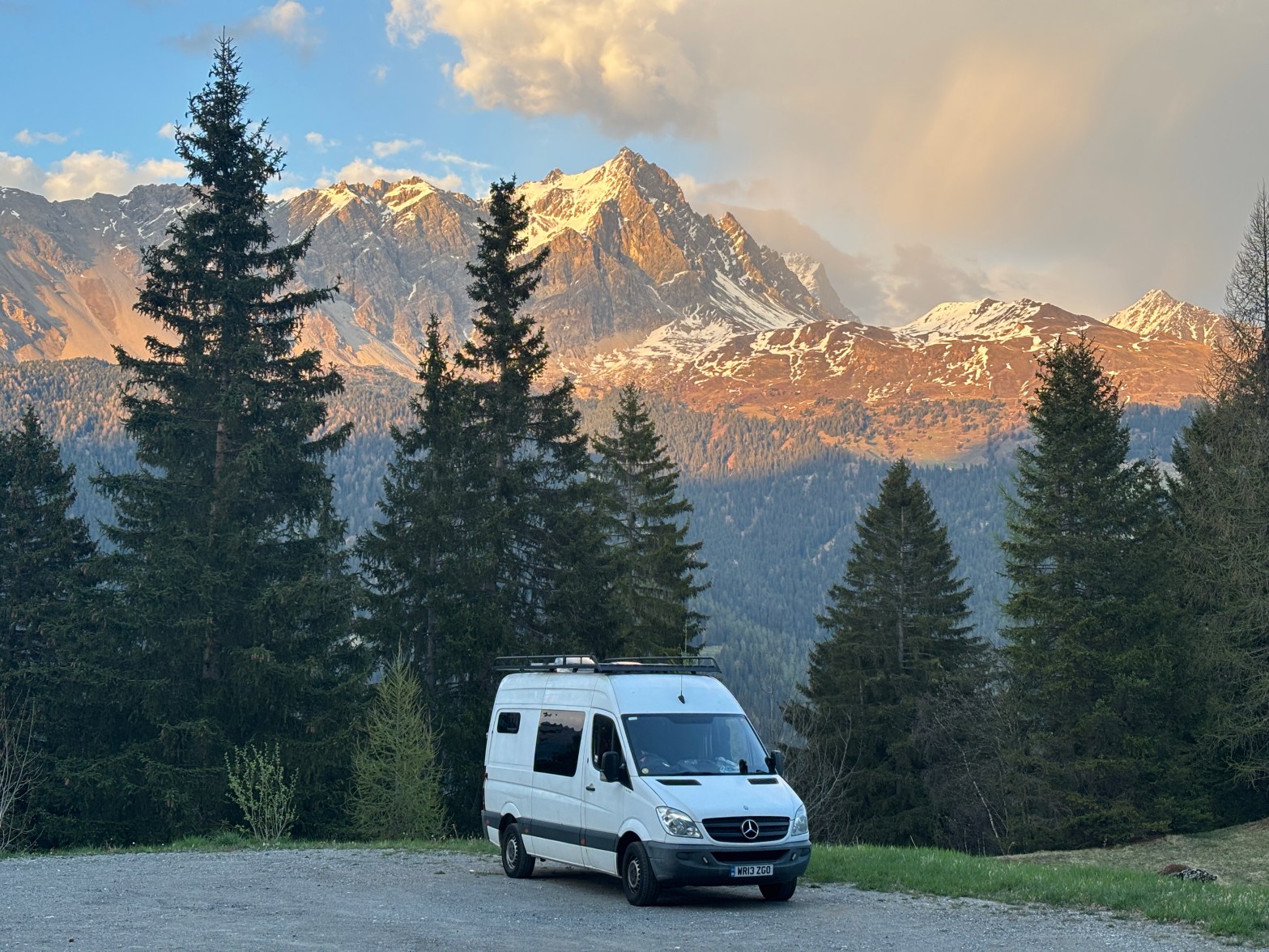
As you might know from my previous posts on here, we spent much of 2024 living in our van before a rather unexpected move to Switzerland right at the end.
For a while, we weren’t sure whether we would keep Ziggy – our trusty home on wheels – long-term in Switzerland. After all, he’s 2.7m tall meaning it’s impossible to fit into underground car parks, and manoeuvring a large van around a city and over mountain passes isn’t exactly convenient.
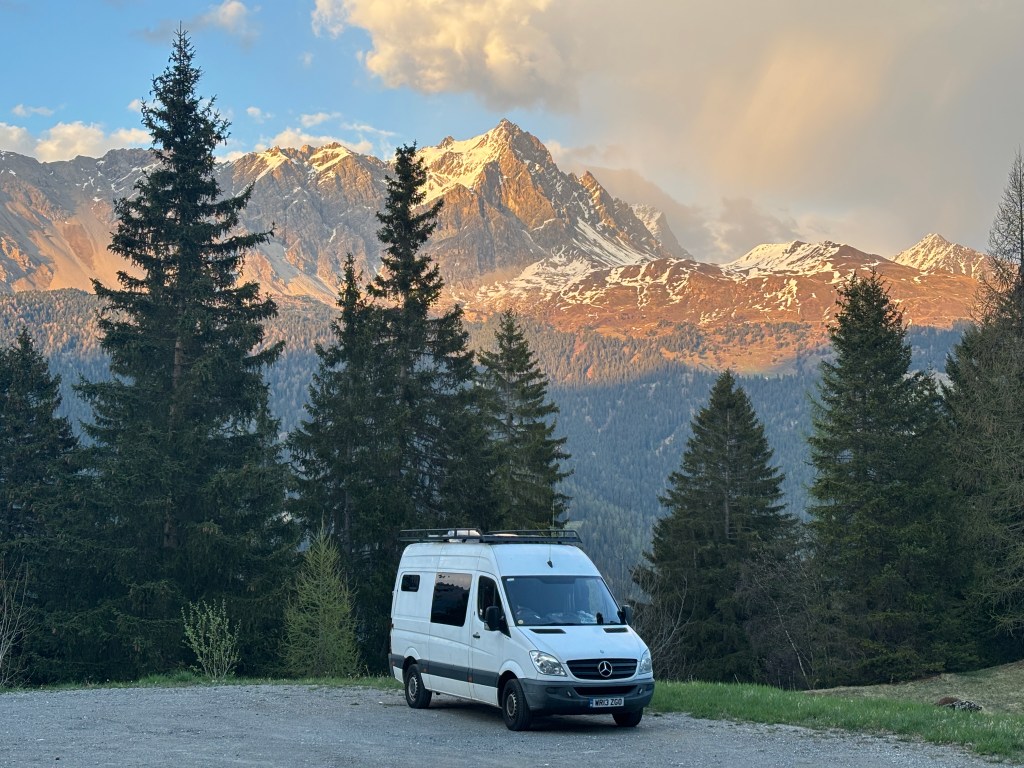
We looked into buying a new van in Switzerland, but found that for about double the price of Ziggy we could buy a van that was about half as good. In the end it was that, plus a heavy amount of sentimentalism, that resulted in us deciding to import Ziggy to Switzerland.
We received our Swiss license plates just last week after what felt like a mission to the moon and back, so I felt that now was a great time to write a blog on how you could import your van to Switzerland, too!
Disclaimer and first steps
Before I get started, I want to just clarify the scope of this blog:
- Every canton in Switzerland has slightly different rules and the MFK (similar to an MOT in the UK, a periodic inspection of your vehicle for road worthiness) varies in requirements between cantons. We live in Zurich, so I can tell you how that works.
- This blog is probably most helpful for those trying to import their van from the UK. I can’t say exactly what the rules are for other countries. For UK vans, you must have your headlamps switched for driving on the right-hand side of the road. This cost us almost 800 francs (CHF).
- We own a Mercedes-Benz Sprinter MWB van, registered in 2013. We don’t have an underslung LPG gas system. We have two acid leisure batteries, solar panel, AC and DC electrics, fridge, and so on. If you have an underslung LPG gas system, I would strongly recommend getting paperwork that confirms it was installed professionally.
- Before you even start down the road of importing your van, make sure you have a Certificate of Conformity (COC). In the UK, we rarely ever get these with our vehicles. A COC from EU/EEA is absolutely essential if you want to import your vehicle. If you wait to order one when you are already in Switzerland, you’ll pay at least 400 CHF for the pleasure.
- Generally, make sure you have all the paperwork (including the COC) available. That includes your V5C (“proof” of ownership), plus ideally a proof of purchase. The Swiss love their paperwork, so consider it a gift.
The process in a nutshell
- Own your vehicle for at least 6 months before importing it to Switzerland. If you buy a van and attempt to import it before this time, you’ll be taxed on it. If you’ve owned it for longer than 6 months, you’re all good!
- Go to the border and officially import your van within a year of moving to Switzerland. You will need various documents to prove you are moving to Switzerland, plus a completed 18.44 form. In return, you’ll receive form 13.20A at a cost of 20 CHF from the border control.
- Apply for insurance. This is usually done by contacting an insurance company like Zurich Insurance or Allianz. This is essentially the insurance company confirming they’d insure you, which they then pass on to the Road Traffic Office. You don’t actually take out insurance yet. It’s a good idea to get insurance as a “light motorhome” (as we are), which is cheaper than “van”.
- Apply for an inspection at your local Road Traffic Office immediately after confirming your insurance. Get every bit of paperwork you feel is necessary, especially: COC, proof of ownership, paperwork for any modifications (wheels, tow bar, LPG systems). You’re usually given a date a month or two away, but you can phone the traffic office between 7am and 7.15am to get a same-day appointment.
- Buy license plate holders. These can be as cheap as 15 CHF at a Jumbo, or as expensive as 90 CHF if you’re so inclined.
- Pass your test, get your plates! Or don’t pass your test, get the necessary repairs (addressing any “mängels”) and retake the test. The first test is 160 CHF in Zurich, and any 30-minute follow-up tests are 80 CHF. Once you pass, you get a month of insurance from the city.
- Purchase insurance and pay road tax. Insurance is around 600 CHF and tax is dependent on the vehicle size.
Sounds simple, right? Well, it is and it isn’t.
Budget
If you are importing your van from the UK, here’s what you should expect to pay:
- Switching of headlamps: Around 900 CHF
- Labour for switching headlamps: 200 CHF minimum
- Administration costs: 20 CHF
- Inspection costs: Starting at 160 CHF
- License plate holders: Starting at 20 CHF
- Insurance: Around 500 CHF depending on your situation
- Road tax: At least 1000 CHF
- Additional repairs to meet Swiss inspection standards: Potentially infinite.
Total estimate: 2800-3000 CHF
Our experience
As I said, we really dithered on importing our van. We made our mind up in April 2025 that we were going to import it and it wasn’t until September 2025 that we actually received our plates.
One of the big things that stymied our initial plan to import the van was a lot of scare stories online about how problematic it can be to import a campervan. We’d heard of people needing to get specific certifications for gas and electric, that they were blocked because of having a bed or a fridge, and any number of other excuses you could imagine the Swiss authorities giving.
In the end, we needn’t have worried because that never became a problem. But we did have a few other hiccups along the way.
Part One: Importing
As I said, we weren’t sure whether we were going to import our van when we initially moved, so we didn’t include it in our first 18.44 form when we moved to Switzerland. Technically you are supposed to declare the vehicle “when the vehicle first crosses the border”. Unless you get a very pedantic customs official, this doesn’t really matter, but you shouldn’t leave it too long.
In April 2025, we filled in our 18.44 form and drove to Koblenz on the German border to get our official stamps. Note: Only main border crossings have these customs offices, and you need to go there when they are open. The customs official is unlikely to need to see inside your van.
They will want to see:
- Proof of ownership (V5C logbook, purchase receipt, etc.)
- Proof of residence in Switzerland (if you’re importing at the same time as you are moving, then a tenancy agreement or work contract will suffice, but otherwise a resident’s permit works)
- Completed form 18.44
- Identification documents
They will scan everything and generate a stammnummer. This number is very important, as it connects your case and your vehicle to you. You’ll have to quote it in every subsequent conversation about your van.
They’ll hand you form 13.20 at a cost of 20 CHF. You have to keep a hold of this document and should have it to hand in case the police pull you over for whatever reason.
Congrats! You’ve made it through step one.
Part Two: The inspection process
We did dilly-dally at this point. Ziggy had taken us 10,000 miles around Europe, and his previous owners had done even more than that. This meant he was carrying some war wounds: Cracked reflectors, broken indicator housing on the wing mirrors, large rust patches. Wear and tear.
The key thing to know is that the Swiss are very scrupulous when it comes to vehicle condition – way more so than in the UK. If you are planning to import your van, I strongly recommend getting everything done in the UK beforehand. Labour costs in Switzerland are astronomical, sometimes 200 CHF per hour.
For that reason, we procrastinated for a while until we realised we absolutely had to sort out our inspection. There isn’t really a time expectation from when you import, but you really shouldn’t wait too long.
Once we had a proof of insurance, I went to the Zurich Road Traffic Office site to apply for an MFK – a vehicle inspection. For that, you will need:
- Your COC document
- Proof of ownership
- Proof of residence
- Paperwork detailing any substantial modifications (e.g. wheels, tow bar, LPG)
- Stammnummer
- Any other relevant documents
It’s a faffy process. Because we didn’t have paperwork for our tow bar, we had it removed. The RTO will post you an invitation to attend an inspection. This is usually quite far into the future and is probably done to give you time to prepare the vehicle. As I said before, you can call them between 7am and 7.15am and get a same-day appointment.
We had a lot to fix on our van, so we went to the UK for the repairs. We just asked a UK garage to carry out a service and an MOT and fix any and all advisories.
We also asked them to clean the engine area. The crazy thing about the MFK is that you need to get the vehicle into pristine condition: Inside, outside, and underneath. If it’s not, you will be sent home.
Once we’d repaired all the rust, replaced all our tyres, removed the tow bar, and fixed every other little thing necessary, we felt fairly confident about our inspection.
The inspection is a stressful process. They check absolutely everything. There are three outcomes possible from the MFK inspection:
- No issues – straight pass
- Minor fail – you’re handed a list of required repairs, you go to a garage, your mechanic tells the RTO the repairs have been addressed, you pass without an additional MFK
- Fail – you’re given a list of repairs, you go to your garage to have them fixed, you come back for another short test
We failed with several mängels that required a re-test, the biggest one being our headlamps. Foolishly, we thought it would be as simple as tweaking the bulbs. Oh, how wrong we were. You will have to change the entire front light system to be fit for the right-hand side of the road. These are expensive! If you have a nice garage, they’ll work hard to find a cheaper set, but generally expect to pay up to 450 CHF for each one.
One thing they didn’t ask for was certifications on electrics, windows, fans, swivel chair, or anything inside the campervan. However, I have heard some cantons do request specific paperwork for these things, Aargau being one of them.
We went back a week later and passed! Hurrah!
Phase Three: Becoming Swiss
Once you pass your MFK (big congratulations, by the way), you’ll be sent to another part of the RTO to receive your new plates.
If you are so inclined and feel you haven’t spent enough money already, you can splash out on a snazzy number plate. Don’t get too excited, though. In the UK, you can personalise your registration plate to your heart’s content, whilst in Switzerland you just get to choose a bunch of numbers. For 299’000 CHF, a guy bought “ZH 24” in 2024. You can be the judge of whether that was worth it.

Either way, you’ll be handed your shiny new metal plates and asked to hand in your old plastic UK plates. The RTO will also tell the DVLA that you’ve permanently imported your vehicle.
You’ll go to your car, unscrew your old plates, hand them in, and then realise you have no way of putting your new plates on because they don’t have screw holes.
Then you’ll learn you have another side quest to complete because the Swiss use specific click-in holders. Hopefully, you’ve read the list above chronologically and bought them already. We didn’t. You can put your plates in the window initially, but go to Jumbo and buy yourself some license plate holders.
Click your plates in – and hit the road!
After passing your test, you’ll have a month of free insurance from the city, but you should finalise your insurance as soon as possible. You’ll also be sent your road tax bill, which in Zurich is based on your engine size and the weight of the vehicle. You can find out how much you’ll pay here.
And, once you’ve done all that, it’s probably time to hand in your UK driver’s license. You need to do this within a year. It’s straightforward enough, just:
- Fill in the form on this website
- Get an eye test – this is very easy to do at McOptic
- Get a passport photo taken – did I mention that Swiss passport photos have specific dimensions?
- Hand your completed form in to the Stadthaus or the RTO
Your UK license will be sent back to the UK and you’ll receive a temporary paper version while you await for the arrival of your shiny Swiss license.
Ready to go?
Hopefully this blog has been helpful if you’re considering importing your van from the UK into Switzerland. You might not get everything quite right, but hopefully this blog will save you from making any expensive mistakes.
Putting those license plates on will feel like an enormous achievement, and you’ll draw fresh bewilderment from fellow drivers who see you driving on the right-hand side of the vehicle while sporting snazzy Swiss license plates.
If you have questions, feel free to reach out – but otherwise, good luck!
 Ross Runs Wild
As someone about to move to Zurich and (try) to import their converted UK van, this was amazingly helpful. Thank you!
LikeLike
My pleasure! Any issues, just contact me via the contact forms on the website!
LikeLike