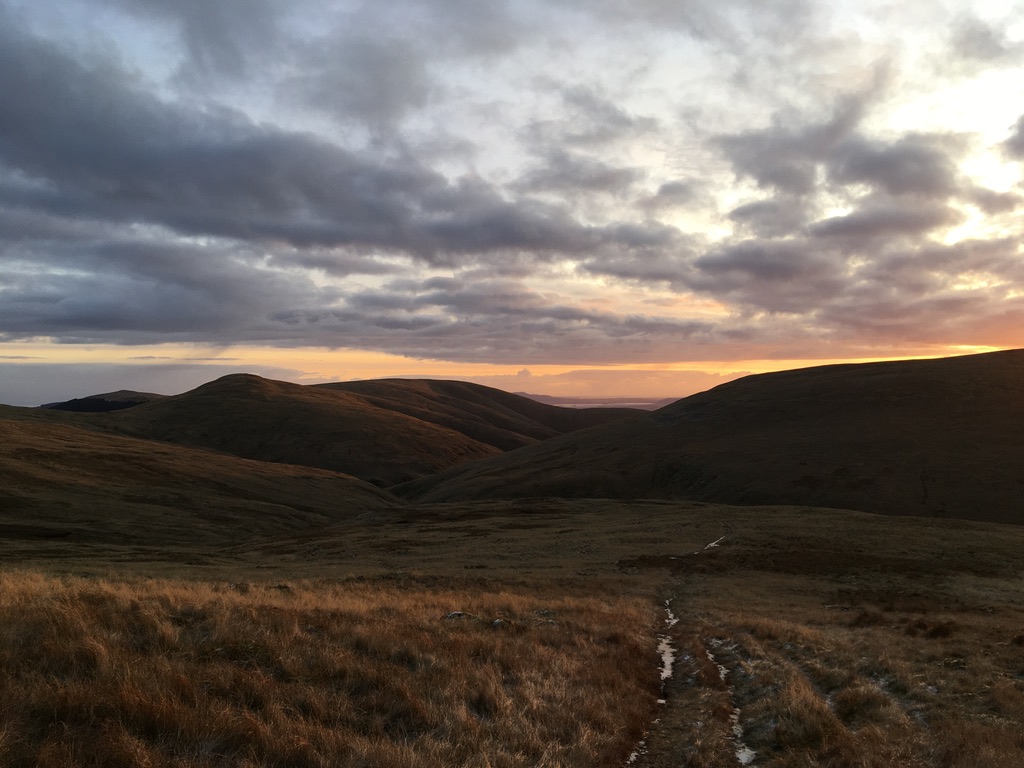
Hefted isn’t a phrase you’ll find many places outside of the Lake District in Northern England. The meaning speaks to a culture endemic to that little corner of the world, and a tradition passed down through generations of farmers.
Hefted is used to describe a system of farming where sheep are left to roam freely across the fells (hills) without physical barriers. While it is a practice, however, it is also a description: To say the flock is hefted to the land is to convey how they are rooted in this land, they know their way around its ghylls and dales without the need to be shepherded, and they pass that knowledge to their lambs.
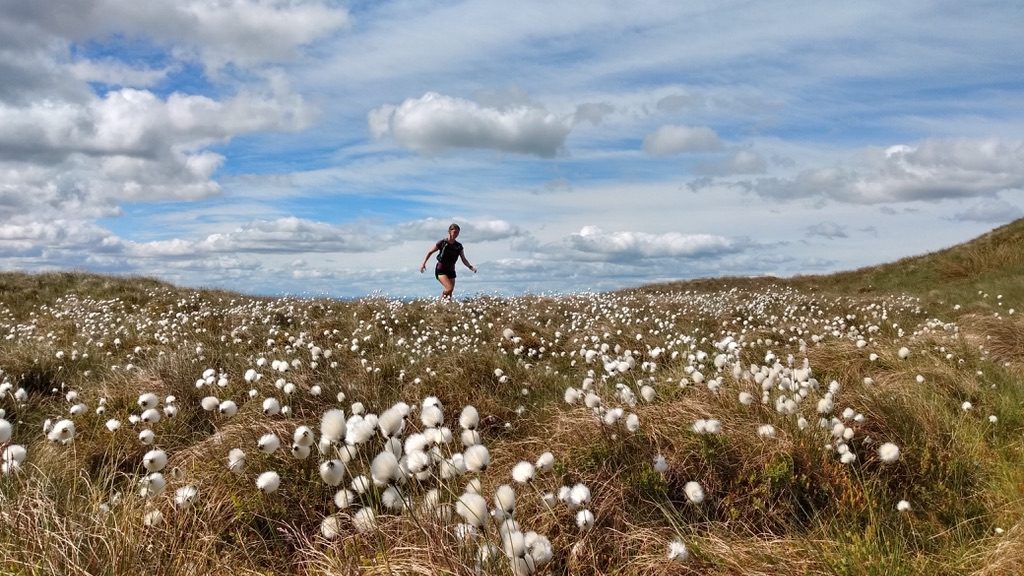
It’s similar to the way a swallow will return to the same rafter year after year, despite spending its winters in the warm climes of southern Spain or Africa. When they are released from their pens, Lakeland sheep are drawn back to their corner of the fells where they will graze unbridled until needed.
***
Friendships of the hills
This word played in my head on a run back in my home hills in February. Not since before Bo and I set off on our van trip have I returned to run in the Ochil Hills in Scotland. One brief visit between van life and Swiss life did not afford the opportunity for me to don my shoes and run through the tussocks of these grassy bumps – but this time I went back with intention.

I was back on this occasion for a surprise visit for my grandfather’s 90th birthday (yes, you read that right). I made plans with long-time friend, Tom, to scale our favourite hills again on one of our beloved routes.
My friendship with Tom is born from a love of the hills. We met working together at Run4It, a retail chain in Scotland, and spent hours together talking about running: him, usually extolling the virtues of barefoot running; me, nodding along patiently while fitting a pair of high-stacked shoes to another customer wanting to ‘correct’ their ‘over’-pronation.
Since then we have been on many a bothy trip and run together, dozens in the Ochil Hills. He now lives 100m from the start of one of our favourite routes (about 100m closer than my parents do), and so we set off up the first unrelenting gradients towards the humpbacked summit of King’s Seat.
***

First forays
Growing up at the foot of the Ochils was a blessing. They were formative hills for me, and featured in almost every weekend growing up. When the snow was too thick to be climbing Munros in the winter, my parents would take my brother and me up into the Ochils, climbing hills with names like The Law, Andrew Gannel, King’s Seat, Innerdownie, Ben Cleuch, White Whisp, and countless others.
Their soft, grassy edges bely their challenging gradients, especially those that plunge vertiginously to the Forth Valley. From the front door of my parents to the summit of Kirk Craigs – a distance of just 2km – you can expect to climb almost 400m. As a youngster, this climb chewed me up, and was the trial to reap the rewards of finding yourself alone among the hills that rise up in all directions. As an adult, it still chews me up, I just get up a little quicker.
***
A gale and a piece
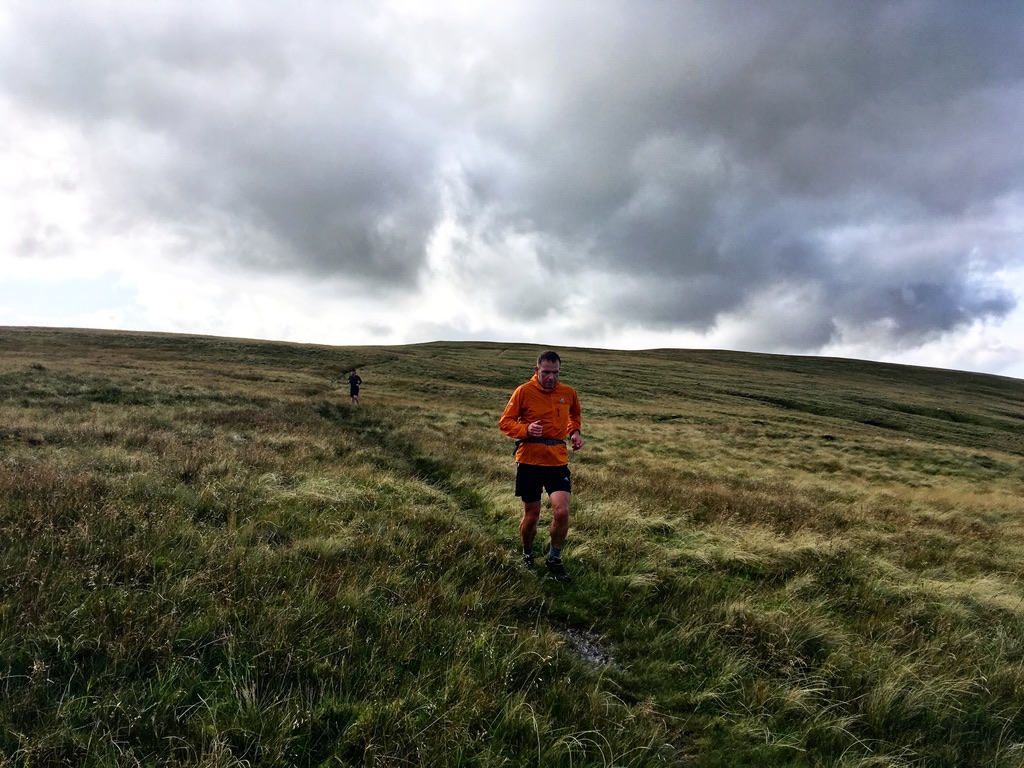
Tom and I choose the more gradual ascent up Kirk Craigs, a steady climb from his house, past the Big Boulder (that marks the turnaround point for the annual Kirk Craigs Christmas Cracker race that my uncle organises) and towards King’s Seat. We wind our way up through the gorse – bereft of its coconut perfume this early in the year – and the brown bracken stalks. In summer, the bracken creates a microclimate I can only imagine equates to that of the Amazon rainforest: Humid, hot, sweaty. Today, however, we only have a wintry breeze to contend with – and a steep climb.
As we crest the top of the steepest part of the climb, the Ochil Hills rise around us and the wind whips across the tussocks and rushes. Normally, skylarks would explode in a siren of chirruping, rising above you until you become dizzy watching them. Today they’re grounded. Still too early in the season, or they have half an ounce of sense.
My being here, as I said, is a secret, and Tom is my abettor, providing sanctuary in his house before I turn up to my parents. Ironically, however, up here in the middle of nowhere with not a soul to be seen, the only people I am likely to bump into are members of my family. These hills are not just my playground but also my parents’, aunts’ and uncles’, and were my grandparents’ until only recently.
The higher we climb, the stiffer the wind becomes before snow eventually appears beneath our feet as we break the 500m barrier. To my right is the summit of Kirk Craigs, where our first family dog Flora’s ashes are buried. Close to that is the stone, curved just enough to provide a comfortable seat, that my grandparents would always stop at for a “piece” (sandwich) and that my grandfather has asked for his ashes to be scattered.
King’s Seat would normally loom above us, but today its head is lost in the clouds, so we make our way up blindly as the fog and snow begin to merge. Vaulting the fence at its base, I remember the days I first discovered what running in the hills was like. At the time I was still wearing a rucksack and boots, but the thrill of throwing myself down a hillside was no less exhilarating. Sometimes I would just be running down myself, other times racing my brother. If only I knew that those first bounding steps would result in a love for hill running!

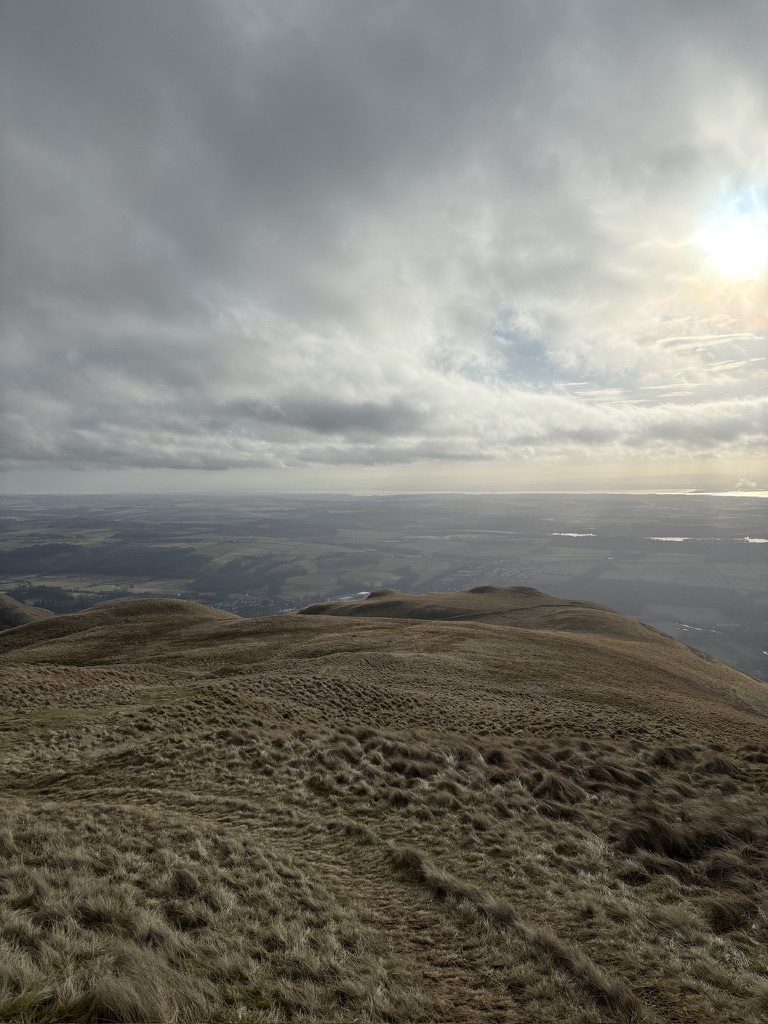
Above: Same day, very different conditions!
Like a pair of ships in the wind, we stagger to the summit of King’s Seat. Tom is wearing shorts – as is his way – and I can see his legs have gone from a bright red to almost grey as his bloods flees the biting gale. We tap the summit and plunge into the nothingness. Until now, we’ve been following the wider trails, but this is where we put our faith in our internal compasses and follow trods (faint paths) known only to those whose feet are familiar with this terrain. Even so, I often have to take a moment to catch my bearings with the snow covering most of the usual clues: “There’s that hollow behind the big tussock, pass that on the right and then bend to the left”.
With a bit of luck – and a little more than half-remembered navigational cues – we are at the Maddy Moss, the namesake of the Maddy Moss Hill Race. Jumping the wobbly wire fence, the conversation turns to our hill running club, Ochil Hill Runners. For the last few years, Tom has organised the Maddy Moss hill race, a race (I am ashamed to admit) I have never run.
***
Forever an Ochil Hill Runner
Though I may live 1,300 km away, I still consider OHR to be my club, helped in large part by the fact my family and friends are still heavily involved in it. It’s been a great couple of years for the club, with some fresh, fast blood taking it to the top of the Scottish Senior Championships – the first time in 31 years that one of the two biggest clubs, Shettleston and Carnethy, hasn’t won.
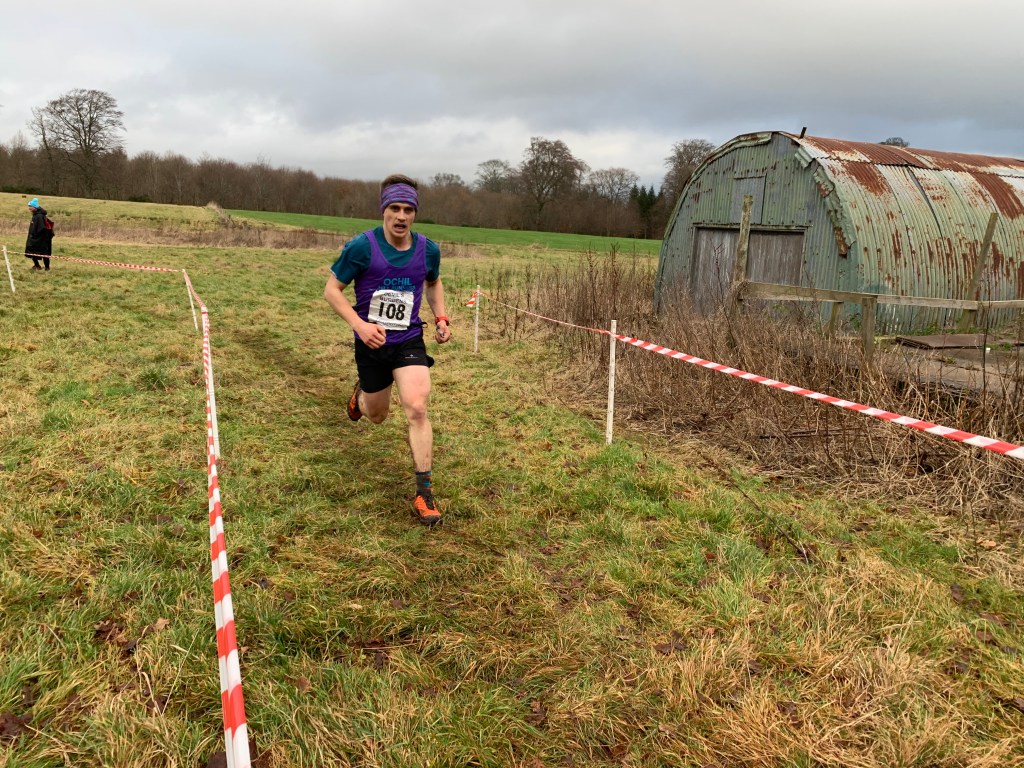
I have raced plenty of other races in the Ochils, including the infamous Ochil 2000s. In 2019, the race started very well for me, sitting in the top 10%. But if the Ochils don’t beat you at the start, they will break you down by the end. Ultimately, it was the descent off Blairdennon that broke me: A leg-sucking bog that turns into a precipitous 500m descent back to the foothills, promptly followed by a spirit-breaking climb to the 418m-high Dumyat. This is the catalyst for many a runner’s demise, and it takes a strong runner to push through it.
***
Endless opportunity
The steep gradients of King’s Seat have given way to the broad side of Andrew Gannel Hill, a top that is the chagrin of any marshal on the Ochil 2000s race thanks to the fact that Ordnance Survey and Harvey Maps place the summit in two different locations.
For us, however, it’s the end of the thick fog as the sun finally feels strong enough to send its rays to Mother Earth. Our route undulates over uneven ground as we climb towards Ben Cleuch, the highest point of the Ochil Hills at 721m. Its bald top often gives sweeping views to surprising reaches of the Highlands, with panoramic views of Ben Lomond and the Arrochar Alps in the west. Directly ahead the conical summit of Ben Vorlich and its crooked partner Stuc a’Chroin are prominent, and on a clear day you could even see Glen Coe. As you turn right, you can spy the Breadalbane hills, Ben Lawes range, and north-eastwards to the Grampians.
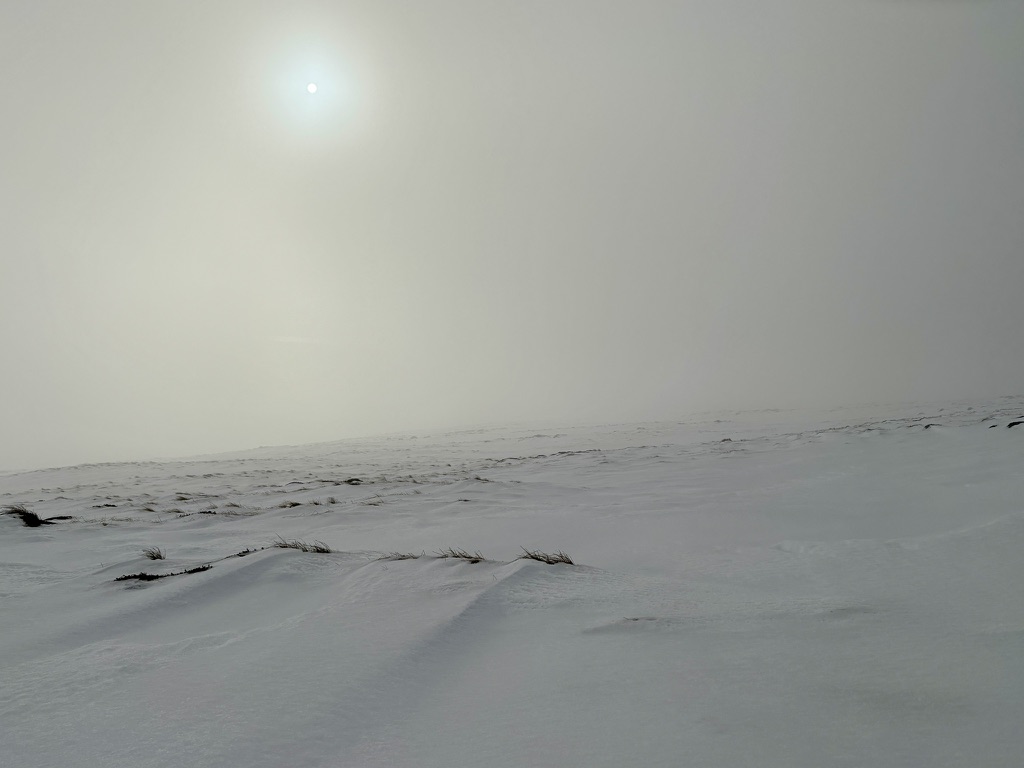

Today, only a hint at those views is possible as we shelter behind the summit cairn to clad ourselves in windproof layers. Wrapped against the gale, we traverse the summit plateau, diving down to the cleft between Ben Cleuch and Ben Ever – our final top of the day.
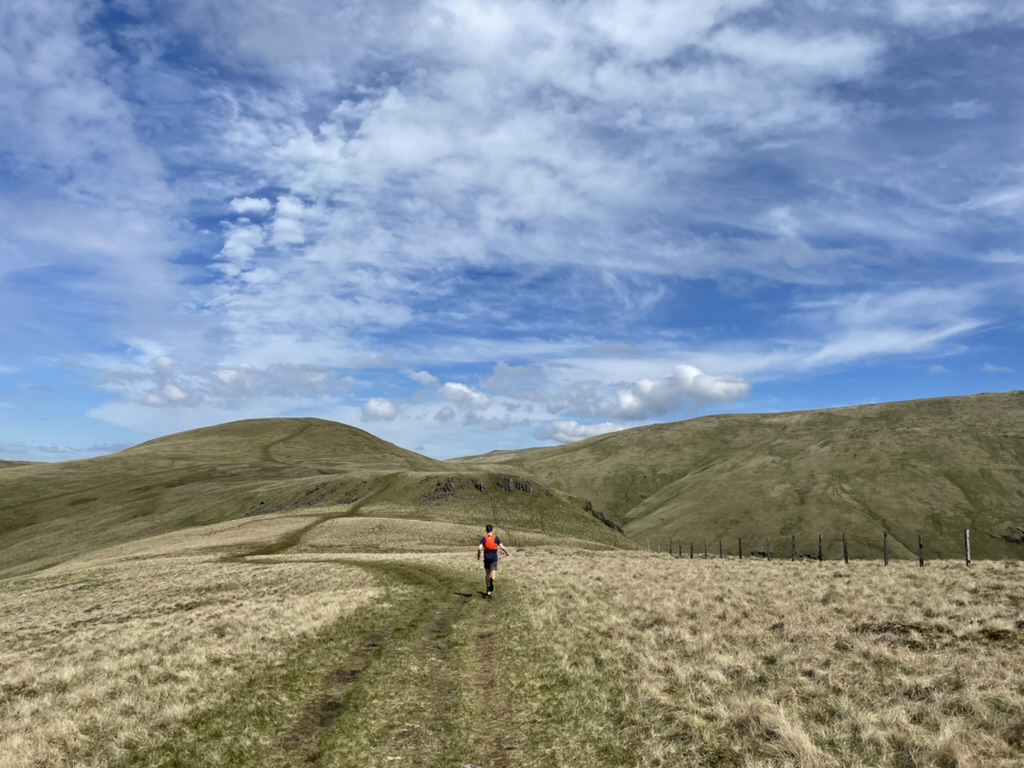
There are many things I love about the Ochil Hills, but one of them is how easy it is to add to and cut away parts of your route. From this crease, it is possible to take in Ben Buck, traverse around Ben Cleuch, tap The Law, and descend to Mill Glen. Or bypass Ben Buck and head west to the head of the ATV track before climbing to Craighorn and over The Nebbit. The possibilities are endless.
Many faces
As we begin our final stretch towards home, I think more on that point, and that word hefted comes back to me. I could navigate these hills blindfolded, my feet knowing every trod, tussock, and stile on them. For the entire run, I had felt this boundless energy, a feeling I attribute to that sense of familiarity, of my feet being in their natural habitat. These hills make sense to me in a way that is hard to describe.
Despite my lack of affection towards them for turning the Ochils (and many hills in Scotland) to ecological deserts, I thank the sheep for bringing the word hefted into my lexicon. It’s the only word I feel can capture that feeling of familiarity I have for these hills. Not only that: This level of understanding allows for so much play. In knowing every twist, turn, and mood, I know how I can immerse myself in the landscape and play.
These are hills of many faces. Like a crème brûlée, you have to pierce through the tough exterior that is their valley cliffs to find the soft, rolling tops they are defending. And though they may not be the highest peaks, you can easily rack up over 1000m of climbing in a little over 10km.
Though their barren tops have been domesticated by farming and grazing and the towns of Tillicoultry, Alva, and Menstrie are only a short distance away, there are few places I have felt more exposed and that have tested my mountain craft than the Ochil Hills.
Descending into Mill Glen, I look to our left and see the usually soft curves of the hills have turned into striated muscles, every fibre and sinew brought into stark relief by the streaks of windswept snow.
To know a place
My feet are cartwheeling beneath me, thundering down the hillside and keeping me upright against gravity’s pull. The idea of running downhill at such speed sounds sickening to anyone who has never experienced it: “What about your knees? What if you fall? What if you roll your ankle?” To them I would say you have never known joy until you have left the brakes of rationalism behind and hurtled down a hill.
After bottoming out in Mill Glen and nursing our beaten legs up the final short rise to our descent home, our conversation turns to projects and plans for summer. Tom’s plans nowadays include a lot of climbing and mountaineering, something that has captured his imagination just like running did when we met.
Trotting into the field, I take another glance back up to these hills of home. I have so many memories of mornings before university, evenings after work, sunrises, sunsets, days above the clouds and days in the clouds, runs of joy and others of anguish, walks with family and runs with friends up there.
My personality is interwoven in the Ochil Hills, in their tops, their curves, and their creases. Whilst I might have traded them for the lofty heights of the Swiss Alps, they are the hills that shaped me as a person, and where I will always go back to – like the swallow in summer, or the sheep let loose from the pen. They are the nexus point for who I was, who I am, and who I will be.
This is what it means to know a place, to have it reflect you and reflect in you.
And, of course, the sky is clear, and the Ochil Hills are bathed in winter sun.
 Ross Runs Wild